.jpeg)









There’s nothing random about mergers and acquisitions (M&A). Businesses that are good at closing deals on mergers and acquisitions have a process that takes them through all the major stages of an M&A deal.
Dividing the process into different phases helps you remain organized and achieve success without getting overwhelmed and bogged down in the process. There are usually 7 stages in the M&A pipeline process. These stages include:
- Strategy and objective setting
- Target identification and market analysis
- Outreach and preliminary assessment
- Evaluation and due diligence
- Deal negotiation and structuring
- Closing the deal
- Post-deal integration
Each of the phases in the process usually has its own set of objectives and criteria that you should fulfill before moving to the next phase in the process.
Although you may have more than 100 prospects in your pipeline at a given time, it helps to have a process that helps you achieve your objectives with intention and a unified vision in mind.
- Define what success looks like to you in terms of metrics.
- Evaluate cultural fit in due diligence.
- Plan integration before closing the deal.
The above decisions can have a direct impact on whether you achieve the expected value.
Strategy Development and Target Identification
Having a mergers and acquisitions pipeline involves developing a good acquisition strategy as well as an efficient process to identify acquisition targets. It’s the responsibility of the corporate development team to make sure that the acquisition strategy aligns with the corporate strategy and to do research to develop a robust acquisition target list.
Developing Your Acquisition Strategy and Strategic Objectives
It all begins with your acquisition strategy. This will set the tone for all other aspects of your M&A process. Your team will have to determine what industry to target, what gaps exist in your current portfolio, what your competitive landscape looks like, and so on.
Set strategic goals that will help you solve real business needs, whether that be entering new markets, acquiring technology, vertical integration, or other goals. Make sure to set criteria as well. This can be based on the size of the acquiring company, the acquiring company’s geographical area, revenue minimums, or other criteria.
Consider risks, ROI, and how effectively your acquisition strategy aligns with your corporate strategy as a whole. Remember, you want to make deals that will benefit your company in the long run.
Conducting Research and Creating a Target List
The research will ultimately determine the discovery and evaluation of deals. Research will include analyzing industry trends, competition, consolidation, and other factors.
When creating your target list, you can use a top-down and bottom-up approach. A top-down approach will begin at the industry level and work its way down to the industry that aligns with your strategic goals.
A bottom-up approach will begin with exceptional companies that may not fall in line with the top-down approach.
Don’t limit yourself to using just a few research resources. Use industry resources, industry databases, industry publications, and industry news and releases.
Once you’ve created your target list, prioritize them based on revenue, revenue growth, profitability, and market share. Try to create a tiered approach to prioritize your target list while keeping the number of potential deals high.
The Target Identification & Screening skill in our free M&A Skills Library does the tiering for you: it proposes a weighting from your thesis, you confirm or adjust it, and it ranks the list.
Determining Strategic Fit and Synergy
The process of determining strategic fit will involve determining how this target will fit with your current business model, culture, and operations, including determining whether there is any overlap and complement between the two businesses.
What is Synergy?
Value is created in the process of synergy. Cost synergies can be created through scale, efficiency, and eliminating redundancy. Revenue synergies can be created through cross-selling, market expansion, and product expansion.
Where possible, quantify the synergy and include a timeline. Ensure that there’s cultural and management team compatibility, as this can be a deal breaker in the future.
Lastly, quickly review their financials to determine if they’re worth pursuing.
Deal Initiation and Target Assessment

The deal initiation process lays the groundwork for the entire deal process. This is where the identifying, researching, financial analysis, and determining strategic fit occur.
Deal Initiation
The first contact with the potential target company can set the tone for the relationship moving forward. Take the time to learn about their business and don’t jump too quickly into the deal.
Build rapport and make connections with the key stakeholders. This can give you insight into their current and future direction.
The best way to initiate a deal is to approach them directly, use your network of industry contacts, or use investment bankers to assist in the process.
In the beginning, you can ask questions to gather information about the company, revenue, market share, growth, competitive advantage, and organizational structure.
Once mutual interest is established, it is likely that a Non-Disclosure Agreement (NDA) will be executed between the two parties, permitting the free exchange of information. Information regarding the company's operations and financials can be discussed.
The quality of information shared during this phase is very important. You should prepare questions you can ask them regarding their customer base, technology stack, employee turnover, growth plans, and other information. Information shared during this phase will enable you to determine whether you want to continue with the acquisition process.
Preliminary Analysis and Financial Review
When conducting a preliminary analysis, you should review the financial information of the target company and determine if it’s worth pursuing.
You should review financial statements, quality of revenues, profitability, and any liabilities. You should ensure you obtain accurate financial information and determine if it’s repeatable. You should create a financial model and determine the synergy and return on investment.
You should consider the company's history and growth prospects, as well as your company's assumptions regarding how you can improve the company after acquisition. Project management skills are essential during this phase.
You can use market data to compare it with the target company and determine its performance relative to market benchmarks. You can determine market share, customer concentration, and market competitiveness and determine if its financial history is repeatable.
Valuation and Selecting Targets
Valuation is a process of utilizing financial information to determine a price range for acquiring a target company. Several methods of valuation can be employed. These methods should be employed concurrently. These methods include comparables, precedent transactions, and discounted cash flow (DCF).
Comparables give us an idea of what the market thinks is valuable, precedent transactions give us real priced transactions, and DCF looks at future cash flows. Choose valuation methods that make sense based on the particular target and the availability of information.
If there’s sufficient historical information, DCF can be used on publicly traded companies with predictable cash flows. Comparables are best used on private, early-stage, high-growth companies.
In addition to financial considerations, compare the target’s standing on your selection criteria. Some of the factors to consider are strategic, cultural, integration, and management. Investment bankers and other M&A advisors can assist with benchmarking your key assumptions.
Due Diligence and Deal Structuring

Due diligence is the process of analyzing the financial and operational status of the target company. Deal structuring is the process of determining the way value is transferred from the selling company to the new company.
Each process requires your team, in conjunction with outside counsel and advisors, to work through the process.
Due Diligence Process & Virtual Data Rooms
Due diligence is done through a checklist of financial, legal, operational, and strategic information. You should assemble a team of legal, accounting, and industry experts to review the hundreds, often thousands, of documents in a reasonable amount of time.
A Virtual Data Room (VDR) is a data room where you can store all your diligence information. You can set up your VDR so that only certain documents are accessible to certain people. You can also use your VDR to keep an audit trail of which documents have been opened.
Some of the information on your checklist might include:
- Financial documents - Tax returns, audited financial statements, projections, debt obligations
- Legal documents - Company structure, pending legal cases, intellectual property
- Operational due diligence - Contracts, contracts with suppliers, employee information
- Compliance documents - Legal filings, permits, environmental reports
When these red flags are identified, risk mitigation becomes a key issue. You’ll need to assess these liabilities and determine if they are deal-breakers and if they can be negotiated as concessions.
Legal Review, Contracts, and Compliance
Your company’s legal counsel will review all contracts, warranties, and undertakings that bind the company and require it to take specific actions. They’ll determine what, if any, liabilities you’ll take on if these contracts are left in force after closing. You should negotiate any contracts with unknown liabilities and attempt to negotiate indemnification clauses.
The purchase agreement includes all of the representations and warranties made by the seller regarding the business. You should attempt to negotiate warranties for financial performance, legal compliance, ownership of intellectual property, employees, and known liabilities.
Review these key items:
- Regulatory permits and licenses
- Employment law and labor agreements
- Environmental permits and cleanup obligations
- Data privacy and security
What licenses are the business required to have to operate? Are there any environmental licenses? Are there any employment licenses?
Are there any customer and employee information obligations related to regulatory compliance? What about data privacy and security?
Review contracts for change of control clauses, where the contract would terminate if there is a change of ownership of the company. These are often present in contracts with customers and suppliers. You may need permission from a customer/supplier to buy the company, and these contracts could dictate how you purchase it.
Negotiations and Letter of Intent
The Letter of Intent (LOI) outlines basic terms of the deal before conducting exhaustive due diligence. The basic terms will include deal structure and valuation. You should also negotiate your exclusivity period and confidentiality provisions.
The negotiation will involve balancing risk and your desire for a smooth integration against the purchase price. The higher purchase price upfront equates to higher risk for your company and faster access to profits. Using part of the purchase price as an earnout or escrow arrangement will mitigate risk but also cause integration issues.
The table below outlines key negotiation considerations:
The key issues you negotiate will depend on your approach to the deal. Leave your ego at the door because value is created when both sides feel like they won.
The Role of AI in Due Diligence
The role of artificial intelligence in M&A is growing and is of critical importance in M&A deals, especially when it comes to analyzing complex legal and financial documents. In fact, as per a survey carried out by Deloitte, 99% of respondents have implemented AI at some stage of the M&A lifecycle for better decision-making.
For example, with the DealRoom AI platform, you can instantly create a deal playbook, including a custom tracker and folder structure, all unique to the deal. This saves many valuable hours by using DealRoom AI to extract key terms and financial information from documents, uncovering hidden obligations and red flags as soon as the documents are uploaded to the virtual data room.
Signing, Closing, and Post-Merger Integration
After the diligence process is complete and the deal has been negotiated, the deal enters the execution phase.
The diligence team’s role now shifts from evaluating the deal to closing the deal and integrating the two entities to achieve success.
Closing the Deal and Signing
Signing the deal happens when both the buyer and the seller execute the deal documents, binding both to their obligations to complete the deal.
It’s important to prepare other ancillary documents, such as license agreements, transition service agreements, and corporate resolutions.
Observe the manner and location of the signing. For example, the share transfer may need to be notarized, or the file documents may need to be signed with the so-called wet-ink signatures.
It’s important to note that signing and closing the deal are not simultaneous actions, and there may be a time lag between closing the deal and the satisfaction of the conditions precedent, such as the receipt of regulatory approvals or the receipt of third-party consents.
The deal documents must clearly spell out the definition of completion, payment terms, and the timing of the exchange of ownership.
The key considerations to keep in mind when signing the deal include the following:
- Execution of all the deal documents, including ancillary documents
- Witness and signing authorities
- Filing with the relevant authorities
- Payment and escrow arrangements
- Tracking the satisfaction of the conditions precedent
Integration Planning and Execution
Ideally, integration planning should take place before the deal is closed. However, if you involve your integration team during your due diligence phase and create integration plans before the deal is closed, you are setting yourself up for success.
This doesn’t leave you behind scrambling to integrate once the deal is done.
Integration planning includes the following:
- Operating Systems
- Technology
- Organizational Structure
- Culture
Integration is a massive undertaking. You’ll want project management applications and task tracking to monitor the dozens of pieces moving forward.
Have defined owners, milestone dates, and contingencies for roadblocks.
Integration workstreams to consider:
- IT and data
- HR policies and communications
- Customer retention
- Supply chain and vendors
- Management, reporting, culture
- Brand and market positioning
Integrations can take anywhere from 12-24 months post closing.
Realizing Synergies and KPI Tracking
The reason you identified synergies to begin with was to realize them down the road. Revenue synergies can be achieved via cross-selling, entering new markets, or expanding product offerings.
Cost synergies can be achieved via eliminating redundancies, consolidating locations, and volume purchasing. Not very glamorous, but all things that add up to your bottom line.
Establish key performance indicators (KPIs) to measure the progress of integration and how you’re achieving your identified synergies. KPIs will help you realize synergies and adjust as necessary.
Change management plays a critical role in integration. Whether it’s new operating procedures, a new reporting structure, or an entirely new company culture, change will be necessary.
Key Integration KPIs include:
- Customer retention rate
- Employee turnover in key positions
- Percent of system migration complete
- Cost synergies realized vs. target
- Revenue growth in the combined company
- Time to integrate key functions
Your integration team should check in with leadership regularly and tweak plans based on real results, not just projections.
Frequently Asked Questions
Setting up your M&A pipeline, maintaining it, and making it your own can be a daunting task. It also presents a lot of questions. Below is a list of frequently asked questions regarding mergers and acquisitions pipelines:
What are the important stages in an M&A pipeline?
There are seven major stages involved when it comes to the process of making a deal and closing it. The first step involves strategy and goal setting. What do you want to achieve with this acquisition? Are you trying to enter a new market? Are you trying to improve cost efficiencies? Are you trying to obtain certain capabilities?
Next, you’ll develop your M&A strategy, carry out market research, and identify your acquisition targets. After that, you’ll reach out to your acquisition targets, followed by the assessment and due diligence stage. The structuring and negotiation of the deal will be the next stage of the M&A pipeline.
The legal closure will be the sixth stage, and the final stage will be the post-merger integration stage. For you to have a well-defined M&A pipeline, you’ll need to make sure each stage has defined deliverables and a specific person or people to own them. If not, you’ll end up missing out on some steps.
Do all companies have the same stages in their M&A pipeline?
Not quite. The stages in your pipeline will vary depending on the size of your organization, the industry you're in, and the complexity of your transactions. For example, large organizations may have over 100 potential deals in their pipeline at any given time. These deals will have complex financial models associated with them.
For a smaller organization, you may be focused on a handful of identified deals at a time. Furthermore, your strategy will dictate your pipeline. Perhaps you're looking to quickly evaluate the deals and weed them out as early as you can. Others may be spending more time in the initial phases before kicking the deal into the next stage.
For example, if you're in a highly regulated industry such as healthcare or financial services, you may have additional steps in your pipeline.
At which stage of the M&A pipeline does most of the diligence happen?
Ideally, most of the diligence will occur in stage five of your pipeline. This is the stage in which you transition from the qualitative to the quantitative assessment of your deals. This is the stage in which you truly begin to differentiate between the deals that have the potential to be successful and those that are dead ends.
Virtual data room reviews, site visits, management presentations, contract reviews, and compliance reviews all occur within this phase. Your objective is to validate the growth models and to identify the potential synergies between your target and the acquirer.
Due diligence has been shown to overlook up to 50% of the total value of mergers and acquisitions. If you're looking to find additional synergies, you're going to have to dig deeper than traditional due diligence.
What software can I use to track, manage, and analyze my M&A pipeline?
You can manage your pipeline using a spreadsheet program such as Microsoft Excel or Google Sheets. You would need to create columns such as target name, date contacted, status, valuation, finance needed, and so forth. We also have our own M&A Pipeline Excel Template, which is ready for use and can help you in managing your pipeline.
If you’re managing fewer deals, then this can work for you. But what happens if you’re managing more than just a few mergers and acquisitions? This is where deal management platforms such as the DealRoom M&A Platform can help you store all your data in a centralized place. The DealRoom M&A Platform also has a tool called DealRoom Pipeline, which is created especially for pipeline curation and management.
Platforms such as Pitchbook, Crunchbase, Capital IQ, and Bloomberg can also help you filter and compare target companies by size, financials, and culture.
Virtual data rooms can also help you share data with others in the process.
How can organizations enhance their M&A pipeline for effective acquisitions?
Firstly, organizations should make sure their acquisition strategy is in line with their business strategy. It’s also important to create definitive criteria for screening acquisitions. What industry, what geographic region, what size, what profitability, and what growth rate – these are some things organizations would need to consider.
Meetings are also very important in managing your pipeline. This is not too often if you consider holding two to three meetings every week.
Label some of these activities as critical or high priority. This will help your team recognize which deals require momentum and which ones can be stalled if someone is busy.
What importance does the integration stage hold in an M&A pipeline?
You can consider the integration stage the make-or-break stage in any M&A pipeline. It doesn’t matter how good your pipeline is structured. If you can’t get the integration right, you won’t realize the expected returns.
Do you recall all those deals you had in the pipeline? Those deals created no value until the integration phase. This is where you integrate the strategic, financial, and operational aspects of both businesses. You cannot just focus on one area and neglect the others.
The best acquirers begin working on their model even before the closing of the deal. Use the data you have acquired in the due diligence process to forecast your future state.
It’s also important to have a detailed integration roadmap, including milestones, priorities, risks, synergies, and some form of performance measurement. This is important to help your team not get lost.
Prepare for Day 1 Readiness. Cultural integration, talent retention, and communication are just some of the activities you can undertake even before closing.
Later, you can use a simple scorecard to track your progress toward your milestones.
Key Takeaways
- The M&A pipeline has seven structured stages, which take you from strategy development all the way to post-merger integration.
- Having clear entry criteria and success metrics for each stage also prevents deals from progressing before they’re ready.
- Don’t leave integration planning until after closing – start preparing during your due diligence phase.
At DealRoom, we have helped hundreds of companies overcome the challenge of managing pipelines using spreadsheets and email threads. It works for a while.
But then, 10 targets become 50. The documents are scattered in different folders. One person updates a spreadsheet while another person reviews an outdated version of the spreadsheet. You spend your time searching for information instead of analyzing the deal.
Our team developed DealRoom after running M&A transactions and seeing firsthand how much friction exists in the M&A process. When you go from target sourcing to diligence and integration, you need a place where your entire team works from the same information.
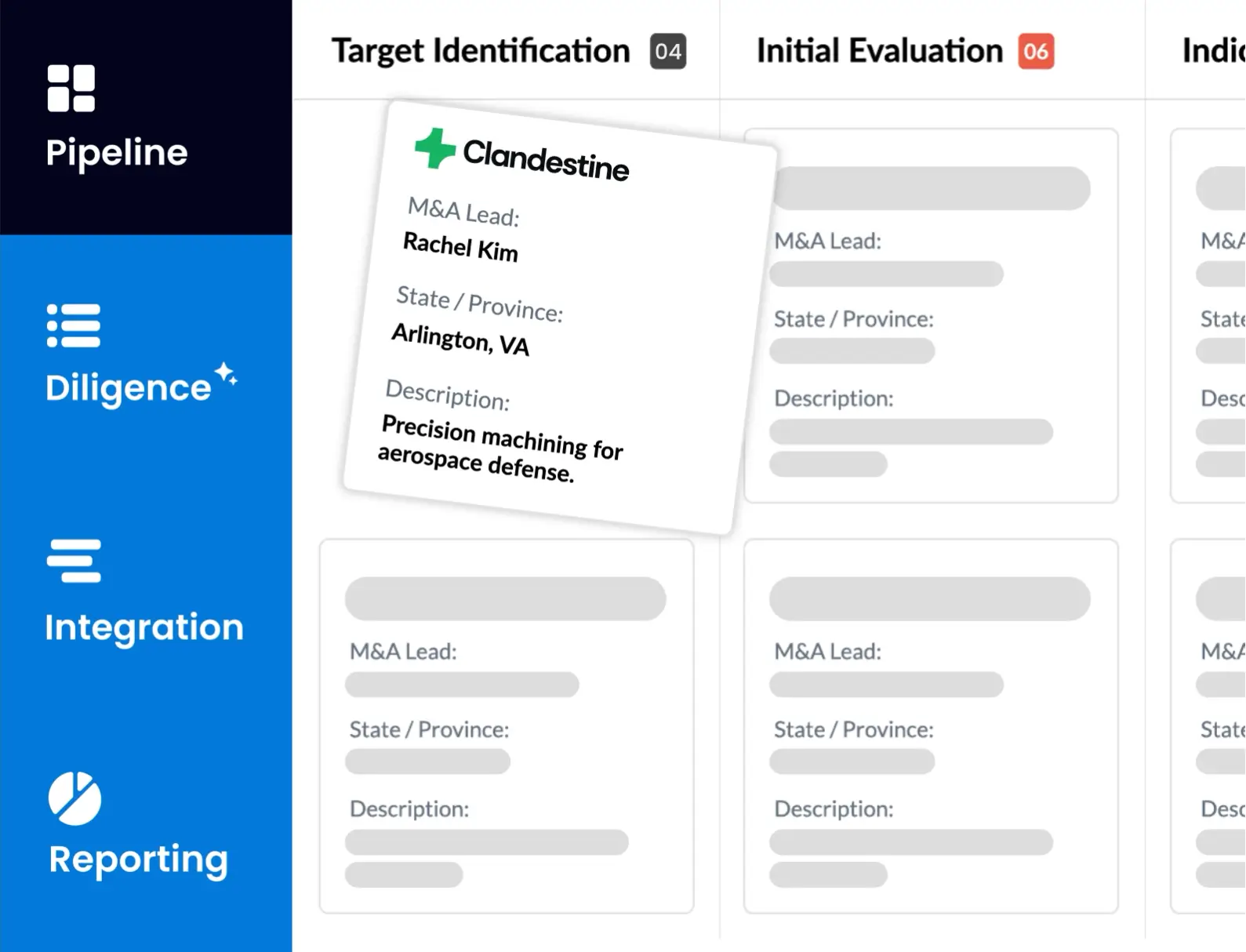
With DealRoom Pipeline, part of the DealRoom M&A Platform, your team will be able to track all your deals throughout your entire pipeline. Strategy targets, initial outreach and financial analysis of targets are all organized in a single platform. You’ll be able to see where each deal is in your process and which deals are worth your attention.
We have helped teams go from spreadsheets and email threads to a structured pipeline in just a few days. Once you have a deal in your pipeline, the DealRoom M&A Platform will support you through every other stage of M&A as well.
An M&A pipeline only works if the data it holds is constantly correct and visible to all parties involved. The process outlined in this guide becomes more accessible when the platform it runs on behaves similarly to the way M&A deals naturally flow.
DealRoom is built for teams in active pipelines. If your team is reviewing dozens of targets on an annual basis and advancing several deals into diligence and integration, you need structure. Request a demo and see how DealRoom provides your team with the infrastructure needed to manage your pipeline, diligence process, and integration without losing control of the process.









.png)
.avif)

.avif)