.jpeg)









Private equity firms evaluating acquisition targets need more than financial statements or market analysis to make informed decisions. Operational due diligence examines a target company's operations, management strength, and infrastructure to identify risks, validate value-creation opportunities, and plan for post-acquisition improvements.
This process examines how a business operates day-to-day. It covers everything from production systems and supply chain to organizational structure and tech platforms.
Financial and legal due diligence have long been standard, but operational due diligence now plays a larger role in private equity success. Operational improvements now account for 47% of private equity value creation, up from just 18% in the 1980s, reflecting a major shift toward operational execution as the primary driver of returns.
Research shows that while revenue growth and multiple expansion drive returns, profit margin improvements often lag behind projections. That shortfall usually stems from operational weaknesses that only become apparent after the deal closes. Understanding what operational due diligence involves (and how to do it right) can make or break an investment.
Your approach to operational evaluation before closing a deal shapes your ability to deliver on your value-creation plans and hit your target returns.
What is Operational Due Diligence?
Operational due diligence (ODD) is the systematic evaluation of a company's operational infrastructure, management, and business processes. You use it to figure out if a target company can really execute its business plan and hit performance targets.
Core Principles of Operational Due Diligence in Private Equity
Operational due diligence in private equity digs into a target's internal capabilities, processes, and infrastructure. The goal is to assess the value-creation potential and identify operational risks.
This assessment complements financial and commercial due diligence by focusing on the systems and people that drive business performance.
The scope stretches across organizational structure, management depth, IT systems, supply chain, and production. Human resources, vendor relationships, and regulatory compliance also fall under the spotlight.
ODD now includes specialized reviews for carve-outs, build-ups, and value-creation projects. These targeted looks help you understand operational challenges tied to different deal types.
Your process examines both current performance and future potential. You look for inefficiencies, capacity issues, and integration needs that could affect post-acquisition value.
Distinct Differences From Financial Due Diligence
Financial due diligence reviews historical performance and projections based on accounting records. Teams review balance sheets, income statements, and cash flow to verify financial accuracy.
Operational due diligence, though, focuses on the mechanisms behind those numbers. Teams look at how the business operates day-to-day, not just the financial outcomes. This includes reviewing production processes, tech platforms, and organizational effectiveness.
The table below highlights these key distinctions.
| Financial Due Diligence | Operational Due Diligence |
|---|---|
| Validates past financial performance | Assesses future operational capability |
| Reviews accounting and financial controls | Evaluates business processes and systems |
| Quantifies historical results | Identifies improvement opportunities |
| Focuses on numbers and compliance | Focuses on people and processes |
Both types of due diligence matter. Financial analysis alone can't uncover operational weaknesses. A company may show strong historical margins, but an operational review may reveal outdated equipment or leadership limitations that threaten future performance.
Strategic Role in Private Equity Transactions
Operational due diligence is a strategic tool for evaluating value-creation potential beyond the numbers. You use ODD to assess whether margin and profit projections are achievable given real operational capabilities.
Your findings shape investment decisions and deal structure. You can identify which operational improvements are needed to achieve target returns and develop realistic value-creation plans before closing.
ODD helps with post-acquisition planning. You turn operational gaps into actionable improvement programs, so you can start working on value-creation right after closing.
Deal teams also use operational assessment to weigh different deal scenarios. Whether it's a standalone buyout, a company combination, or a carve-out, ODD helps you understand the complexity and resources required for each path.
Bringing together operational and commercial due diligence keeps your growth strategy grounded in reality. You make sure the target has the systems, people, and processes to support projected growth.
Step-by-Step Operational Due Diligence Process

The operational due diligence process in private equity moves from initial info gathering to detailed operational analysis, then planning for synergy capture and post-investment monitoring. Each phase builds on the last, giving investment managers a thorough understanding of the target's operational strengths and weaknesses.
Preliminary Assessment and Information Gathering
You start by defining the scope of your operational due diligence checklist based on your investment thesis and any specific concerns about the target. This means requesting documents through a virtual data room, including financials, organizational charts, procedures, and compliance records.
Your team should focus on gathering information on key areas, including supply chain documents, IT assessments, HR policies, and compliance files. Identify stakeholders within the target company who can explain daily operations and strategic challenges.
During this stage, you set your due diligence framework, including timelines, team responsibilities, and any outside experts you might need. The preliminary assessment also includes reviewing public information on the company's market position, competitors, and industry standards.
Detailed Evaluation of Key Operational Areas
Deal teams assess the target's operational efficiency by examining production processes, resource utilization, and workflows. This usually involves site visits, interviews, and comparisons of operational metrics against industry benchmarks.
Your review should cover IT architecture, cybersecurity, and technology integration. You need to know whether current systems can handle growth or if major upgrades will be needed after the deal closes. Data management and business continuity plans warrant close review to identify potential weaknesses.
Assess the organizational structure, compensation, and talent retention strategies. Knowing the workforce's capabilities and identifying key people helps you judge cultural fit and integration risks.
Supply chain relationships, vendor contracts, and procurement processes need to be checked for stability. Watch for any single-supplier or single-customer dependencies that could threaten future performance.
Developing the Value-Creation Plan
You turn your ODD findings into specific value-creation opportunities. This means pinpointing improvements such as automation, cost reductions, or revenue drivers that align with your investment thesis.
Your plan should include clear financial projections, realistic timelines, and any needed capital investments. Show how each initiative will impact margins, cash flow, and business performance.
High-priority areas typically include streamlining processes, upgrading technology, adopting best practices, and strengthening management. Assign owners and set measurable milestones for each action item.
Risk mitigation strategies you identify during ODD are also included in your roadmap. Establish contingency plans for critical risks that could impact returns.
Ongoing Monitoring and Reporting
Set up KPIs to track progress against your value-creation plan after closing. Regular reporting keeps your investment manager informed about performance, initiative status, and any new risks.
Your monitoring should include quarterly reviews, monthly financials with operational metrics, and escalation protocols for big issues. The due diligence report serves as your baseline for measuring improvements and holding management accountable for their commitments.
Keep access to operational data through reporting systems and periodically reassess capabilities as the market or strategy changes. This ongoing monitoring helps you spot new opportunities or tackle problems before they hit returns.
Critical Operational Areas Under Review

Operational due diligence assesses the functional strengths that determine whether a target can execute its business plan and scale under new ownership. These areas often reveal hidden risks, inefficiencies, and opportunities that financials just can't show.
Management Team and Human Capital
The strength of your target's leadership team really matters after the deal. Review each key executive's track record, decision-making, and ability to run with strategic initiatives.
Look for proof they've handled similar growth or turnaround situations. Beyond the C-suite, evaluate the broader organizational structure and reporting lines. Make sure they're set up for fast decision-making, not bottlenecks.
Middle management depth is important. Thin layers can signal succession risks. Employee retention is critical during ownership changes, so review staff turnover rates, compensation, and incentives to ensure they align with your operational improvement goals.
Talk to department heads to understand team dynamics and identify key people whose departures could disrupt operations.
IT Systems and Technology Infrastructure
Your target's tech infrastructure should support both current and future needs. Start by mapping the main systems, such as ERP, CRM, and production software.
Watch out for old hardware or unsupported software that could demand immediate spending. Don't ignore data security and compliance. Review cybersecurity protocols, disaster recovery, and backup plans.
Check compliance with GDPR or any applicable industry or regional regulations. A single data breach could blow up your value-creation plan and damage customer trust.
Compare automation levels to industry standards. Manual workarounds often hide bottlenecks that limit scaling. Assess if the IT team can handle the system integrations you'll need after closing.
Supply Chain and Procurement
Supply chain resilience is key to keeping operations running and meeting customer needs. Map the vendor network and identify any single-source suppliers that bring concentration risk.
Geographic diversification and near-shoring have become strategic priorities for companies seeking to reduce supply chain risk and improve resilience. Procurement teams should analyze data on spending patterns to identify savings opportunities and mitigate supplier risk.
Review contracts for favorable terms and assess whether the company is using its buying power effectively. According to Ardent Partners’ CPO Rising 2025 report (sponsored by Zycus), procurement teams achieved an average of 6.4% realized savings, with best-in-class organizations reaching 8%. This makes 2-4% savings from targeted spend analysis and supplier optimization a conservative and achievable outcome during operational improvement.
Assess inventory management by reviewing safety stock levels, turnover rates, and related performance metrics. Excess inventory locks up working capital, while insufficient inventory increases the risk of stockouts and fulfillment delays. Site visits help validate reported data and often uncover maintenance issues or operational bottlenecks that don’t appear in reports.
Organizational Structure and Processes
Operational processes demonstrate whether the business can scale smoothly. Document workflows in production, warehousing, and logistics to identify redundancies or manual steps that slow things down.
Compare process maturity to industry standards to see where you stand. Watch for bottlenecks that limit throughput. Equipment utilization, cycle times, and changeover efficiency all affect capacity, often without extra spending.
Benchmark functional costs, including headcount across finance, HR, IT, and marketing, against peer organizations to identify inefficiencies or resource constraints. The organizational structure should align with the company’s strategic priorities. Review reporting lines and decision authority to confirm teams can execute without unnecessary delays or escalation.
Poor alignment creates coordination headaches and slows down improvement efforts. That, in turn, delays value creation.
Operational Risks, Compliance, and Risk Mitigation

Private equity firms face a range of operational risks during acquisitions. If left unchecked, these risks can seriously undermine value creation.
To effectively mitigate risk, you need to identify operational vulnerabilities early, conduct thorough compliance reviews, and implement effective strategies to manage execution risk throughout the deal lifecycle.
Identifying and Assessing Operational Risks
Begin the operational risk assessment with a structured framework. Review the target company's entire operation, rather than focusing only on the most visible areas.
Pay close attention to business continuity plans, supply chain dependencies, and any technology infrastructure weaknesses that could cause headaches after the deal closes.
Key operational risks to watch for include:
- Process inefficiencies that drive up costs
- Technology dependencies on old or mismatched systems
- Vendor concentration that leaves the supply chain exposed
- Key person dependency, where critical knowledge resides with a small number of employees
- Infrastructure weaknesses in facilities or equipment
Rank the risks based on their potential impact and how likely they are to happen. This helps you focus your resources where they matter most during due diligence.
Fund managers often use risk matrices to sort findings by severity. Each risk is classified by impact and likelihood. Document supporting evidence for every risk and estimate the potential financial impact whenever possible.
Regulatory Compliance Considerations
A regulatory compliance review helps prevent legal exposure or operational disruption after closing. Confirm that the target complies with applicable industry standards, environmental requirements, and employment regulations.
Healthcare and financial services require especially rigorous compliance checks due to strict regulations. Ensure licenses, permits, and certifications are up to date and transferable after the deal closes.
Some compliance areas to dig into include:
- Environmental regulations and cleanup obligations
- Labor law compliance, particularly wage and hour practices
- Data privacy requirements and customer data protection
- Industry-specific licenses and operational permits
Engage compliance specialists who understand the target's regulatory landscape. They can spot weaknesses in policies, procedures, or paperwork that could become big problems for your investment.
Risk Management Strategies and Execution Risk
Your risk management plan should cover both the risks you've identified and the execution risk inherent in the deal itself. Build out specific mitigation plans for your top operational risks before you finalize the deal.
Execution risk centers on challenges such as integrating operations, retaining key personnel, and ensuring business performance doesn't decline during the transition. You need clear integration plans with who does what, when, and how you'll measure success.
Business continuity plans are critical here. They show how ready the target is for disruptions. Test these plans and flag any issues that need to be addressed immediately after closing.
Put together contingency plans for critical scenarios. Build in some financial cushion in your deal model, just in case you run into unexpected operational issues during integration.
Addressing Limited Access to Information
Limited access to information is a significant hurdle during operational due diligence, especially in competitive auction settings. Make the most of the data you receive, but also identify missing information that may require contractual protections.
If you can't get full operational visibility, lean on management interviews, industry benchmarks, and third-party reviews to validate what you can. Ask for specific operational metrics and KPIs that show performance trends, even if you can't get every process document.
Protect yourself from hidden operational risks with representations and warranties insurance or indemnification clauses. You can also structure earnouts or holdbacks to align seller incentives with honest operational disclosures.
Some warning signs of poor information access include:
- Vague answers about processes
- Hesitation to share customer or supplier data
- Incomplete financial records, which make operational analysis difficult
Frequently Asked Questions
Operational due diligence in private equity requires a tailored approach. Processes, requirements, and risks vary by investment and industry. Knowing these differences helps you make sense of what you're really getting into before signing on the dotted line.
What are the key components included in an operational due diligence checklist for private equity?
Start with supply chain efficiency, operations infrastructure, and IT systems. Determine whether the target company meets or exceeds industry benchmarks for inventory management and cycle times.
A private equity due diligence checklist should include margin sustainability analysis and capacity assessments to see if the company can handle future growth. Review fixed asset conditions to avoid unplanned capital spending.
Assess working capital deployment and human capital efficiency to understand how effectively resources are used. Don't skip IT infrastructure maturity and tech investment gaps, which can make or break operations.
Quality control systems and customer satisfaction metrics should be on your assessment list. Evaluate cybersecurity and business continuity plans to spot existential threats.
Leadership skills and a culture of continuous improvement are must-haves. Wrap up your checklist by flagging specific operational efficiency opportunities that could boost margins and working capital.
How does operational due diligence differ between alternative investments and traditional equity?
Alternative investments like private equity require a deeper dive into operations than traditional equity. Buyers acquire significant ownership positions and cannot exit quickly if performance falls short. The focus shifts to operational performance, scalability, and management execution rather than market-level metrics alone.
In private equity, due diligence goes beyond desk research. Investors conduct site visits, interview management, and evaluate operations firsthand. Private companies provide less standardized disclosure than public firms, which makes direct validation essential.
Operational due diligence for alternative investments considers longer holding periods, so you need to assess transformation potential and value creation, not just current performance. Traditional equity is more about what's happening now and in the near future.
Your private equity review covers post-acquisition integration and operational improvement plans. You need to determine how your firm will actively improve the business, not just maintain it.
What are the typical steps involved in conducting operational due diligence in the private equity sector?
Begin with a document review and initial data analysis to understand how the target operates. Collect financial statements, operational reports, organizational charts, and process documentation early to establish a clear operational baseline.
Next, conduct management interviews and visit facilities to see things firsthand. Assess manufacturing, distribution, and tech systems up close during these visits.
Conduct benchmarking analysis to assess how the target compares with industry peers. This helps you spot performance weaknesses and size up improvement opportunities.
Dig into specific areas like supply chain resilience, production efficiency, and tech infrastructure scalability. Assess the numbers, but also pay attention to culture and leadership.
Wrap up by turning your findings into actionable insights and risk assessments that guide your investment decision. Draft a preliminary value-creation plan with clear operational improvements you can make after the acquisition.
How do operational due diligence requirements for private equity firms vary across different industries?
Manufacturing and industrial deals require a detailed review of production equipment, maintenance, and process efficiency. Evaluate capacity utilization, yields, and quality control tailored to manufacturing.
Technology and software companies need you to focus on intellectual property, product development, and technology scalability. Don't forget cybersecurity, data management, and the tech stack itself.
For service businesses, human capital management, service delivery, and customer retention metrics are top priorities. Assess workforce productivity, training, and consistency in delivering quality service.
Healthcare and regulated industries require a deep dive into compliance systems, regulatory relationships, and quality assurance. Know the licensing and accreditation requirements inside out.
Distribution and logistics companies call for a close look at warehouse ops, transportation, and inventory management. Check route optimization, fleet management, and fulfillment accuracy.
What are the common challenges faced during the operational due diligence process in private equity?
Obtaining reliable operational data can be challenging when evaluating private companies. Many of them lack standardized reporting or maintain incomplete operational metrics, which makes analysis difficult.
Timelines are often tight. Teams must complete thorough operational assessments as the deal progresses. It's a real balancing act between digging deep and keeping up with the pace of the deal.
Management sometimes paints a rosier picture than reality or holds back info about operational flaws. It's your job to validate their claims and find issues they're not volunteering.
Evaluating operations across multiple locations or business units requires extensive coordination and resources. Maintaining consistent assessment standards becomes more difficult as operational complexity and geographic footprint increase.
It takes careful analysis and industry expertise to distinguish temporary hiccups from deep-rooted operational problems. You need to assess whether weaknesses can be addressed post-acquisition or are baked into the business model.
What role does operational due diligence play in the overall risk assessment of a private equity investment?
Operational due diligence identifies risks that financial analysis alone cannot reveal. It helps prevent unexpected costs and reduces the likelihood of performance issues after the acquisition closes.
A detailed operational review reveals capacity constraints, technology limitations, and supply chain vulnerabilities that can affect returns. This process provides a clear view of the company’s true operating condition before making an investment decision.
This process helps you quantify operational improvement opportunities. Those numbers have a direct effect on your investment thesis and what you can realistically expect to earn.
Operational findings help validate and refine financial projections. In some cases, they reveal lower value-creation potential than expected. In others, they uncover operational improvements that increase upside.
Operational risk assessment shapes deal pricing. It highlights what you’ll need to spend on infrastructure, technology, or process improvements. These insights support purchase price negotiations and help buyers plan for post-close operational investments.
The review also uncovers integration headaches and resource needs you’ll want to plan for early on. You’ll spot key people, crucial customer ties, and must-have capabilities that you really can’t afford to lose.
Key Takeaways
- Operational due diligence goes beyond the numbers to uncover risks and value-creation opportunities.
- The process covers areas like management, technology, processes, and compliance.
- Good operational due diligence informs both deal decisions and post-acquisition strategies.
Operational due diligence helps private equity firms validate investment assumptions, identify operational risks, and uncover value-creation opportunities before closing. It ensures deal teams understand what improvements are required and how those changes will affect returns.
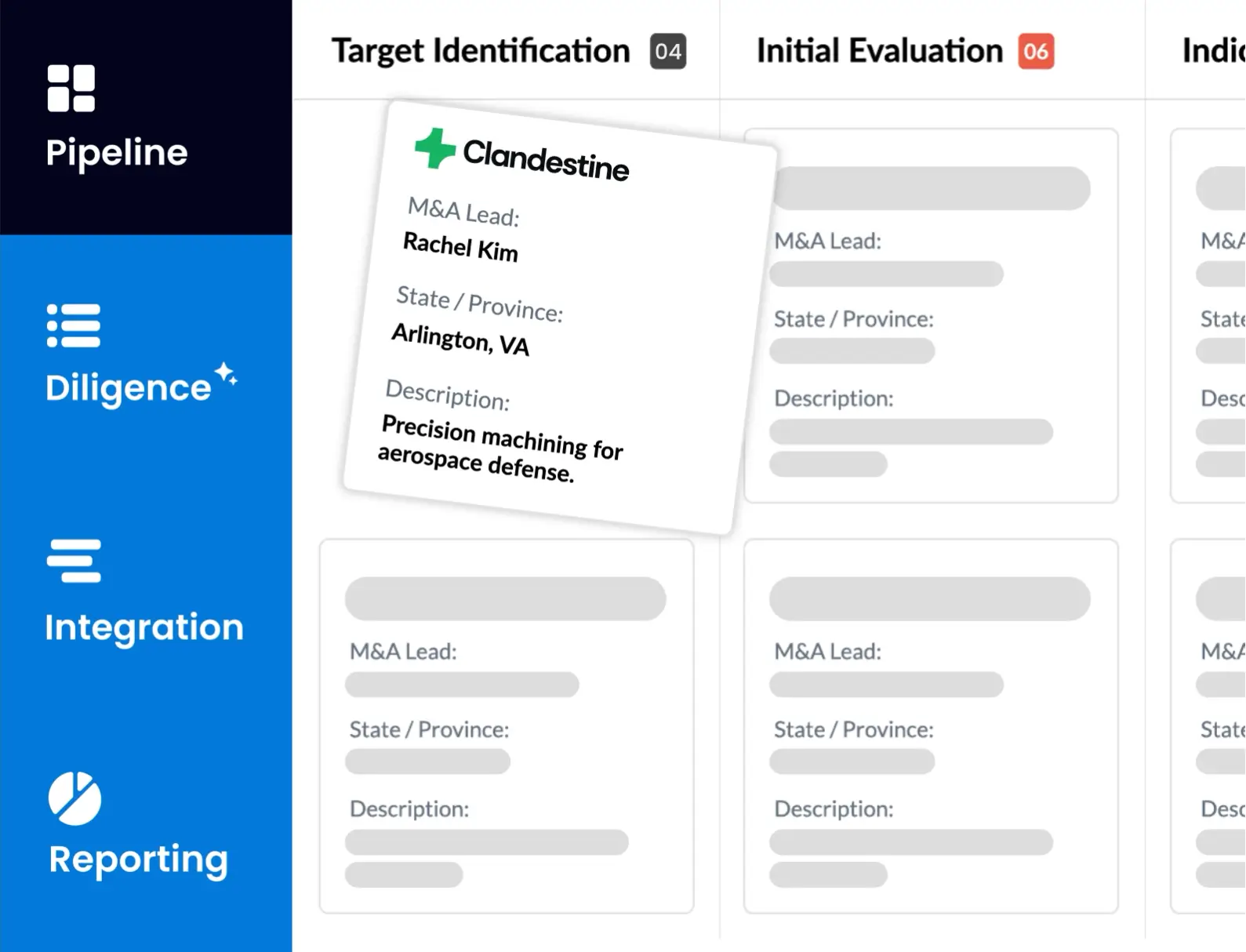
The DealRoom M&A Platform simplifies this process by providing a purpose-built platform to manage diligence workflows, centralize operational data, and track findings in one secure location.
After closing, DealRoom helps teams monitor operational initiatives and execute their value-creation plans with full visibility. This ensures operational due diligence translates into measurable post-acquisition results.
Request a demo to see how DealRoom helps private equity firms run more effective due diligence and drive operational value creation.








.png)



.avif)

.avif)