.jpeg)









Financial due diligence determines whether a deal is valued appropriately and whether the risks are understood. It goes past the financial statements to test what drives earnings, how cash really moves, and where the story breaks under pressure. The right diligence team gives buyers leverage and gives sellers a cleaner path through the process.
In this guide, we explain what financial due diligence firms do, when to engage one, and how to choose the right partner. We also highlight leading firms used across private equity and corporate M&A.
Why Companies Hire a Financial Due Diligence Firm

Companies hire a financial due diligence firm to see the business clearly before committing capital. Financial statements tell part of the story. Due diligence shows how that story holds up under pressure. Buyers want to know what drives earnings and what could break them.
A financial due diligence firm helps you understand the quality of revenue. They look at customer concentration and contract terms, examining margins and cost structure. They test working capital and cash flow patterns to understand what’s real and what may change after close.
Due diligence reduces surprises by surfacing issues early. Problems found during the due diligence period can be priced in or addressed through deal terms, but problems found after close turn into write-downs and hard conversations. Early visibility protects value and trust.
Experienced teams spot issues that internal teams often miss. They see patterns across many deals and know where risks tend to hide and which questions to ask. Internal teams know the business well, but they may not see blind spots shaped by familiarity or time pressure.
Hiring a financial due diligence firm leads to better decisions, with clearer tradeoffs and more confidence when the deal moves forward.
When to Bring a Firm into the Process
The best time to bring in a financial due diligence firm is early. Waiting too long to bring a third party on board limits a company’s options. Early work gives deal teams room to adjust valuation and structure before positions lock in.
There are clear signals that outside support is needed. For example:
- Fast growth without clean reporting raises questions.
- Complex revenue models add risk.
- International operations introduce accounting differences.
- Tight timelines leave little margin for internal review.
Timing in the due diligence process directly affects deal terms and leverage. Issues found early can be reflected in price or working capital targets, while late findings often lead to rushed fixes or weaker protections. In buy-side M&A advisory, early insight gives buyers more negotiating power and gives sellers time to prepare clean answers.
Both buyers and sellers use third-party diligence for different reasons. Buyers want downside protection and confidence in forecasts, while sellers want credibility and fewer last-minute objections. Independent analysis creates a shared fact base that keeps deals moving.
What a Financial Due Diligence Firm Brings to the Table
A financial due diligence firm brings an outside view grounded in deal experience. The work focuses on what drives value and what puts it at risk and helps teams decide how much to pay and how to protect against downside risk. Here’s a look at the key areas financial due diligence firms focus on:
- Revenue quality and customer trends. This shows how stable sales really are. Financial due diligence firms look at repeat business and churn, flagging one-time revenue and customer concentration that could distort earnings.
- Margins and cost structure. This explains how the company actually makes money. Financial due diligence firms test whether margins are sustainable. They look for costs that may rise after close or savings that are unlikely to last.
- Working capital and cash needs. This helps buyers understand how much cash the business needs to operate. It also informs working capital targets at close. Poor analysis here often leads to post-close disputes.
- Debt, liabilities, and off-balance-sheet items. This includes loans, earnouts, and deferred revenue. It also includes obligations that do not show up cleanly on the balance sheet. These items can quickly change enterprise value.
- Forecasts and assumptions. Forecasts matter only if the inputs make sense. Diligence teams test growth drivers and cost assumptions and assess whether plans reflect reality or optimism.
- Risks tied to operations or market shifts. This includes supply chain exposure and pricing pressure, as well as regulatory change and customer behavior. These risks shape how confident teams should be in future performance.
Thorough due diligence work creates a clearer picture of value, so both parties have a clear understanding of what they can earn after the deal closes.
How to Choose the Right Financial Due Diligence Firm

Choosing the right financial due diligence firm affects the entire deal. The right team brings clarity, but the wrong team creates noise and causes delays.
Start with industry experience. Ask what deals they have worked on in your sector. Look for patterns, not one-off exposure. Familiarity with revenue models and cost drivers accelerates work and improves judgment.
Sector knowledge matters because accounting is rarely generic. SaaS looks different from manufacturing, and healthcare looks different from retail. A team that knows the space understands where adjustments hide and which metrics actually matter.
Assess how the firm approaches analysis. Strong teams focus on decision-making, explaining how findings affect price structure and risk. While they do deliver a due diligence report, they also walk you through what matters and why.
Watch for red flags early, such as:
- Vague answers about prior work signal weak experience.
- Overly rigid templates suggest shallow analysis.
- Promises of fast work without understanding the business should raise concern.
Clear thinking shows up quickly in the first conversations.
The best firms feel like partners. They ask sharp questions and challenge assumptions, and they stay focused on value from the first call through close.
Leading Financial Due Diligence Firms
Not all financial due diligence firms approach deals the same way. Some lead with operational insight, while others bring scale or deep sector focus.
The firms below (listed in alphabetical order) are commonly used across private equity and corporate mergers and acquisitions (M&A). Each brings a different lens to diligence, depending on deal size, complexity, and risk.
AlixPartners
AlixPartners, founded in 1981, is a global consulting firm known for execution under pressure. The company built its reputation in turnarounds and performance improvement before expanding into M&A support. Today, AlixPartners works across North America, Europe, Asia, and the Middle East. The firm is often brought in when deals involve complexity or operational risk, or when urgency drives the timeline.
AlixPartners employs more than 3,500 professionals worldwide. The firm works closely with private equity firms, boards, and executive teams, with a hands-on and senior-led culture. Teams stay close to decisions and outcomes rather than slide decks.
AlixPartners approaches financial due diligence with an operational lens. They focus on how the business performs day-to-day and how that performance may change after close. The work highlights risks related to integration and value creation, as well as execution risks.
AlixPartners supports buy-side and sell-side deals with a strong focus on what happens after close. Diligence is framed around execution integration and performance improvement rather than reporting alone.
Alvarez & Marsal (A&M)
Alvarez & Marsal (A&M), founded by Tony Alvarez and Bryan Marsal in 1983, is a global professional services firm known for hands-on execution. The firm built its reputation in turnarounds and restructuring before expanding into transaction advisory and performance improvement. Today, A&M operates across the Americas, Europe, Asia, and the Middle East.
The firm employs more than 9,000 professionals worldwide, with revenue exceeding $3 billion annually. Alvarez & Marsal works closely with private equity firms, lenders, and boards. The firm provides senior-led teams who are deeply involved in the work. They’re often brought in for complex or high-risk situations.
Alvarez & Marsal’s financial due diligence focuses on decision-grade insight. A&M supports both buy-side and sell-side deals and often integrates financial due diligence with operational and commercial diligence.
A&M brings an operator mindset. Their diligence teams look at how results are produced on the ground, which resonates in carve-outs, turnarounds, and complex integrations.
Baker Tilly
Baker Tilly is a global advisory, tax, and assurance firm with a strong focus on the middle market. The firm traces its roots back to the early 1900s and has grown through mergers and global expansion.
Baker Tilly operates through an international network with coverage across North America, Europe, Asia, and other key markets. In the U.S., the firm has expanded quickly in advisory and transaction services.
Globally, Baker Tilly has more than 40,000 professionals across over 140 territories and annual global revenue exceeding $5 billion. The firm works closely with private equity firms, family-owned businesses, and public companies. Clients often choose Baker Tilly for senior-level involvement and practical deal experience.
Baker Tilly’s financial due diligence teams focus on how a business performs under real operating conditions. The firm supports buy-side and sell-side transactions and works closely with sponsors, lenders, and management teams throughout the process.
Baker Tilly is frequently chosen for sponsor-heavy deal pipelines. The firm emphasizes repeatable diligence execution across multiple portfolio companies.
BDO
BDO, founded in 1963, is a global professional services firm with a strong presence in the mid-market that has grown through a network model rather than a single global partnership. Today, BDO operates in more than 160 countries, serving private companies, public businesses, and private equity firms. BDO is often brought in when clients want senior-level attention without the scale and cost of the Big Four.
Globally, BDO has more than 115,000 professionals, with annual revenue north of $14 billion. In the U.S., BDO has continued to expand its advisory practice, focusing on transaction growth and value creation, especially in complex lower and middle-market deals. BDO competes on senior access and mid-market focus. Deal teams tend to be hands-on with fewer layers, which resonates with private equity firms and founders who want direct answers fast.
BDO provides financial due diligence as part of its M&A and transaction advisory work. They help buyers and sellers understand what the numbers really say before a deal moves forward. The focus is on earnings quality, revenue trends, cost structure, and cash flow reliability.
BDO supports buy-side and sell-side engagements and often works directly with private equity teams and management throughout the process.
BerryDunn

BerryDunn, founded in 1974 and headquartered in Maine, is a U.S.-based accounting and advisory firm with a strong focus on the middle market. Over time, it expanded beyond its regional roots and built deep industry practices in healthcare, government, technology, education, and energy. BerryDunn primarily works with private companies, public-sector organizations, and nonprofit entities.
The firm employs more than 1,000 professionals across offices in the U.S. and abroad. BerryDunn is known for industry specialization and long-term client relationships. In transactions, the firm is often brought in where regulatory complexity and operational detail matter as much as the numbers.
BerryDunn’s financial due diligence teams focus on understanding financial performance and deal risk early. The firm supports buy-side and sell-side deals and helps teams address issues before they affect valuation or closing timelines.
BerryDunn brings strong public-sector and regulated-industry insights. That experience carries into diligence, where compliance and reimbursement drive financial outcomes.
Clearwater International
Clearwater International, founded in the UK in 2003, is a global corporate finance advisory firm focused on the middle market. It has grown steadily through international expansion rather than large mergers. Today, Clearwater operates across Europe, North America, Asia, and Australia.
The firm employs several hundred professionals worldwide. Clearwater, which works mainly with private equity firms, corporates, and founder-owned businesses, is built for cross-border mid-market deals.
Their diligence work reflects how value shifts across jurisdictions, currencies, and regulatory environments. The model is partner-led with a strong emphasis on hands-on involvement throughout a transaction.
Clearwater approaches financial due diligence as part of the broader deal process, supporting buy-side and sell-side transactions. Findings are used to shape valuation discussions and deal structure, rather than to create standalone reports.
CliftonLarsonAllen (CLA)
CliftonLarsonAllen (CLA) is a U.S.-based professional services firm with deep roots in the middle market. The firm was formed in 2012 through the merger of Clifton Gunderson and LarsonAllen. Both firms had long histories serving private businesses and family-owned companies. CLA has continued to grow through acquisitions and organic expansion.
Today, CLA employs more than 8,000 professionals across the United States. The firm works closely with private companies, private equity firms, and nonprofit and government organizations. It’s known for industry depth and long-term client relationships rather than one-off deal work.
CLA’s sell-side due diligence services focus on preparing a business for market. CLA works closely with management teams and advisors to present a clear and defensible financial story.
CLA is especially strong on sell-side readiness. Many sellers engage CLA before a process launches to clean up issues buyers would otherwise price against them.
Crowe
Crowe, founded in the U.S. in 1942, is a global public accounting and consulting firm with a long history in advisory and assurance work. Over time, Crowe expanded through its independent member firm network and now operates in more than 130 countries. The firm works with public companies, private businesses, and private equity firms with a strong focus on regulated and complex industries.
Globally, Crowe employs more than 30,000 professionals, with annual revenue exceeding $5 billion. The firm is well known across sectors such as financial services, healthcare, manufacturing, and technology. In M&A, Crowe often supports middle-market and sponsor-backed transactions where risk visibility and hands-on execution matter.
Crowe’s financial due diligence teams focus on understanding the financial risks behind a transaction to identify issues that could affect the valuation deal structure or post-close performance. Crowe supports buy-side and sell-side engagements and works closely with management teams and investors throughout the deal lifecycle.
Crowe brings strong industry specialization. Their diligence work is often shaped by sector-specific regulatory and reimbursement dynamics rather than generic accounting analysis.
Deloitte
Deloitte is one of the world's oldest and largest professional services firms. The firm began in London in 1845 when William Welch Deloitte opened a small accountancy practice. Over several decades, it expanded internationally and merged with other firms, becoming a global network of member firms operating in more than 150 countries. Today, Deloitte is part of the Big Four along with PwC, EY, and KPMG.
Deloitte’s global network employs roughly 470,000 professionals. In the fiscal year ending May 31, 2025, the network reported around $70.5 billion in revenue. Deloitte’s U.S. member firm alone recorded about $35.7 billion in revenue in its most recent fiscal year. The firm’s services include audit, tax, consulting, risk advisory, and financial advisory.
In M&A work, Deloitte tackles complex deals around the world. Its reach helps clients that operate across borders or in highly regulated sectors. Deloitte’s financial due diligence services are offered as part of its M&A and sell-side advisory services, helping buyers and sellers work through the numbers that matter before a deal moves forward.
Deloitte also integrates financial work with other functional reviews. They may run deep dives into finance alongside operational, IT, HR, and logistics assessments to provide a fuller picture of deal readiness.
Deloitte stands out for scale and integration. Few firms can combine financial due diligence with deep operational, IT, cyber, and regulatory reviews under a single umbrella. That matters in deals where financial risk ties directly to systems data or compliance exposure.
EisnerAmper

EisnerAmper is a U.S.-based advisory tax and accounting firm with a strong footprint in the middle market. The firm was formed in 2009 through the merger of Eisner LLP and Amper Politziner Mattia.
Since then, it has grown through steady acquisitions and expansion of its advisory practice. EisnerAmper works with private companies, public entities, and private equity firms across a wide range of industries.
The firm employs several thousand professionals across offices in the U.S. and abroad. EisnerAmper is especially active in sponsor-backed transactions, real estate, financial services, and technology. Clients often choose the firm for senior-level access and practical deal experience rather than large firm layers.
EisnerAmper’s transaction advisory teams focus on the financial reality behind a deal. EisnerAmper supports buy-side and sell-side transactions and works closely with sponsors, lenders, and management teams throughout the diligence process.
EisnerAmper has built a strong niche in sponsor-backed and real estate-driven deals. Their diligence teams are accustomed to complex ownership structures and multiple layers of financing.
EY Parthenon
EY Parthenon is the strategy and transaction advisory arm of Ernst & Young. The group was formed following EY's acquisition of The Parthenon Group in 2014, a move that combined Parthenon’s strategy focus with EY’s global reach and transaction expertise. Today, EY Parthenon is under the umbrella of EY’s Strategy and Transactions practice.
EY itself dates back to the late 1800s and operates as one of the Big Four professional services firms. The global EY organization employs hundreds of thousands of professionals across more than 150 countries. EY Parthenon works closely with EY’s tax assurance and sector teams, which gives it strong coverage in complex and regulated industries.
EY Parthenon provides due diligence as part of its strategy and transactions work. Their financial due diligence focuses on what drives value and what puts it at risk.
The firm places financial findings in a broader deal context. They connect the numbers to strategy, market position, and operating model to help buyers understand not just what the business earned but how and why.
EY Parthenon brings a strategy-first mindset to diligence. The work is often integrated with commercial and operational diligence. Financial findings are rarely presented in isolation. Instead, they’re framed around market position, competitive dynamics, and execution risk, which appeals to buyers focused on growth theses.
Forvis Mazars
Forvis Mazars is a newer name with deep roots. The firm was formed in 2024 through the combination of Forvis and Mazars. Forvis itself came from the 2022 merger of BKD and Dixon Hughes Goodman.
Mazars has a much longer history, dating back to 1945 in France. The combination created a global professional services firm with strong coverage in the U.S., Europe, and beyond.
Today, Forvis Mazars operates in more than 100 countries and employs over 40,000 professionals. Forvis Mazars blends local partner involvement with international reach. That combination is useful for sponsor-led transactions and cross-border deals that need local insight without having to hand work off to disconnected teams.
Forvis Mazars provides financial due diligence focused on understanding how a business performs in practice. They support both buy-side and sell-side deals to surface issues early and give deal teams a clear view of what may impact value after close.
FTI Consulting
FTI Consulting is a global advisory firm focused on high-stakes situations. The firm was founded in 1982 and grew through acquisitions and expansion into specialized practices.
Today, FTI operates across the Americas, Europe, Asia, and the Middle East. The firm works with corporates, private equity firms, lenders, and boards, often being called in when decisions carry real financial or reputational risk.
FTI Consulting employs more than 8,000 professionals worldwide, with annual revenue north of $3 billion. The firm is known for combining financial analysis with sector expertise and dispute experience, which is evident in how its teams approach transactions and risk.
FTI Consulting’s financial due diligence teams focus on clarity before capital is committed. The work supports buy-side and sell-side deals with findings framed to help deal teams make decisions, not just document issues.
FTI blends diligence with dispute and forensic experience. That background makes them a fit for deals where downside risk litigation or financial integrity are concerns.
Grant Thornton
Grant Thornton, founded in Chicago in 1924, is a global professional services firm with a long history in the middle market. It grew over time into an international network of independent member firms. Today, Grant Thornton operates in more than 130 countries and serves public companies, private businesses, and private equity firms.
Globally, the network employs more than 70,000 professionals, with annual revenue of over $7 billion. In the U.S., Grant Thornton is known for combining scale with partner-level involvement.
The firm often works with growing companies and financial sponsors seeking practical advice without the complexity of the Big Four. Buyers often choose the firm when they want experienced teams without the cost structure or process weight of the largest firms.
Grant Thornton’s financial due diligence teams focus on how a business performs in real conditions to identify risks that affect valuation and deal terms. Teams support buy-side and sell-side transactions and work closely with management and investors throughout the process.
Houlihan Lokey
Houlihan Lokey, founded in Los Angeles in 1972, is a global investment bank with a strong focus on advisory work. It built its reputation in valuation opinions and restructuring before expanding into M&A and transaction advisory.
Today, Houlihan Lokey operates across the Americas, Europe, and Asia, employing more than 2,500 professionals worldwide. It’s publicly traded and works closely with corporates, private equity firms, and boards.
Houlihan Lokey is known for deep expertise in complex situations, including distressed transactions, fairness opinions, and disputes. Its advisory model is relationship-driven and senior-led, which is evident in how closely teams work with deal principals.
Houlihan Lokey’s transaction advisory teams, supporting both buy-side and sell-side transactions, focus on the financial details that drive deal outcomes. Findings are linked directly to valuation, financing, and negotiation decisions rather than academic analysis.
Houlihan Lokey is deeply embedded in valuation fairness and restructuring. Their diligence work is tightly tied to how deals get financed and defended.
KPMG
KPMG is one of the Big Four professional services firms. The name comes from a 1987 merger between Klynveld Main Goerdeler and Peat Marwick. The firm operates as a global network of member firms with a strong presence across North America, Europe, and Asia, working with public companies, private equity firms, and mid-market businesses.
Globally, KPMG employs more than 275,000 professionals across over 140 countries and generates more than $35 billion in annual revenue. Its work spans audit, tax, and advisory services.
KPMG is often selected for deals with regulatory complexity. Their strength lies in highly controlled industries where accounting, compliance, and audit alignment matter as much as valuation mechanics. In M&A, KPMG is known for disciplined analysis and close coordination across service lines.
KPMG delivers financial due diligence as part of its deal advisory services. They support buy-side and sell-side arrangements, helping clients identify risks early and explain how financial performance may change after the deal closes.
On the sell side, they help prepare the financial story ahead of buyer review. On the buy side, they focus on downside risk and valuation drivers.
Kroll
Kroll is a global advisory firm known for risk intelligence investigations and financial analysis. The firm was founded in 1972 and built its reputation around corporate investigations and dispute work.
Over time, it expanded into valuation restructuring, cyber risk, and transaction advisory. Today, Kroll operates across North America, Europe, Asia, and the Middle East.
Kroll operates as a single global firm following its integration with Duff & Phelps. Duff & Phelps acquired Kroll in 2018, and the combined firm fully transitioned to the Kroll name by 2021. Today the Kroll brand covers valuation corporate finance investigations cyber risk and governance under one platform.
Kroll employs several thousand professionals worldwide. The firm works with public companies, private equity firms, lenders, and legal teams. Its background in investigations and disputes shapes how it approaches deals. Kroll’s work tends to be detail-oriented and risk-focused, especially in complex or sensitive transactions.
Kroll’s financial due diligence teams work to identify issues that could affect valuation, financing, or post-close outcomes. Kroll supports buy-side and sell-side transactions and often works alongside valuation and dispute specialists when risks are elevated.
Kroll’s roots in investigations shape its approach to diligence. The firm excels at identifying hidden risks related to governance fraud or sensitive counterparties.
Lazard
Lazard, founded in 1848, is one of the world's oldest financial advisory firms and has operated as an independent advisor for most of its history. Lazard is known for advising on major strategic and M&A transactions without providing lending or underwriting services. That independence is a core part of its identity.
The firm operates globally with offices across the Americas, Europe, Asia, and the Middle East. Lazard is publicly traded, employing several thousand professionals worldwide and working with large corporates, governments, and financial sponsors. Lazard is often involved in complex high-value transactions where judgment and discretion matter.
Lazard approaches financial due diligence through a strategic and transaction-focused lens. The work is closely tied to valuation deal structure and negotiation strategy. Rather than running broad accounting reviews, Lazard focuses on the financial questions that directly impact whether a deal should move forward and on what terms.
Lazard operates without lending conflicts. Its diligence work supports independent advice tied directly to strategic decision-making.
Lincoln International
Lincoln International, founded in 1996, is a global investment bank focused on middle-market M&A. The firm grew quickly by building deep industry expertise and a partner-led model. Lincoln operates across the Americas, Europe, and Asia and works primarily with private equity firms, corporates, and entrepreneurial founders.
Lincoln International employs more than 700 professionals worldwide. The firm is known for advising on transformational and cross-border deals across sectors such as industrials, business services, healthcare, and consumer. Its teams are senior-led and closely involved throughout the valuation and execution process.
Lincoln’s financial due diligence teams focus on how a company actually performs and what drives value. The work supports buy-side and sell-side mandates, and findings feed directly into valuation, negotiation, and deal-execution planning.
Lincoln combines investment banking and diligence under one roof. That alignment keeps financial analysis tightly connected to valuation and buyer expectations.
MarshBerry

MarshBerry, founded in 1981, is a specialized investment banking and consulting firm focused on the insurance and wealth management industries. From the start, it concentrated on financial advisory work for firms in regulated financial services markets. It operates primarily in North America and works almost exclusively within its core verticals.
The firm employs several hundred professionals and serves clients including insurance agencies, brokerages, and wealth management firms, as well as private equity investors active in those sectors. MarshBerry is known for deep industry knowledge rather than broad generalist coverage. That focus shapes how it approaches M&A work.
MarshBerry’s financial due diligence services are tailored to insurance and wealth management transactions. Teams aim to validate earnings sustainability and identify risks specific to regulated financial services businesses. MarshBerry supports buy-side and sell-side deals with diligence designed to inform valuation and deal terms within its niche markets.
MarshBerry is a niche firm by design. Their diligence is purpose-built for insurance and wealth management economics, not adapted from general corporate models.
PKF Octagon
PKF Octagon is a specialist corporate finance and transaction advisory firm. The firm operates as part of the wider PKF Global network but runs independently with a sharp focus on deals.
PKF as a network dates back to 1969. Today, it spans more than 150 countries. PKF Octagon focuses on mid-market and cross-border transactions where hands-on execution matters.
The firm offers lean and senior-led teams that work closely with private equity investors, corporates, and founders. Clients work directly with decision makers, which is rare in larger advisory models and appeals to clients who want direct access to decision makers rather than layered delivery models. PKF Octagon is often brought in for complex situations that need judgment, not just process.
PKF Octagon provides financial and tax due diligence for buy-side and sell-side deals. They focus on the sustainability of profits and exposure to downside risk. Tax diligence runs alongside financial work to identify deal breakers early, and the output is practical and deal-focused.
PwC
PwC stands for PricewaterhouseCoopers. The firm traces its roots to the 19th century with Price Waterhouse and Coopers & Lybrand. Those two firms merged in 1998 to form today’s global PwC network.
The firm is based in London but operates in nearly every major market worldwide. PwC is one of the Big Four professional services firms, offering audit, tax advisory, and deals work alongside other services.
In the fiscal year ending June 30, 2025, PwC’s global revenue was about $56.9 billion. The network employs roughly 364,000 professionals worldwide. Its teams serve a broad range of clients from large multinationals to mid-market companies.
PwC delivers financial due diligence as part of its acquisitions and deals work. Their approach blends financial analysis with commercial and operational context.
PwC’s diligence goes beyond basic numbers, connecting financial findings to strategic and operational factors that shape value. This gives clients context for negotiation and post-deal planning.
PwC is known for linking diligence to value creation early. Their teams emphasize how financial findings connect to growth plans, operating assumptions, and post-close execution rather than treating diligence as a standalone exercise.
RSM
RSM is a global professional services firm focused on the middle market. The firm traces its roots back to 1926 and has grown steadily through acquisitions and expansion across key markets.
RSM operates as a network of member firms with a strong footprint in North America, Europe, Asia Pacific, and Latin America. In the U.S., RSM is a leading advisor to middle market companies and private equity firms.
Globally, RSM has more than 64,000 professionals across over 120 countries, with annual global revenue exceeding $9 billion. The firm offers audit, tax, and consulting services, with a heavy emphasis on growth-focused, sponsor-backed businesses. In M&A, RSM is known for practical advice and close collaboration with deal teams.
RSM’s financial due diligence teams, supporting both buy-side and sell-side engagements, help buyers and sellers understand the financial reality behind a transaction. Their diligence approach reflects how private equity firms think about downside protection, debt, and exit readiness.
Stout
Stout is a global advisory firm focused on valuation transactions and disputes. The firm was founded in 1991 and has grown steadily through organic expansion and targeted acquisitions. Stout operates across North America, Europe, and Asia. The firm works with private equity firms, corporates, lenders, and legal teams and is known for technical depth and independent thinking rather than audit-based delivery.
Stout employs more than 1,000 professionals worldwide. The firm is especially active in valuation fairness opinions and complex transaction support.
Stout’s valuation background influences how its diligence teams approach risk and financial analysis. The work is designed to support buy-side and sell-side decisions with clear, defensible analysis that holds up in negotiations, financing discussions, and fairness debates.
Frequently Asked Questions
What does a financial due diligence firm actually do?
A financial due diligence firm analyzes how a business makes money and where that performance could change after close. The work focuses on earnings quality, cash flow, working capital, and balance sheet risk. The goal is to inform price structure and risk protection, not just report on the company’s history.
Is financial due diligence different from an audit?
Yes. An audit confirms whether financial statements comply with accounting standards, while financial due diligence looks ahead, testing sustainability risk and deal impact. Audits look backward, but diligence supports decisions.
When should financial due diligence start in an M&A process?
As early as possible. Early diligence gives buyers leverage and gives sellers time to address issues. Waiting too long limits options and often weakens deal terms.
Do sellers need a financial due diligence firm, too?
Yes. Sellers use diligence to prepare a defensible financial story. Pre-sale diligence reduces surprises, shortens timelines, and limits last-minute price pressure.
How long does financial due diligence usually take?
Most engagements run two to six weeks, depending on deal size, complexity, and data readiness. Clean data and clear workflows significantly reduce timelines.
How much does financial due diligence cost?
Costs vary based on scope, deal size, and complexity. Middle-market deals often range from tens to low hundreds of thousands. The cost is small compared to the downside risk it helps avoid.
Final Thoughts
Financial due diligence shapes how deals are priced and structured. The right firm brings clarity early, but the wrong timing or weak execution creates friction that shows up at signing or after close. What matters most is turning findings into decisions that move the deal forward with confidence.
That work does not happen in isolation. Diligence teams rely on clean data, clear workflows, and tight coordination among internal and external stakeholders. When information lives in spreadsheets and disconnected tools, risk increases and momentum slows.
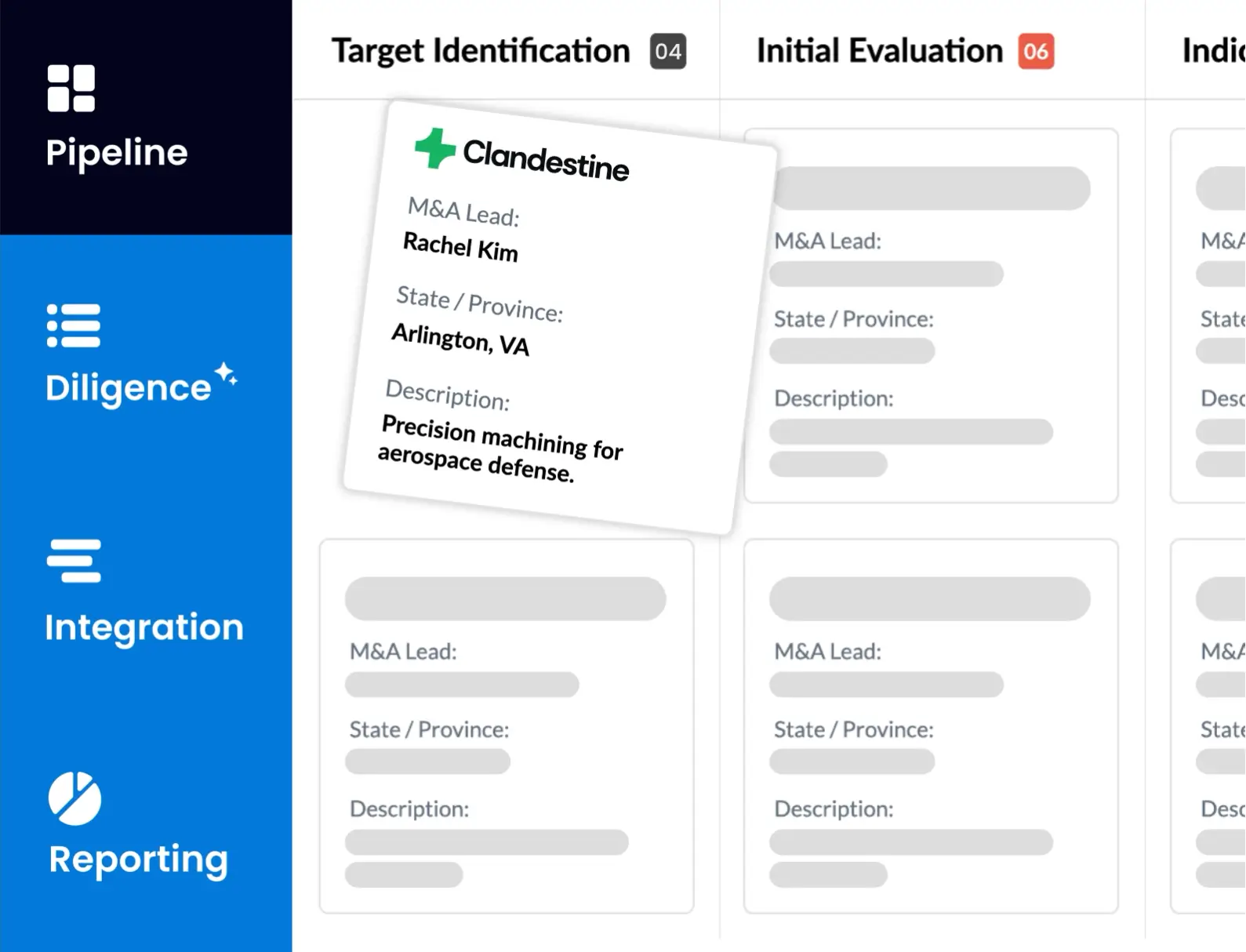
The DealRoom M&A Platform gives deal teams a single place to manage diligence from start to finish. Requests documents comments and findings stay connected to the deal context. Buyers and sellers see the same information at the same time, and advisors stay aligned without chasing updates. Request a demo to learn how DealRoom can streamline your financial due diligence processes.









.png)


.avif)