.jpeg)









Due diligence reports outline the findings of an investigation before finalizing an important business transaction like a merger, acquisition, or investment opportunity. They pull together financial, legal, operational, and marketing information so executives can assess risks and opportunities before entering into a deal.
Templates simplify the process and help ensure you don't overlook anything. Instead of starting from scratch, you can modify a sample due diligence report that already contains sections for financial statements, legal documents, lists of assets, employee information, supplier details, and more.
This allows you to focus on gathering and analyzing data instead of formatting your report.
Due diligence reports can make or break multimillion-dollar deals. They can prompt buyers to proceed with a deal, renegotiate, or walk away from a deal altogether. A clean, comprehensive template allows you to clearly and concisely communicate your findings so that busy decision makers have the information they need to quickly evaluate a situation.
What is a Sample Due Diligence Report?
A sample due diligence report serves as a reference. It demonstrates what data should be presented to management, how you should organize your findings and what format will effectively communicate high-priority information to executives and stakeholders.
Essential Elements of a Sample Due Diligence Report

Every strong due diligence report example will contain these key sections to walk investors through the process of your investigation. They provide a defined format for your findings and let decision-makers assess the deal quickly.
Executive Summary and Intent
Positioned at the beginning of your due diligence report template should be your executive summary. This should encapsulate your entire investigation into a few pages.
Here you will want to provide highlighted information for busy executives who do not have the time to read your entire report. Include the reasoning behind the transaction, key risks identified, major opportunities, and your recommendation on proceeding with the deal.
If you uncover any glaring issues with the company’s finances, legal integrity, or operations, highlight them immediately. Leading with the negatives will prepare the reader for your findings and grab their attention.
Make sure to include the scope of your research. Define what was looked at during your due diligence process and what was not.
The executive summary should be able to act independently if board members/leaders only need a summary for M&A discussions.
Company Overview
The company overview will provide an overview of the target company and their role in the industry. Include the company legal structure, history, locations, number of employees, and years in operation.
Provide a list of their primary products/services, revenue sources, and target customer. Who are the company’s competitors? How much market share does the company own within the industry? How does the company make money? Include an organizational chart showing key employees and who reports to whom.
Remember this section shouldn’t contain any opinions, save that for your analysis section. Include tables to showcase financial ratios, headcount, and locations of facilities. This information allows readers to understand who your target company is before you dive deeper into your due diligence report sample.
Deal Summary and Objectives
The deal summary section outlines the form of the proposed transaction and the strategic rationale for the deal. Include the proposed purchase price and payment structure. Is the purchase price for stock or assets?
Include any details on earnouts, seller financing, or contingent value rights based on future performance. Articulate your company’s strategic objectives for the deal. Are you trying to expand into new markets? Are you buying new technology? Are you trying to hire new talent? Are you trying to diversify revenue streams? Tie these objectives to specific attributes of the target company.
Provide a proposed timeline for closing and include any conditions to closing. List out any required regulatory approvals and known obstacles.
Financial, Legal, and Commercial Analysis
Your due diligence will include financial, legal, and commercial information about the target company. These areas address various risks and benefits involved with the transaction.
Financial Due Diligence and Statements
Financial due diligence reviews the financial information supporting the overall health of the target company. Review three to five years of audited financial statements including a balance sheet, income statement, and statement of cash flows.
Review the balance sheet for the quality of the assets being acquired, debt loads and working capital needs. Verify age of accounts receivable, inventory valuation method, and any off-balance sheet liabilities.
Analyze the income statement for revenue and margin trends as well as overall cost structure. Reconcile tax returns to the financial statements. There should be no surprises.
Your financial due diligence should identify any tax liabilities, pending audits, or aggressive accounting practices being used by the target.
Develop a comprehensive financial model based on your research. Project forward looking financial performance under a variety of scenarios. Validate assumptions around revenue, cost structure, and capital expenditures.
Based on your analysis you will be able to determine if the purchase price is justified.
Legal Due Diligence and Regulatory Matters
Reviewing legal due diligence can uncover compliance, contracts and liability concerns that could affect the deal. Included in your due diligence should be an examination of:
- Corporate Documents: Articles of incorporation, bylaws, board meeting minutes, stock purchase agreements.
- Contracts: Review material contracts with customers, suppliers, leases, and joint ventures. Look for change-of-control provisions that may allow a party to renegotiate or terminate the contract.
- Employee Issues: Review employee agreements, non-compete agreements, and benefits for retention risks or unfunded liabilities.
- Litigation: Past lawsuits can uncover liability concerns. Review pending or threatened lawsuits. Review any past or pending regulatory investigations and settlements.
- IP Ownership: Make sure the company owns all intellectual property such as patents, trademarks, copyrights and trade secrets. Check that all IP is registered, licensed and there are no pending infringement disputes.
- Data Privacy: Depending on the industry and where customers sit, the GDPR, the CCPA and the state consumer privacy laws now enacted in 24 US states may apply. Ensure there’s a data privacy policy in place. Review any cybersecurity measures, data breaches, and third party vendor management.
Commercial and Market Research
Commercial due diligence focuses on market conditions, competition, and the sustainability of the company’s revenue stream. Your due diligence report should analyze the market. This includes industry growth trends, regulatory environment, and competitive pressures.
Look at customer concentration. How dependent is the target on its top 10 to 20 customers? Look at contract length, renewal potential and pricing stability. The more concentrated your customer base the higher your business risk. Competition can be broken down into direct and indirect competitors.
Look at their market share, competitive advantages, and barriers to entry. Supply chain and supplier termscan also affect operations and pricing.
Revenue streams should be scrutinized for quality over quantity. Breakdown between recurring and non-recurring revenue. Calculate customer acquisition costs vs. customer lifetime value. Watch for aggressive sales practices that inflate revenue such as channel stuffing or extending credit terms.
Operations and Technology
Operational due diligence assesses the quality of management, operational processes, and technology. Assess the current organizational structure, key employee depth, and succession plans.
Review the production/process or service delivery operations for efficiency and scalability. Look for bottlenecks or quality issues where the company may have an operational advantage.
Technical due diligence is particularly critical for technology companies. Review their IT systems and technology stack. Understand their system architecture, software licenses, maintenance costs, technical debt, and integration capabilities.
Your technical due diligence report should assess cybersecurity practices, data backup/recovery procedures, and evaluate the pros and cons of any cloud vs. on-premise solutions. Technology scalability will highlight if the technology will support growth or require significant investment.
Human capital assessment involves reviewing the employees, talent risks, turnover, compensation, and company culture. Look for key-person dependencies that could pose a risk if that person were to leave the organization.
Due Diligence Process and Best Practices

A successful due diligence process is repeatable. Assign team member responsibilities and report regularly. Your discoveries are only as good as your preparation, information gathering, and risk identification throughout the company.
Due Diligence Checklist and Investigation
The due diligence checklist should include financial, legal, operations, IT, human resources, and commercial topics. Include items that you can tie to financial statements, key metrics, contracts, operations manuals, legal documents, tax returns, etc.
Sample due diligence topics might include:
- Financial: Balance sheets, income statements, cash flows, tax returns, debt payments
- Legal: Contracts, litigation history, IP portfolios, compliance reports, company charter
- Operations: Supplier contracts, vendor research, production processes, quality control
Due diligence investigation includes reviewing documents, visiting sites, interviewing stakeholders, and verifying data. Triple check all information with third-party sources when available.
Read every document you get twice. If you see something off with a stakeholder interview, ask them about it right then.
Due Diligence Team Responsibilities
Due diligence is generally performed by a team of financial analysts, attorneys, operations specialists, IT professionals, and industry consultants. Allocate topics that align with individual team members’ experience. However, each member should review all of the information.
Your financial team will spearhead research on accounting records, valuation, and revenue projections. Attorneys will guide due diligence on contracts, regulatory compliance, indemnification, and litigation risk. Operations experts review supply chain, inventory, production facilities, and operating processes.
IT and cybersecurity due diligence should include technology stacks, integration risks, digital security, and data privacy. The lead manager schedules interviews, sets deadlines, and identifies gaps in the team’s coverage.
Depending on the transaction, you may also engage third-party consultants to assess tax, regulatory, or industry specific risks. Ensure that team members are communicating to share information and avoid duplication of effort.
Report Formatting and Structure
A due diligence report is typically broken up into sections that review each aspect of the business. You’ll want to start with an executive summary, followed by each area of review, and conclude with your recommendations.
Due Diligence Report Sections:
- Executive Summary - Summary of your key findings and recommendations
- Corporate Overview - Ownership, governance, organizational structure
- Financials - Performance, assets, liabilities
- Operations - Manufacturing, supply chain, logistics
- Legal/Compliance - Contracts, regulations, litigation
- Technology - Software/hardware, infrastructure, cyber security
- HR - Employees, compensation, recruiting
- Risks - All risks identified and categorized by severity
- Synergies/Recommendations - Potential synergies and next steps
Provide a short narrative description for each section. Attach supporting documents to your due diligence report template.
Use tables to highlight comparisons. Bullet points for itemized lists. Bold important information. Write short paragraphs. And rely less on opinions and more on concrete facts.
Getting to those facts is the slow part. The Document & CIM Summarizer in our free M&A Skills Library turns a dense CIM or contract into an executive summary, a key-facts table and a list of red flags you can lift straight into the report.
Risk Assessment and Key Findings
The risk assessment ranks risks based on severity, likelihood and deal value impact. Rank each risk as high, medium or low depending on the potential impact to the purchase price or integration costs.
Financial risks could include unknown liabilities, customer concentration, cash flow discrepancies, etc. Operations risks could encompass supplier dependency, labor unrest, production bottlenecks.
Lawsuits pending, regulatory fines, Intellectual Property ownership disputes are examples of legal risks. You may find technology risks such as outdated equipment, cyber liability exposures, data migration risks.
Provide documentation to support each risk and quantify the exposure if possible. In our State of AI in M&A 2026 report, 25% of 237M&A practitioners said due diligence is where they already use AI, so expect more of the findings in this section to arrive AI-flagged and in need of a human check against the source document. Your major findings should include deal killers, material risks that may impact purchase price, and areas of potential value. Provide recommendations for use in negotiation discussions and integration planning.
Frequently Asked Questions

Due diligence reports come in all shapes and sizes depending on the type of transaction, industry specifics, and client requirements. To save you time and endless Google searches, here are answers to many of your common questions about what goes into a due diligence report.
What should be included in a comprehensive financial due diligence report?
A financial due diligence report should include three to five years of financials including income statements, balance sheets, and cash flow statements. This also includes a quality of earnings check to adjust for any non-recurring items or items that distort the company’s actual performance.
Analysts should review working capital trends, debt payments, revenue recognition, tax exposures, compliance risks, and other liabilities not shown on the balance sheet.
How do major accounting firms structure their due diligence reports?
Big Four and mid-market accounting firms structure a due diligence report the same way: an executive summary of key findings and deal implications first, then a body organized by topic (quality of earnings, net debt and debt-like items, networking capital, cash flow, tax), then appendices. Each section pairs a short narrative with tables, and the appendices hold the adjusted EBITDA bridge, supporting schedules and the list of documents reviewed. Firms start from a house template and tailor the scope to the deal and the industry.
What are the key components of a due diligence report for a business acquisition?
A due diligence report for a business acquisition has six key components: an executive summary with the recommendation, a company overview (structure, ownership, business model), a deal summary (price, structure, closing conditions), findings by workstream (financial, legal, commercial, operational, tax, HR and IT), a risk assessment that rates each issue high, medium or low, plus recommendations for the purchase agreement and integration plan. Appendices carry the financial model, the document list and the questionnaire responses.
Customer and supplier analysis to understand risk concentration. Legal compliance review based on industry and business activities. Risk assessment and final thoughts with recommendations summary.
Where can I find a reliable template for creating a due diligence report?
You can obtain due diligence report templates from many places. Consulting firms often have templates or portions of templates you can use. Professional organizations and law / accounting groups are another great source.
Many virtual data room providers have templates and due diligence checklists as part of their portal. You could even use a template from a past deal, as long as you update it to fit your situation. Just make sure it fits the industry and transaction.
What is the typical format of a due diligence report in the M&A process?
The typical format of an M&A due diligence report is nine parts in this order: titlepage, table of contents, executive summary, scope and methodology, company and deal overview, findings by workstream (financial, legal, commercial, operational), a risk register with a high, medium or low rating per item, recommendations and appendices. Keep the executive summary to two pages so aboard member can read it on its own. Appendices hold the financial model, backup schedules, the document list and due diligence questionnaire responses.
Appendices should include your financial model, detailed backup schedules, documents you reviewed, and due diligence questionnaire responses. Including a thorough appendix allows the reader to verify your analysis if they want to.
How can I differentiate between due diligence reports for financial performance and legal compliance?
Financial due diligence emphasizes a company’s financial performance. This includes quality of earnings, revenue, and cash flow. Financial due diligence uses modeling and financial trend analysis.
Legal due diligence focuses on contracts, audits, litigation, and compliance. It’s important to perform both financial and legal due diligence to get a full picture of the company you’re buying.
Key Takeaways
- A due diligence report is a compilation of your financial, legal, and operational findings to justify your deal decisions.
- Due diligence report samples outline the important sections you should include such as finances, assets, employees, and legal information.
- Focus on finding the information that matters for your deal and presenting it clearly instead of trying to include everything you find.
Your due diligence report shouldn’t just be a summary of your findings. Winning deals and avoiding unknown deal risks comes down to your team’s ability to find information, analyze it, and make decisions based on incomplete data that’s spread across systems. And you need to do it all in days, not months.
When you’re working with spreadsheets, email threads, and static templates, dealing is difficult. Inefficient, even. Complex deals weren’t designed to be done this way.
That’s why we built DealRoom.
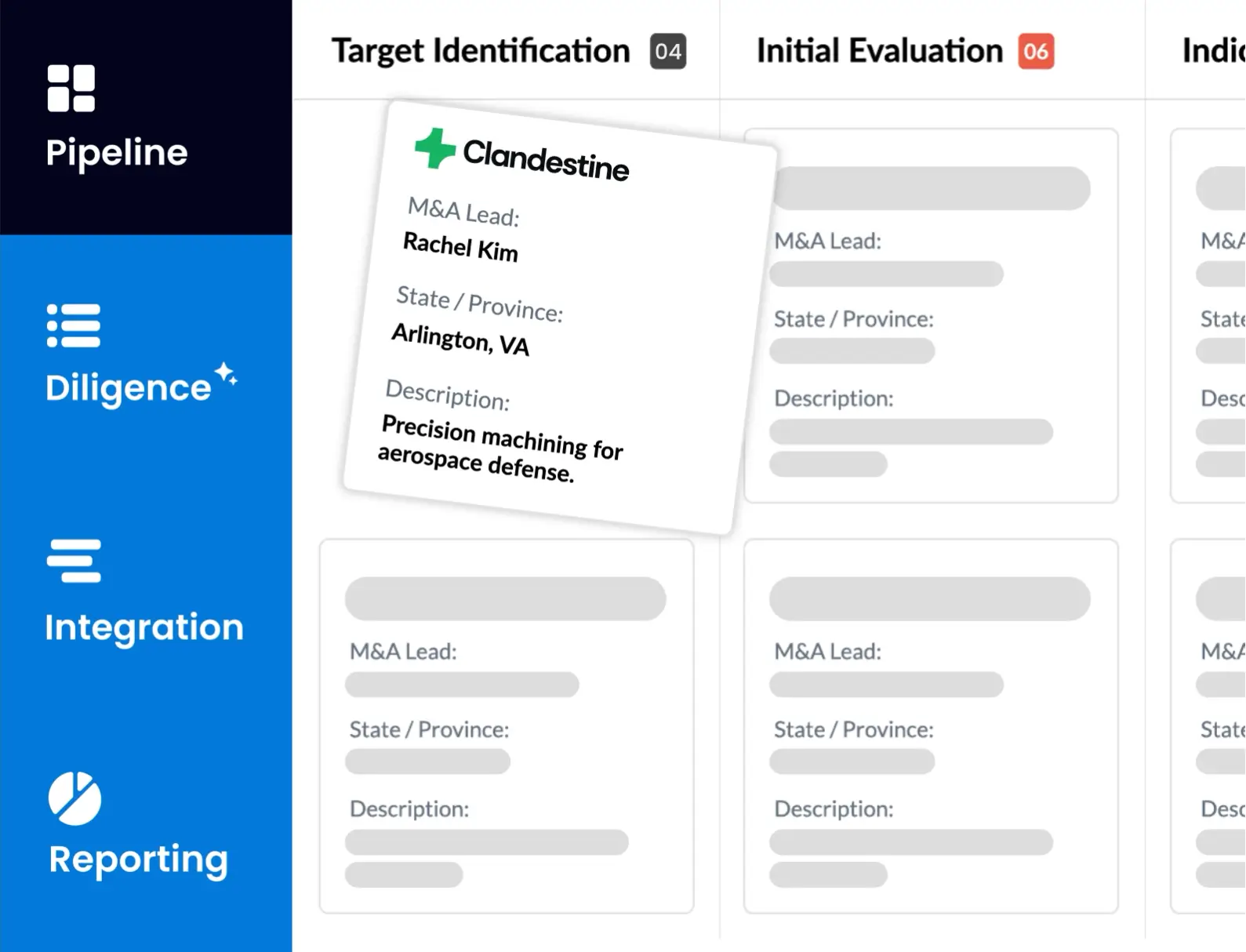
The DealRoom M&A Platform gives your team a place to manage your deals from pipeline to integration from start to close. Instead of using disconnected tools, your teams collaborate in one workspace. Store all deal documents in one place. Gain visibility into deal progress as it’s happening.
Due diligence is no different. DealRoom Diligence streamlines your diligence reports so they’re no longer static PDFs. You can:
- Store all of your requests, diligence documents, and findings in one place
- Monitor diligence progress from across teams in real time
- Link requests to documents and Q&As to reduce back and forth emails
- Create templates to standardize your diligence workflow so every deal is executed the same way
- Spot risks, gaps, and insights faster by having all of your information in one place
Simply put, your diligence will be completed faster, done more thoroughly, and help you make better decisions when it matters most.
If your diligence process feels too manual, disjointed, or just hard to scale. The problem isn’t your diligence reports. It’s your workflow. Request a demo to see how DealRoom can give your deal teams the structure and transparency they need to run diligence at scale.









.png)


.avif)