.jpeg)









Global M&A activity in 2026 is showing a mixed but ultimately encouraging picture. By and large, dealmakers are now more selective in their targets, focusing more on strategic alignment, operational resilience, and long-term value creation.
Total transaction volumes have softened across several sectors; however, deal value is on the rise, thanks to competition for high-quality assets, mega-deals that are mostly strategic consolidations, and renewed momentum in private equity.
This sector-by-sector breakdown highlights the latest 2026 M&A statistics, trends, and insights across key industries shaping today’s global dealmaking environment:
- Technology, Media & Telecommunications (TMT)
- Healthcare & Life Sciences
- Financial Services
- Energy, Utilities & Infrastructure
- Industrials, Manufacturing & Transportation
- Consumer & Retail
- Real Estate
- Energy Transition & Sustainability
- Aerospace & Defense
In each market, we explore the latest statistics to uncover how the broader macroeconomic environment, investor demand and supply-side considerations, and strategic drivers are impacting M&A volume, deal value, and valuation multiples in 2026.
Technology, Media & Telecommunications (TMT)

1. Mid-market deals are in the spotlight. Tech M&A is becoming less dominated by large, high-risk bets. Interest is growing in mid-market targets with strong, stable cash flows, high retention rates, and scalable business models. Activity is up, but average deal values are down as acquirers take a more cautious approach. The biggest players are strategic and private equity investors who have a lower risk threshold and clearer integration and ROI roadmap. (Shoosmiths)
2. AI-native and infrastructure software dominate deal flow. AI-native and infrastructure software companies lead the deal flow. On a per-deal basis, AI-native companies continue to get the highest multiples. Infrastructure software, including cloud platforms, developer tools, and vertical SaaS, also commands high interest as their predictable recurring revenue and closer customer relationships make them some of the most stable bets in the space. As more than $1 billion pours into AI infrastructure, R&D, and strategic acquisitions every day, the current gold rush can also be characterized as a battle for the basic building blocks of AI, from semiconductors to data centers. (Shoosmiths)
3. Mega-deals drive momentum in U.S. tech M&A. While the U.S. technology sector saw flat deal volume in the first half of 2025 compared to the same period in 2024, total deal value and the number of mega-deals increased as buyers regained confidence and were more willing to engage in larger, strategic transactions. (PwC)
4. Global M&A rebounds with higher deal values despite fewer transactions. In the first half of 2025, total global M&A volume fell by about 9% compared to the same period in 202. However, total deal value has increased by roughly 15%, indicating a rebound in higher-value transactions and a renewed focus on strategic M&A despite a decrease in overall deal numbers. (PwC)
5. Global M&A activity gains momentum in Q2 2025. The total value of global M&A transactions in the 2nd quarter of 2025 reached about US $780 billion, 5% higher than the previous quarter and one of the highest quarterly levels ever recorded in recent years, demonstrating a robust rebound in dealmaking appetite. (S&P Global)
6. Dealmaker optimism is high in 2025. In Deloitte’s 2025 M&A Trends Survey, executives expressed growing confidence in the deal environment, particularly in areas such as technology-driven growth, digital transformation, and private equity activity, even as transactions become more complex and strategically focused. (Deloitte)
Healthcare & Life Sciences
7. Deal values diverge across healthcare segments. Overall deal volume in global health industries decreased in the first half of 2025, with the number of deals down by around 22% and the total value of transactions down by approximately 25% year over year. Average deal size was lower in Pharma and Life Sciences, where deal volume and value were down by 19% and 33%, respectively. Healthcare Services witnessed 25% fewer deals in the first half of 2025 compared with the prior-year period, but total deal value rose by half, suggesting an uptick in larger, strategic buyouts. (PwC)
8. Strategic healthcare services deals bounce back. In the U.S. healthcare services segment, deal activity increased in H1 2025, with 231 total deals (a 14.4% increase from H2 2024) and a total deal value of approximately $20.8 billion (up nearly 550% from H2 2024), driven by a return to large-scale strategic investments by acquirers. (KPMG)
9. Biopharma deal activity hits a high-water mark. The total value of M&A deals in the biopharma sector during the first quarter of 2025 rose to about $37.7 billion, up an impressive 101% on a quarter-on-quarter basis from the fourth quarter of 2024. (Pharmaceutical Technology)
10. Life sciences retains significant deal-making capacity. According to EY’s Firepower Report 2025, life sciences companies have an estimated US$1.3 trillion in “firepower” (cash and debt capacity available for M&A). Acquisition premiums, however, remain high in 2024, with median deal premiums at around 75%, establishing a strong baseline for valuations heading into 2025. (EY)
11. Investor interest surges in behavioral health. In the U.S. behavioral-health space, deal flow increased by more than 35% year-on-year in Q1 2025. In the autism services sub-sector, transactions doubled in the same period, reaching the highest quarterly level since 2020. (PwC)
12. Private equity participation increases significantly. PE firms accounted for about 40.2% of total M&A deal investment in the healthcare sector in Q1 2025, up from 25.1% in 2024. (R.L. Hulett)
Financial Services

13. Financial services dealmaking is picking up pace. EY says global financial services M&A activity increased in the first half of 2025, with 1,125 publicly disclosed deals globally compared to 1,106 during the same period last year. Total disclosed value rose to $160.8 billion, from $137.2 billion during H1 2024. 35 transactions valued at $1 billion or more represented 83% of total deal value, demonstrating the ongoing prevalence of large-scale transactions. (EY)
14. Large-scale transactions are driving financial services M&A growth. Total deal value for global financial services M&A transactions increased by approximately 15% year over year to the first half of 2025, even as volumes declined by 1% for the same period, per PwC. The rise in value is being driven by an uptick in larger transactions, with ten megadeals valued at over $5 billion announced in H1 2025, up from six during the same period last year. Notable deals during the period include Global Payments’ proposed $24.25 billion acquisition of Worldpay, Monte dei Paschi di Siena’s $13.9 billion bid for Mediobanca, and FIS’ planned $13.5 billion purchase of Global Payments’ Issuer Solutions business, highlighting the sector’s continued focus on scale and consolidation. (PwC)
15. U.S. banking M&A remains steady. Data from S&P Global Market Intelligence shows that in the first five months of 2025, there were 57 bank deals announced (versus 56 in the same period in 2024) and that the aggregate assets of target banks were $65.67 billion (versus $64.95 billion in the same period in 2024). (S&P Global)
16. Asset management consolidation hits a decade high. Asset management M&A activity globally exceeded $50 billion for the first time in a decade to reach $50.8 billion in the first seven months of 2025, marking a 76% increase on the same period a year earlier, data from LSEG reported by Financial News London. Increased competition in the sector and a drive to build scale are behind a wave of deals, as players adapt to fee compression and demand for diversified capabilities. (Financial News London)
17. Wealth-management M&A hits a record high. Data from Fidelity Investments revealed the registered-investment-adviser (RIA) segment recorded 132 transactions in the first half of 2025, involving $182.7 billion in client assets, the best H1 ever since data was first tracked in 2015. (Fidelity)
18. European financial services deal value surges in H1 2025. According to EY, financial services disclosed deal value in Europe (EMEA) increased from US$17.5 billion in H1 2024 to US$44.4 billion in H1 2025, representing growth of around 154%. (EY)
Industrials, Manufacturing & Transportation
25. Industrial manufacturing shows mixed momentum. Following the momentum at the start of the year, the M&A activity in the industrial manufacturing space tempered in the second quarter of 2025. The number of deals declined by ~11.4% compared to 1Q 2025. The total deal value for the quarter was US$78.1 billion, a ~28.8% drop from the previous quarter but remains ~32.8% higher than the same period a year ago, indicating sustained interest in a limited number of high-quality assets. (KPMG)
26. Transportation and logistics dealmaking continues to be strategic in nature. Over the trailing 12 months through Q2 2025, the sector saw 113 transactions, down from 132 a year ago. Strategic buyers continued to be the primary driver (making up 88.5% of all deals) as companies focus on targeted acquisitions that bolster core strengths and supply chain resilience. (PCE)
27. M&A in industrial sectors is facing strong headwinds. Bain’s 2025 Mid-Year report found the value of industrial M&A deals fell by an estimated 15% as companies grapple with higher interest rates, regulatory uncertainty, and a changing global industrial footprint. (Bain & Company)
28. U.S. M&A in transportation & logistics is holding firm. In the first quarter of 2025, M&A deal volume in the U.S. transportation & logistics sector remained relatively flat compared with the first quarter of 2024, with a continued emphasis on strategic fit rather than deal volume as companies navigate challenging macroeconomic and geopolitical conditions. (PwC)
29. Industrial and manufacturing M&A shows cautious resilience. The industrial and manufacturing sectors saw continued resilience in Q2 2025 despite ongoing uncertainty surrounding trade policy, inflation, and supply chain pressures. While there was a decrease in both deal volume and value from the prior quarter, investor interest held firm for strategically positioned, high-margin assets. (KPMG)
30. Private equity participation in industrials deals climbs. PE acquirers represented 42.1% of total capital invested in the global Industrials M&A market in H1 2025, a significant increase from 25.1% in 2024. (R.L. Hulett)
Energy, Utilities & Infrastructure

19. Infrastructure M&A rebounds on solid ground. Following a relatively quiet year in 2024, US infrastructure dealmaking has seen a strong rebound through H1 2025 with a total transaction value of US$136.6 billion, which already exceeds the US$125 billion total for all of 2024. Even as market volatility continues, investor appetite for long-term infrastructure bets in the sectors of transportation, energy transition, and digital remains a key driver of deal flow. (White & Case)
20. Renewables deal-flow is gathering pace. Global renewables M&A reached US$43 billion in H1 2025, with North America at the helm at US$16 billion, followed by Europe at US$13 billion and APAC + Latin America at US$12 billion. (Enerdatics)
21. Oil & gas M&A activity accelerated in early 2025. Global oil & gas M&A in Q1 2025 included 104 announced deals valued at US $45.6 billion. North America represented 46.6% of the deal volume. (Kroll)
22. Utilities deal volume surges across the US. For the period ending September 25, 2025, US utilities M&A reached US$128.73 billion, an increase from US$76.43 billion in the same period in 2024. (S&P Global)
23. U.S. power and utilities M&A bounces back on rising AI-driven demand. Deal-making momentum in the U.S. power and utilities sector continues into the second quarter of 2025, following a strong start to the year. This is highlighted by a ~US$29 billion independent power producer transaction in January, one of the largest of 2025 to date. Increasing demand for electricity driven by data centers and artificial intelligence remains one of the key drivers of M&A activity. (PwC)
24. Strategic buyers lead energy-utilities M&A growth. In KPMG's mid-year 2025 review of the energy, natural resources & chemicals sector, strategic buyers (i.e., non-private-equity acquirers) accounted for just shy of 70% of the value of energy/utility M&A in H1 2025. The number of deals in this subsector during the same period was down ~10.7% from H2 2024. (KPMG)
Consumer & Retail
31. Increased demand for strategic transactions. Over half of retail executives (53%) expect to have moderate-to-major investments in M&A activity in 2025, which marks a sharp increase from just around 30% of retailers in 2024. This data signals a significant change in the approaches retailers are taking to growth, showing a preference for consolidation and strategic transactions to fuel competitiveness in a volatile market. (Deloitte)
32. Fewer deals, higher values. Value in the consumer & retail sector soared by 175% year-on-year to US$19.9 billion in Q2 2025, even though activity remained relatively unchanged with 261 transactions (Q2) against 258 (Q1), a 7.8% fall in volume on an annual basis. The trend indicates a clear preference for a smaller number of large-scale strategic transactions where acquirers seek scale and brand value. (KPMG)
33. Selective dealmaking defines 2025. Global M&A volume declined approximately 9% during H1 2025 while value increased around 15%, according to PwC. For the consumer and retail sector, this mirrors the broader environment: fewer, higher-value deals as acquirers prioritize strategic alignment and profitability over expansion at any cost. (PwC)
34. Consumer products dealmaking recovers with moderation. Bain analysis found that global consumer products M&A volume totaled approximately US$3.4 trillion in 2024, representing an increase of 15% from 2023. However, this was still about half the size of the peak seen in 2021. The data suggests a tempered recovery in the space, with activity in 2025 likely to further reinforce this trend as corporates look to optimize portfolios and drive growth through acquisition. (Bain & Company)
35. Portfolio reshaping comes into focus. KPMG’s Global Consumer & Retail M&A Outlook 2025 says that firms are placing greater emphasis on bolt-on deals, non-core asset disposals, and the growing pressure from activist investors. The report illustrates a year of strategic portfolio optimization, with dealmakers pursuing deals to enhance agility and value creation over scale alone. (KPMG)
Real Estate

36. REIT M&A hits a pause. The M&A activity of publicly listed U.S. real estate investment trusts (REITs) has remained highly muted in the first half of 2025. S&P Global counted only two REIT M&A transactions announced in the first six months of 2025, both in the healthcare sector (Welltower/NorthStar Healthcare Income and CareTrust/Care REIT), as a cautious stance persisted in the wider commercial real estate sector. (S&P Global)
37. PropTech consolidation continues. Houlihan Lokey's H1 2025 PropTech Market Update found there were 55 M&A transactions and approximately $2.3 billion in growth equity and debt financings in the U.S. PropTech market. Much of the activity was focused on property management, data analytics, and digital marketplace platforms, signaling continued investor appetite for real estate technology even as the broader market pulls back. (Houlihan Lokey)
38. Selective momentum returns to commercial real estate (CRE). PwC's mid-year 2025 outlook noted another resurgence in commercial real estate M&A, which began in the first half of the year with headline transactions including Blackstone's ~$4 billion ROIC deal and Apollo's ~$1.5 billion acquisition of Bridge Investment Group. The firm added that while deal volume lags pre-pandemic levels, investors are becoming increasingly selective in targeting high-quality assets and platform plays as confidence in the sector returns with some caution. (PwC)
39. Institutional capital leads the charge. The 2025 Real Estate M&A Trends report by RSM Global cites an increasing role for pension funds and sovereign wealth funds in real estate transactions as institutional capital gains prominence in propelling deal activity. Such investors are focusing on long-term, income-producing assets and platform deals. (RSM Global)
40. Sector focus shifts toward operational assets. According to RSM Global’s 2025 Real Estate M&A Trends report, the largest level of M&A interest from investors is in hotels, logistics, and retail parks due to the attraction of income stability and scalability of these assets. On the other hand, the residential sector of commercial real estate has been more subdued, with relatively low deal activity due to higher financing costs and tighter margins. (RSM Global)
Energy Transition & Sustainability
41. Renewables M&A activity remains strong in early 2025. Global renewable energy transactions were approximately $32 billion in the first quarter of 2025, continuing the strong transaction activity at the end of 2024. Despite macroeconomic uncertainty and tighter financing conditions, demand from investors for clean-energy assets remains strong, particularly for wind, solar, and battery storage platforms, reflecting ongoing confidence in the long-term energy-transition thesis. (Enerdatics)
42. Emerging markets are providing a tailwind for renewables M&A activity. Global deal value for renewable energy transactions totaled just under $43 billion in H1 2025, led by healthy activity in North America (~$16 billion) and Europe (~$13 billion). There are also strong signs that dealmaking is picking up in emerging markets such as India and Brazil, suggesting that investor interest in clean-energy assets is broadening beyond mature markets. (Enerdatics)
43. Solar M&A activity picks up pace in 2025. Solar companies announced 50 corporate M&A deals in H1 2025, compared with 40 in the first half of last year. Additionally, 106 solar projects with a total capacity of 19.9 GW changed hands. This reflects an ongoing consolidation in the solar value chain as developers and investors seek to scale and diversify their portfolios. (Mercom Capital)
44. Energy storage M&A sees transition to project-level deals. The first half of 2025 has been a slower period of corporate M&A activity for the energy storage industry: there were only 3 transactions recorded in the first half of the year, compared to 14 for the same period in 2024. Project-level M&A has been on the rise, with 31 deals completed in the first six months, marking a 138% year-over-year growth. Investors continue to focus on operational and late-stage assets, while corporates remain selective. (Mercom Capital)
45. Power and utilities M&A surges in 2025. As of September 25, 2025, the total announced value of U.S. utility and power sector deals reached $128.73 billion, a significant increase over the $76.43 billion in deals during the same period last year. The increase is largely driven by a pickup in large-scale transactions as investors and strategic buyers reposition to gain scale in areas of grid reliability, decarbonization, and energy-transition infrastructure. (S&P Global)
Aerospace & Defense

46. Defense-tech, AI assets fuel deal flow. Global aerospace and defense M&A totaled an estimated 250 transactions in H1 2025, rebounding sharply from 175 in H2 2024 and reflecting a return of investor confidence and appetite for next-gen technologies. Many transactions involved defense-tech innovators and AI-driven systems, highlighting how digital capabilities are driving strategic priorities for both traditional primes and private-equity buyers. (Axial)
47. Aerospace & defense dealmaking accelerates. Deal volume in the A&D industry increased by approximately 12% quarter-over-quarter in Q1 2025 vs. Q4 2024; 71% of transactions were by strategic buyers, and cross-border activity increased by approximately 27% QoQ. (Meridian Capital)
48. The U.S. aerospace and defense sector continues to see strong deal valuations. In the last 12 months through Q3 2025, there have been 122 transactions (24 in Q3 2025), with median multiples of 17.82× TEV/EBITDA and 3.22× TEV/Revenue. (PCE)
49. Valuation multiples are stable in major A&D subsectors. In their five-year average review, valuation multiples for engines & engine systems, sensors & C4ISR, and defense electronics in the aerospace & defense sector are in the low-to-mid teens on a TEV/EBITDA basis. (BRG)
50. Sentiment in the M&A market is slowly improving. The average sector-outlook score for investment bankers has increased to 6.5 (on a 0-10 scale) as of March 2025, per FTI Consulting, from 5.6 in March 2024. (FIT Consulting)
Frequently Asked Questions
Which sectors are seeing the most M&A growth and investor interest in 2026?
The hottest sectors are those aligned with long-term macroeconomic trends:
- Technology (especially AI & Infrastructure). The battle for AI-native companies and the underlying infrastructure (semiconductors, data centers) is fueling a "gold rush."
- Energy Transition & Renewables. Despite financing challenges, investor appetite for wind, solar, and battery storage assets remains very strong, driven by the long-term decarbonization thesis.
- Healthcare Services & Biopharma. While pharma volume is down, healthcare services are seeing a bounce-back in large, strategic deals, and biopharma deal value has surged, supported by massive "firepower" from large life sciences companies.
How is private equity influencing the 2026 M&A landscape?
Private equity (PE) is a dominant force in 2026. Their participation has increased significantly across nearly all sectors, including Healthcare and Industrials.
PE firms are increasingly selective, focusing on mid-market companies with stable cash flows and scalable models. They are often the drivers of competitive auction processes for high-quality assets.
Are there any sectors where M&A activity is lagging in 2026?
Yes, some sectors are facing headwinds:
- Real Estate (especially REITs). M&A for publicly listed REITs has been highly muted due to higher financing costs and valuation uncertainties in the commercial real estate market.
- Certain Industrial Subsectors. Sectors facing trade policy uncertainty, supply chain pressures, and higher interest rates have seen a dip in deal volume and value.
- Residential Real Estate. Within commercial real estate, the residential sector has been more subdued compared to operational assets like hotels and logistics parks.
What are the key drivers behind the surge in mega-deals ($5B+)?
Mega-deals are primarily driven by the pursuit of scale and market consolidation. In sectors like Financial Services, Technology, and Energy, companies are making bold moves to acquire competitors or complementary businesses to achieve market leadership, reduce costs, and gain a competitive edge in a challenging macroeconomic environment. The renewed confidence to execute these large, complex transactions signals a maturing and more stable dealmaking environment.
Navigating the M&A Landscape with DealRoom
From AI-powered tech and energy transition to healthcare and industrial manufacturing, one thing is abundantly clear across all sectors as we head into2026: dealmaking has become increasingly strategic, data-driven, and selective.
Overall deal volume may have cooled in some sectors, but rising deal values, the resurgence of mega-deals, and the continued preference for strategic and private equity buyers have all indicated a maturing M&A market where operational discipline and acumen are essential.
At the same time, deal complexity has increased significantly across multiple dimensions: regulatory and antitrust scrutiny, cross-border integration challenges, ESG considerations, and data analytics powered by AI. The need for a more intelligent and connected approach to due diligence and deal execution has never been greater. That’s where DealRoom comes in.
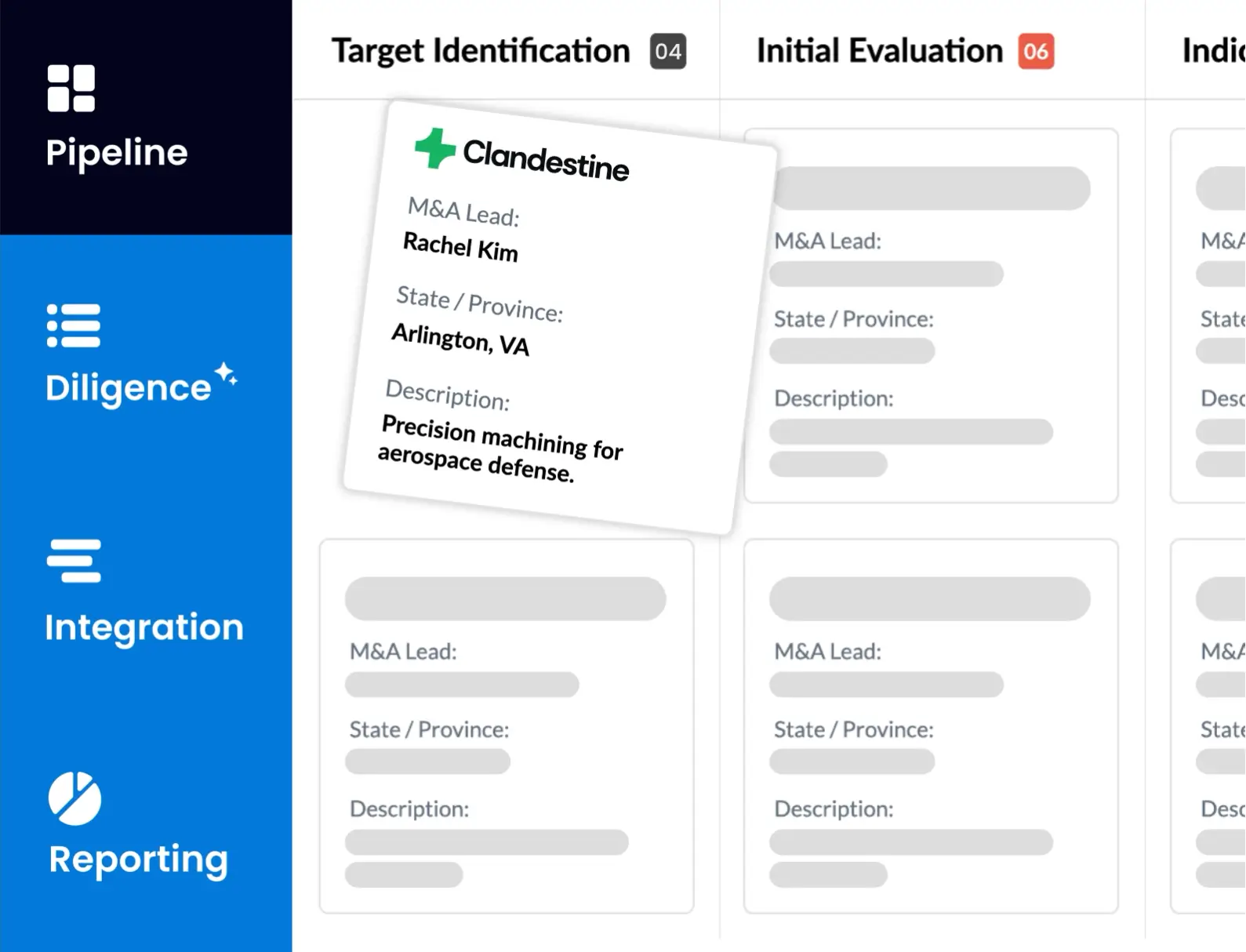
DealRoom’s M&A Platform is a next-generation M&A lifecycle management platform that helps deal teams work more effectively throughout the entire M&A process. From pipeline management and due diligence to post-merger integration, DealRoom enables corporate development teams, investment banks, and private equity firms to manage their entire deal process within a single, integrated workspace. Built-in analytics, task automation, and real-time reporting allow teams to:
- Centralize and accelerate due diligence by managing requests, documents, and communication in one place.
- Eliminate manual distractions with integrated project management and automation.
- Drive deal momentum and performance with data-driven analytics and milestone tracking.
- Align for success and ensure smooth integrations with post-close playbooks and performance tracking.
In a year defined by more selective and strategically disciplined dealmaking and smarter deployment of capital, DealRoom gives deal teams the visibility and agility they need to compete and close successfully in today’s M&A environment. See how DealRoom can power your next transaction: Book a demo today.









.png)
.avif)
.avif)

.avif)