.jpeg)









In Axial's 2026 M&A Fee Guide (331 advisors surveyed in Q2 2026), 71% charge an upfront fee and 77% credit it against the success fee. Buy-side M&A fees are the retainer and success fee an acquirer pays its buy-side advisor or investment bank for an acquisition. Buy-side advisors typically charge a monthly retainer plus a success fee of roughly 2% to 5% of deal value in the middle market, set on a Lehman formula, a flat rate or a tiered scale, with the rate falling as deals get larger.
Over a decade running a boutique M&A practice before founding DealRoom in 2012 taught me which of those terms to negotiate hardest.
Understanding Buy-Side M&A Fees
Buy-side advisory fees represent compensation paid to investment banks and financial advisors who represent acquiring companies in merger and acquisition transactions.
These fee structures differ significantly from sell-side arrangements and involve unique components tied to deal complexity and execution success.
Definition and Importance in Mergers and Acquisitions
Buy-side M&A fees are payments made by acquiring companies to their financial advisors for services during the acquisition process. These fees compensate advisors for strategic guidance, target identification, valuation analysis, and support for deal execution. They align advisor interests with buyer objectives and ensure dedicated resources throughout the transaction lifecycle.
Key fee functions include:
- Securing expert transaction guidance
- Accessing advisor networks and deal flow
- Obtaining independent valuation perspectives
- Managing complex negotiation processes
Investment banking merger fee contracts typically structure compensation to incentivize successful deal completion. This creates a partnership dynamic between buyers and their advisors.
Key Components of Buy-Side Fee Arrangements
Buy-side fee structures comprise multiple components that compensate advisors for different phases of work and risk levels.
- Retainer fees represent upfront payments that secure advisor services and cover initial work phases. In Firmex's 2024-25 Global M&A Fee Guide (456 middle-market advisors), the most common monthly work fee is $5,000 to $10,000,16% of firms charge $16,000 or more a month and 38% of firms using a one-time upfront fee charge more than $26,000. Bulge-bracket retainers on public deals run far higher: Union Pacific paid Morgan Stanley and Wells Fargo $7.5 million each on signing the Norfolk Southern merger agreement.
- Success fees form the largest component, paid only upon transaction completion. These fees are usually calculated as a percentage of deal value: 4.8% on a $5 million deal falling to 1.9% at $150 million in Firmex's 2024-25 survey and well under 1% on the largest public deals.
- Work fees cover specific project phases, such as due diligence support, financing arrangements, and regulatory approval processes. These fees compensate for intensive work periods regardless of the deal outcome.
Buy-side advisory arrangements often include expense reimbursements for travel, legal costs, and third-party services. Fee caps may limit buyers' total compensation exposure.
Some agreements feature minimum fees that guarantee baseline compensation even if deals terminate early or at lower valuations than anticipated.
Differences Between Buy-Side and Sell-Side Engagements
Buy-side and sell-side fee arrangements reflect fundamentally different transaction dynamics and advisor responsibilities.
Fee Timing
Fee timing represents a major distinction. Sell-side advisors typically receive payment only upon successful completion, while buy-side advisors often secure retainer payments regardless of outcome.
Fee Calculation Methods
Fee calculation methods also differ significantly. Sell-side fees are usually calculated as fixed percentages of transaction value, while buy-side fees may involve flat fees, hourly rates, or hybrid structures.
Risk Allocation
Risk allocation varies between engagement types. Sell-side advisors assume greater execution risk since their compensation depends entirely on deal completion. Buy-side advisors face less financial risk through upfront retainer payments.
Buy-side and sell-side advisory services require different skill sets and resources. Buy-side work emphasizes target evaluation and strategic fit analysis, while sell-side work focuses on marketing and buyer development.
Fee Transparency
Fee transparency differs between sides. Buy-side fees remain private between acquirer and advisor, while sell-side fees may become public through regulatory filings or disclosure requirements.
Typical Fee Structures for Buy-Side Advisory

Buy-side M&A advisors typically charge through three main fee structures that align their compensation with deal outcomes. These structures often combine upfront retainer payments with success-based fees that reward advisors for completing transactions.
Retainer Fees Explained
Retainer fees are the upfront payments companies make to secure buy-side advisory services. In Firmex's 2024-25 Global M&A Fee Guide, 30% of middle-market firms charge a monthly fee and 28% a one-time fixed retainer; the most common fixed fee is $5,000 to $10,000 and 38% of fixed-fee firms now charge more than $26,000.
Most advisors structure retainers as monthly payments over 6 to 12 months. The most common monthly amount is $5,000 to $10,000, though the share of firms charging $16,000 or more a month doubled to 16% in 2024. Larger firms with higher minimum deal sizes charge more.
Key retainer characteristics include:
- Non-refundable in most cases
- Applied as credit against success fees
- Higher for larger transaction values
- May include expense reimbursements
Top-tier investment banks often demand higher retainers due to their market position. Boutique firms may offer lower retainers to compete for mandates.
The retainer covers initial work like target identification, preliminary due diligence, and strategic planning. Companies benefit from advisor commitment even if deals fail to close.
Success Fees and Payout Triggers
Success fees account for the largest share of buy-side advisory compensation. Buy-side advisory fees typically average lower than sell-side fees in M&A transactions.
In the middle market the most common effective success fee runs from 4.8% at $5 million to 2.0% at $100 million and 1.9% at $150 million. The percentage keeps falling with size: on Union Pacific's $85 billion acquisition of Norfolk Southern, the buyer agreed to pay $52.5 million to each of its two advisors, about 0.12% of enterprise value combined.
Common payout triggers include:
- Signed purchase agreement
- Regulatory approval completion
- Deal closing and funding
- Specific milestone achievements
Some fee structures include fairness opinion fees as separate line items. On the Union Pacific and Norfolk Southern merger, $4 million of each buy-side advisor's fee became payable on delivery of its opinion; on the sell side, $7.5 million of BofA's fee was payable on its opinion.
Advisory fees in tender offers average 1.29% of completed transaction value, showing how deal structure affects compensation.
Tiered and Sliding Scale Models
Tiered fee structures apply different percentage rates based on transaction value brackets. This approach reduces total fees for larger deals while maintaining advisor incentives.
A typical tiered structure might charge:
- 2.0% on the first $100 million
- 1.5% on the next $400 million
- 1.0% on amounts above $500 million
Sliding-scale models offer continuous fee reductions as transaction amounts increase. The fee percentage drops smoothly rather than at specific breakpoints.
The benefits of tiered models include:
- Predictable cost structure
- Lower fees for large transactions
- Maintained advisor motivation
- Competitive with market standards
Some advisors offer hybrid models that combine flat fees with success-based components. These structures work well for repeat clients or strategic partnerships.
The Lehman Formula and Its Variants
Most tiered success fees descend from the Lehman formula, a declining scale Lehman Brothers introduced in the early 1970s for capital raising. In Firmex's 2024-25 Global M&A Fee Guide (456 advisors surveyed in December 2024 and January 2025), 41% of middle-market firms use a Lehman-style scale, 27% charge a flat percentage and 21% use an accelerator that rises above a target value. Axial's 2026 M&A Fee Guide (331 advisors,Q2 2026) puts Lehman-style and flat structures together at 79% of engagement letters.
The versionsyou will see in buy-side engagement letters:
- Original Lehman: 5% of the first $1 million, 4% of the second, 3% of the third, 2% of the fourth and 1% of everything above $4 million.Rarely used on its own today because the brackets were never indexed for inflation.
- Double Lehman: 10%, 8%, 6% and 4% on the first four millions, then 2% above $4million. Common with business brokers and small boutiques.
- Modern Lehman (double percentage): 10% of the first $1 million, falling one poin tper million to 3% of the eighth million and everything above. Mid-market specialists favour it.
- Modified Lehman: the same shape on $10 million brackets (5% of the first $10million, 4% of the next $10 million, down to 1% above $40 million), which ishow larger engagements adapt the scale.
Whatever the variant, compare proposals on the effective rate: total fee divided by deal value. Firmex found the formula itself had very little effect on the average effective fee, which ran from 4.8% at $5 million to 1.9% at $150 million. The brackets and the minimum fee matter more than the label. Use the calculator below to run your own numbers.
Factors Influencing Buy-Side Advisor Compensation

Buy-side advisor fees depend on transaction size, complexity, and the negotiated terms between the parties. Market standards and industry benchmarks also shape compensation structures across different deal types.
Deal Size and Complexity
Transaction value directly impacts advisor compensation through percentage-based fee structures. Investment bankers' most common effective success fee on mid-market transactions runs from4.8% at $5 million to 2.7% at $50 million and 2.0% at$100 million, with rates declining as deal size increases.
Complex deals require more resources and expertise, justifying higher fees. Multi-jurisdictional acquisitions, regulatory approvals, and intricate deal structures significantly increase the advisor workload.
Complexity factors affecting fees include:
- Number of regulatory jurisdictions involved
- Integration challenges between companies
- Multiple-bidder situations
- Distressed asset acquisitions
- Cross-border tax implications
Technology transactions often command premium fees due to specialized knowledge requirements. Healthcare and financial services deals also carry higher rates because of regulatory complexity.
Deal timeline affects compensation structures. Rushed transactions may include success fee premiums, while extended processes can trigger monthly retainer increases.
Negotiation of Fee Terms
Fee negotiations typically occur during advisor selection processes. Companies compare multiple proposals to establish competitive compensation structures.
Common negotiation points include:
- Success fee percentages
- Monthly retainer amounts
- Expense reimbursement limits
- Payment timing schedules
Some firms negotiate caps on total fees for large transactions. Others set minimum fees to ensure the advisor's commitment regardless of the deal outcome.
Network connections between advisors and target firms can reduce advisory fees through improved efficiency. Established relationships often result in lower negotiated rates.
Contingent fee structures align advisor interests with successful deal completion. However, these arrangements may create conflicts when advisors push for quick closings over optimal terms.
Industry Best Practices and Benchmarks
Two annual surveys publish standard fee ranges by deal size: the Firmex Global M&A Fee Guide (with Axial and Divestopedia, run since 2016; 456 advisors in the 2024-25 edition) and Axial's M&A Fee Guide (331 advisors surveyed in Q2 2026).
Typical fee ranges by deal value include:
- $5 million: 4.8% of transaction value
- $10 million: 4.0%
- $20 million: 3.4%
- $50 million: 2.7%
- $100 million: 2.0%
- $150 million: 1.9% (most common effective success fee reported by advisors, Firmex 2024-25; European rates run 0.4 to 1.1 points lower)
Boutique advisory firms often charge higher rates than bulge-bracket investment banks. Firms with specialized sector expertise usually receive additional compensation.
Monthly retainers most often fall between $5,000 and $10,000 in the middle market, with16% of firms charging $16,000 or more; firm size and minimum deal size influence these amounts more than reputation.
Success fees provide the bulk of advisor revenue, but only about a quarter of middle-market firms write a minimum success fee into the engagement letter, 28% charge a break-up fee if a client rejects a bona fide offer and 57% deduct engagement fees from the success fee (up from 53% a year earlier).
Fee structures differ by region. European success fees run 0.4 to 1.1 percentage points below North American rates and European firms charge slightly more per month, while North American firms are more likely to charge no work fee a tall (19% versus 12%).
Key Takeaways: Streamline Buy-Side M&A Execution with DealRoom
- Buy-sideM&A advisory fees typically cost 2% to 5% of transaction value in the middle marketand a fraction of 1% on the largest public deals.
- Fee structures vary significantly based on deal complexity, transaction size, and the level of advisory services required.
- Strong advisor-client relationships and strategic connections can improve deal outcomes while potentially reducing overall costs.
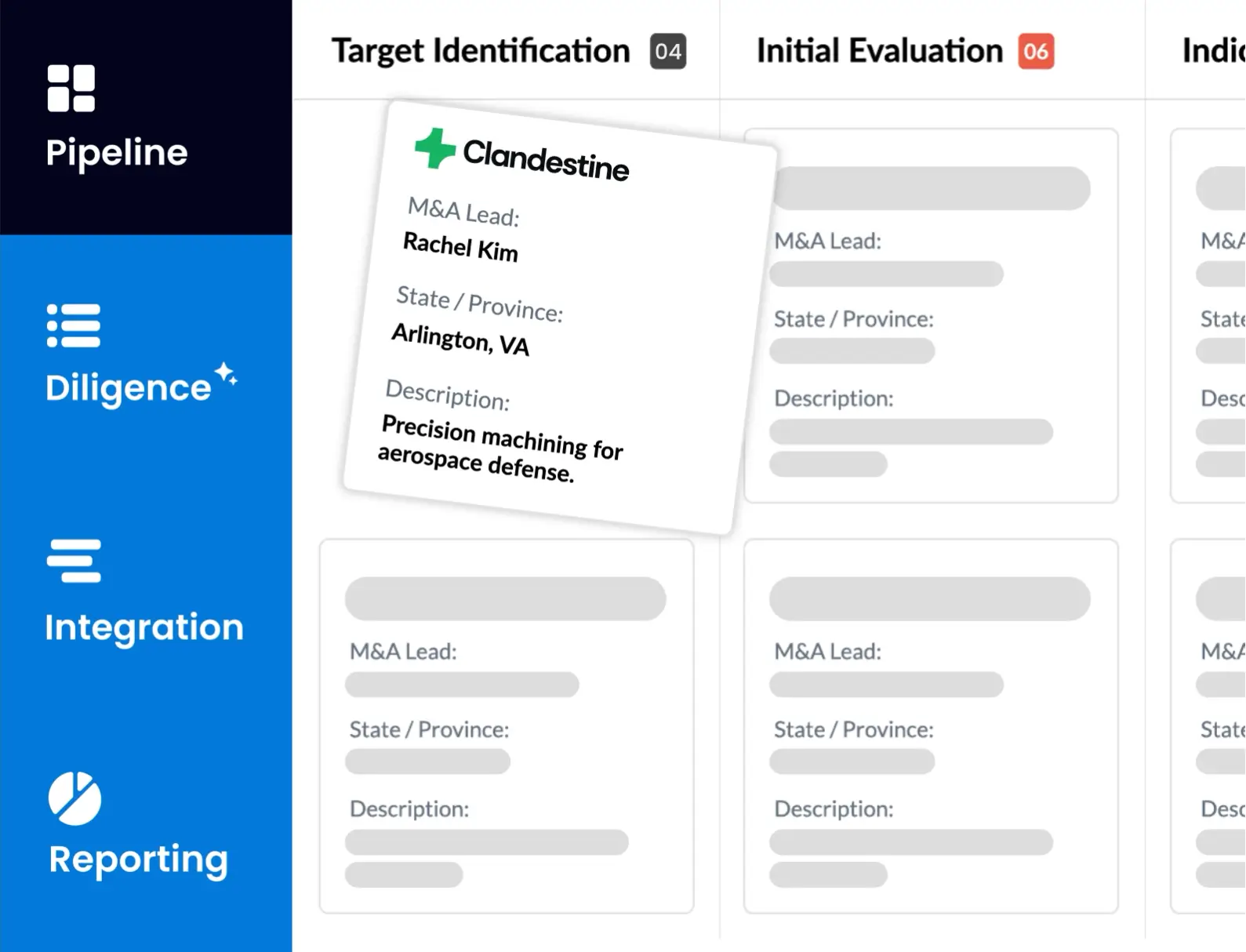
Negotiating favorable buy-side M&A fees is one thing; improving execution to really drive value is another. Advisor collaboration, transparency, and efficiency determine ROI in M&A, and that’s where DealRoom comes in.
DealRoom’s M&A Platform eliminates the disjointed, email- and spreadsheet-driven workflows of traditional M&A in favor of a single due diligence and project management platform that brings advisors, buyers, and internal teams together in one secure environment. Rather than overpaying for siloed inefficiencies, DealRoom enables acquirers to:
- Cut transaction expenses by eliminating duplicate work between advisors and internal teams.
- Complete due diligence faster with pre-built templates, automated task management, and secure file sharing.
- Track deal progress and advisor performance metrics in real time for more effective fee justification.
- Standardize workflows across multiple deals to improve consistency and reduce the need for expensive, custom-tailored advisory services.
DealRoom is ideal for companies juggling multiple transactions or looking to scale their M&A operations with repeatable, efficient workflows. Request a demo to discover how DealRoom helps buy-side teams improve M&A execution and lower costs.
Frequently Asked Questions
What is the single biggest factor that determines the total cost of a buy-side advisor?
Transaction value is the single biggest factor that determines the total cost of a buy-side advisor. Success fees are charged as a percentage of deal size and that percentage declines as the deal grows:
Firmex's 2024-25 Global M&A Fee Guide
(456advisors) puts the most common effective success fee at 4.8% on a $5 million deal, 2.7% at $50 million and 1.9% at $150 million. After deal size, the next biggest factors in what a buy-side advisor costs are deal complexity and the risk of the deal not closing, in the advisors' own ranking.
Are buy-side advisory fees negotiable?
Yes, buy-side advisory fees are negotiable. The retainer amount, whether it is credited against the success fee, the success fee percentage and its tiers, the minimum fee, expense caps and the tail period are all set in the engagement letter. In
Axial's 2026M&A Fee Guide
77% of advisors credit the upfront fee against the success fee and nearly a third charge no upfront fee at all, so there is room to push on terms. Requesting two or three proposals before signing is the most reliable way to get market rates.
How do "success fees" differ from a "contingency fee"?
In the context of buy-side M&A, they are often the same. A success fee is a type of contingency fee that’s paid only upon successful closing of the transaction. The payout is triggered by a specific event, such as the signing of a purchase agreement or the final closing and funding of the deal.
What is a "fee cap," and should I request one?
A fee cap isa maximum dollar amount on the advisor's success fee, set in the engagement letter, that applies no matter how high the final deal value goes. You should request a fee cap whenever a percentage fee would stop tracking the work involved, which in practice means most deals above $100 million. The advisor will usually ask for a higher minimum fee or retainer in return, so negotiate the fee cap and the minimum fee as a pair.
Do buy-side advisors always charge a success fee?
No. In Firmex's 2024-25 Global M&A Fee Guide, 20%of firms that mainly serve buyers charge no success fee at all, compared with4% of sell-side firms. Those buy-side advisors bill a monthly, hourly or milestone work fee instead, which removes the incentive to close at any price. Most buy-side advisors still charge a success fee. Even so, 32% of buyer-focused firms reported more client pressure to cut fees in 2024, up from11% a year earlier, so a work-fee-only structure is a reasonable ask on a long search.









.png)
.avif)

.png)

.avif)