.jpeg)









I was an M&A advisor for over ten years before starting DealRoom. In that time I worked on deals that became overly complex (or fell apart entirely) because of environmental factors that someone didn't catch until it was too late: an unknown tenant, an unclosed tank, an invalid permit. Those experiences informed my view of due diligence as a risk identification process whose goal is to unearth issues that can quietly and significantly shift a deal's price, timeline, or fundamental viability.
In fiscal year 2025 alone, EPA secured more than $6.4 billion in compliance commitments from businesses, on top of over $1.2 billion in penalties, criminal fines, and other court-ordered relief. As a buyer, that liability does not end at closing; in an asset transaction or stock transaction without clean indemnification, it can become your liability. This blog will cover how to conduct environmental due diligence as part of an M&A transaction: key steps, risks that truly impact negotiating position, how to translate findings into price and contract terms, and how to seamlessly incorporate the diligence into your overall workstream instead of making it an afterthought.
Understanding Environmental Due Diligence in M&A
Environmental due diligence is designed to uncover contamination, compliance and physical risks associated with a target's real property and operations. Environmental due diligence is one of the pillars of deal evaluation (along with financial, legal, and operational due diligence), not an ancillary item you bring in only when your target owns a factory.
This usually begins with a Phase I Environmental Site Assessment. If Phase I reveals potential concerns, proceed to Phase II and conduct sampling and/or laboratory analysis of soil, groundwater, or building materials. The extent to which you dig depends on the structure of the transaction and your appetite for risk: an asset purchase where you acquire defined pieces of real property has far less exposure than a stock purchase where you assume all of the target's liabilities.
Prior to initiating due diligence, agree with your M&A advisors on the scope of the diligence: What properties and facilities are included? How far back does the history review go? Which environmental media (soil, groundwater, air) are relevant for this purpose? Narrowly scope the diligence effort to ensure it remains manageable and can be sequenced with your overall deal timeline.
Why It Matters for the Deal
The objective is to ensure that all the information about liabilities, cleanup costs and permitting is on the table prior to closing. Only then do you have something to negotiate: a reduced purchase price, a holdback or escrow, specific indemnification language, environmental reps and warranties, or in extreme cases, walking away.
It also protects you after closing. A well-documented diligence file is what you point to if a regulator or plaintiff asks who knew what, and when.
The Legal Backdrop
In the U. S., the Comprehensive Environmental Response, Compensation and Liability Act (CERCLA), also known as “Superfund,” addresses legacy contamination, the Resource Conservation and Recovery Act (RCRA) addresses hazardous waste, and the Clean Water Act and Clean Air Act address discharges and emissions, respectively. State regulations addressing brownfields, underground storage tanks and vapor intrusion may also apply.
Two principles of liability are particularly important for deal teams to know: joint and several liability (more than one party can be liable for the entire cost of cleanup) and the bona fide prospective purchaser defense (a legal defense available to buyers who do their due diligence before buying contaminated land). Your environmental due diligence should be designed to support this defense if necessary.
Key Steps in the Environmental Due Diligence Process
Environmental due diligence is all about managing risk: every step should provide information that either prompts you to dig deeper, renegotiate deal terms, or walk away.
Preliminary Site Assessment
Ideally, as soon as you’ve identified a target property, search property records, zoning maps and environmental databases for known sites, spills and permits. Conduct a site visit if possible and look for signs of staining, dead vegetation, storage areas, tanks, or unusual odors.
Interview facility managers regarding known prior uses. Report your findings with a low/moderate/high risk rating so the deal team knows whether the timeline and price are justified to investigate further.
Phase I Environmental Site Assessment
This is your standard diligence item on any transaction involving real property. It is usually conducted in accordance with ASTM E1527 standards. Essentially, it's a review of records and history (historic aerial photos, fire insurance maps, regulatory databases, etc.) coupled with a site visit by a qualified environmental professional.
The goal is to identify Recognized Environmental Conditions (RECs). The result is a report which details any findings along with the professional's opinions and any data gaps. Data gaps and/or the presence of RECs typically result in a recommended Phase II.
Phase II Environmental Site Assessment
This phase involves hands-on investigation, such as taking samples of soil, groundwater, or building materials, to confirm or eliminate the suspected conditions identified in Phase I. Effective Phase II work begins with well-focused questions (e.g., "Do we have petroleum contamination in groundwater beneath this former tank area?") instead of sampling everything.
The lab analyses are compared to cleanup standards appropriate for the planned property use, and the report often drives negotiations on the transaction: estimated costs to remediate, required monitoring obligations, or reasons to terminate the deal.
Phase I is nearly universal on real estate-heavy transactions: the cost is inexpensive insurance relative to deal size. Phase II is justified when the potential liability is significant enough to impact pricing or structure of the deal, which on a large acquisition can still result in Phase II spend being a rounding error compared to what it covers.
Common Environmental Risks That Move Deal Terms
The vast majority of findings during M&A environmental due diligence fall into three categories.
Contaminated land. Historic underground fuel storage or spill, industrial use or spillage of other chemicals into soil or groundwater. Typical pollutants include petroleum hydrocarbons, chlorinated solvents like Trichloroethylene (TCE) and Perchloroethylene (PCE), heavy metals and polycyclic aromatic hydrocarbons (PAHs). Phase I determines the history of the property. Phase II determines concentrations compared to state cleanup standards and evaluates how close contaminants are to groundwater supplies or utilities.
Hazardous materials on site. Asbestos, lead paint, polychlorinated biphenyls (PCBs), and bulk chemicals stored on site all have special disposal requirements. Ask for manifests, storage logs and Safety Data Sheets (SDS). Omitted hazardous materials are a frequent cause of post-close surprises: abatement/disposal costs that nobody modeled.
Water and air quality concerns. Groundwater contamination, leaking tanks and stormwater discharges result in National Pollutant Discharge Elimination System (NPDES) liability and related permitting; air risk is manifested through volatile organic compounds (VOCs) emissions, dust, and operations near sensitive receptors such as schools. The diligence question for both is identical: do existing operations comply with what is actually permitted, or is there a compliance gap you are about to inherit?
Industry Considerations for Deal Teams
Each industry has its unique set of hazards, regulations, and investigative tools. Focus on site history, known contaminants, compliance, and feasible solutions for typical transactions.
Manufacturing and industrial targets are inherently the most environmentally complex transactions and should garner the most diligence effort. According to Alex Lubyansky, M&A Attorney at Acquisition Stars:
“Manufacturing facilities regularly trigger Phase I Recognized Environmental Conditions (RECs) because of the nature of the operations conducted on them. Chemical storage areas, above-ground and underground storage tanks, floor drains connected to historic disposal systems, areas where solvents or cutting fluids were used, and properties adjacent to other industrial operations are all common sources of findings.”
Focus on the production process, raw material storage areas, wastewater treatment system and air emissions. Review permits covering air (New Source Review/Title V), wastewater (NPDES), hazardous waste (RCRA) and stormwater (SWPPP) and any spill history or enforcement actions.
Look for unpermitted modifications in older facilities. Remediation costs (excavation, pump-and-treat, monitoring) can be significant enough to impact value. Be sure to consider the cost of business interruption with your cleanup costs.
“A Phase I that returns a clean report with no RECs on a manufacturing property that has operated for decades is relatively uncommon and should itself be examined carefully for completeness,” says Lubyansky. On why skipping Phase II is risky once red flags appear, Lubyansky also warns that skipping Phase II when RECs exist exposes the buyer to undisclosed contamination that can generate six- or seven-figure remediation obligations.
Operating companies that own real property. If the value of the target includes owned real property (a headquarters building, warehouse, retail space), consider that building just another environmental diligence item, even if the transaction is a straightforward operating-company purchase.
Dig into past land uses, previous tenants and building permits. Vapor intrusion, for example, can be an issue with office buildings or retail space that was previously home to industrial tenants or dry-cleaners. Environmental insurance and escrow are the usual solutions where risk remains that cannot be resolved before closing.
Cost of Environmental Due Diligence
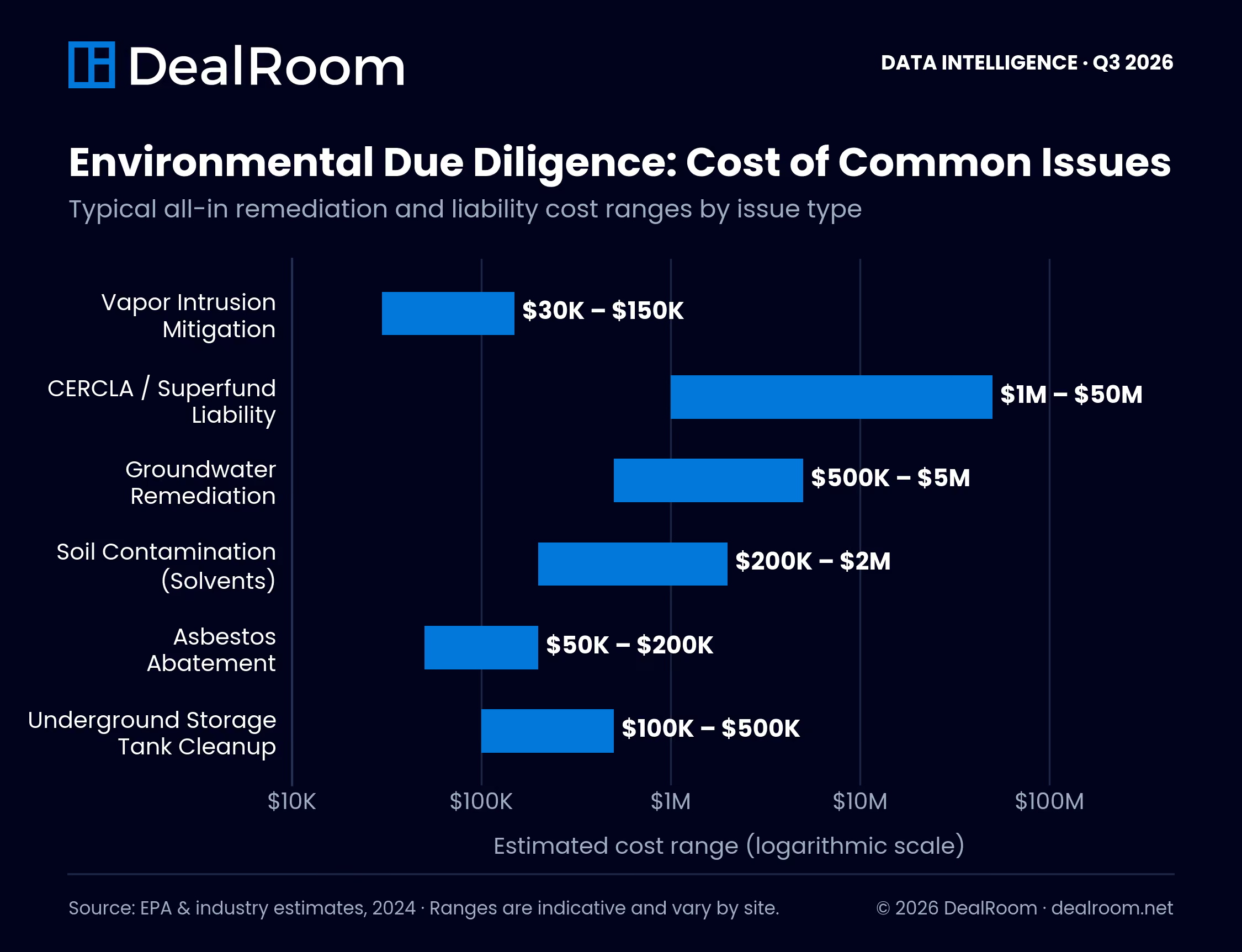
Property size, environmental history of the site (historical industrial use and known/reported RECs increase cost), number of REC's that will need Phase II evaluation and extent of remediation if required are the primary cost drivers.
A $2M bolt-on addition to your portfolio may require no more than a $5,000 Phase I; A $50M industrial platform purchase can require full environmental due diligence in the $15,000 - $100,000+ range. In either scenario, the cost of the study is minimal compared to an unknown liability after closing.
Cost Breakdown
Case Studies
Reviewing case studies can give you an idea of the business impact of environmental issues:
Case Study 1: Undisclosed Contamination in an Acquired Holding
An investor group was purchasing a portfolio company with significant value in a two-story office building appraised at $3.5M in the transaction.
During Phase I, they discovered the ground floor had operated as a dry-cleaner from 1987-2003 - not included in Recognized Environmental Conditions, no violations noted.
Because of this finding, Phase II analyzed soil and groundwater, discovering perchloroethylene (PCE) above drinking water standards of 5 ppb at 50 ppb. The buyer negotiated a $500,000 reduction in purchase price to allow for cleanup, monitoring, and environmental liability insurance. Without Phase II sampling, this cost would not have been priced into the transaction.
Case Study 2: Discovery of Underground Storage Tanks at Manufacturing Facility
A private equity firm bought a 35,000 sq ft manufacturing facility for $12M as part of its platform company build. The facility had 30 years of continuous manufacturing history and had maintained on-site fuel storage, according to the Phase I results provided by the seller.
During Phase II due diligence, two unknown underground storage tanks (USTs) were discovered underneath the building. These tanks had never been closed. One of the tanks had a historic release into the surrounding soil. Remediation was estimated at $2M: excavation/removal ($600K), soil remediation ($800K), groundwater monitoring ($400K), and regulatory ($200K).
The buyer negotiated for a $2.2M escrow funded by the seller at closing. The buyer closed with tank liability contractually off their books. The lesson here for deal teams is that long operating histories often come with undocumented equipment, and a targeted Phase II is what catches it before it becomes a post-close integration problem.
Compliance, Liabilities and Deal Terms
Phase I Environmental Site Assessments have become a standard part of nearly every commercial real estate transaction in the U.S., governed by an ASTM standard that EPA formally recognizes as satisfying "all appropriate inquiries" under the CERCLA. Grady L. Shields and Robert E. Futrell, Jr. , attorneys in the Environmental and M&A Practice Groups at Wyrick Robbins Yates & Ponton LLP, frame the stakes clearly:
“CERCLA, along with the related Resource Conservation and Recovery Act (‘RCRA’), can impose liability for environmental contamination on current owners and operators of real estate, even if the owners or operators had nothing to do with the contamination.”
Two workstreams matter most for translating what a Phase I or Phase II turns up into deal terms.
Permitting review. Obtain all permits related to air emissions, wastewater, stormwater, hazardous waste, and solid waste. Verify permit numbers, issue dates, expiration dates, permitted activities, and numeric limits. Review permitted activities against actual operations on site.
If there are activities being performed that are not permitted, the target will likely need to apply for new permits or modify existing permits after closing. This represents a financial risk (permits cost money) and a timeline risk (permits take time) that you can price into your deal.
Enforcement history. Look at 5-10 years worth of enforcement actions: notices of violation, consent decrees, penalties, anything requiring corrective action. For each item listed write down what was cited, when it was cited, what corrective action was required, and if anything is outstanding. Repeat citations or outstanding orders should set off everyone’s alarm bells before you move too far forward.
Both of these workstreams need to flow directly into your purchase agreement:
- Reps and warranties for environmental compliance.
- Indemnification with appropriate carving around known and unknown environmental issues.
- Escrow or holdback sized to remediate specific issues (like in both examples above).
Environmental liability insurance and reps and warranties insurance policies can also fill in gaps where indemnification falls short.
Reporting for the Deal Team
An effective environmental risk report is created for decision makers, not just for the file. Format it so a deal lead can understand and act upon it in minutes, and a technical reviewer can deep dive as needed.
A well-structured report gives decision-makers enough information to estimate liability and determine what to tackle first. Here's what to include.
Executive Summary
Open with a risk ranking of High, Medium, or Low for each identified risk, along with a brief explanation of why you ranked it that way. This lets a reader assess priorities at a glance before diving into the technical detail.
Sample Data Table
Present your sampling results in a table so findings can be compared directly against regulatory limits:
Maps or Basic Diagrams
Include maps or simple diagrams showing where each sample was taken and how that location relates to potential human exposure, for example, proximity to drinking water wells, occupied buildings, or areas of public access.
Uncertainty and Data Gaps
Note any uncertainty or data gaps, and assign probability and consequence scores for each identified risk. This helps decision-makers understand which findings are well-supported and which need further investigation.
Appendix
Attach supporting documentation (lab reports, chain of custody records, and field notes) in an appendix so the underlying data is available for review without cluttering the main body of the report.
Where remediation is warranted, provide estimates of costs and time, compare remediation alternatives (e.g., excavation/disposal vs. in-situ treatment), and make a recommendation (don't just provide a menu of choices with no opinion or guidance).
Selecting Qualified Environmental Professionals
Verify that the consultant has whatever certifications your state or regional government mandates. Inquire specifically about deal experience: Phase I/II performed for M&A purposes, not just "off the shelf" real estate work.
Ask for references from work performed in the last 12 months and contact them. Inquire about what technical resources they have internally (industrial hygienists, hydrogeologists, remedial engineers, etc.) vs. how much they subcontract and how they manage quality control on subcontracted work.
Clarify scope of work, deliverables, timing, data ownership and indemnification before signing. Responsiveness on a live deal is as important as technical expertise. If the consultant cannot deliver a Phase I on your timeframe, the entire transaction could be delayed.
Common Challenges
Records can be incomplete (unknown historical uses, permitting deficiencies, spotty monitoring data), meaning the risk estimation can be more judgment than science. Rules change from state to state, municipality to municipality, so you can't cookie-cutter your way through due diligence. There's always a tradeoff between being thorough and being timely. More sampling and more legal review both cost more time than you have on a competitive transaction.
Buyers, sellers, lenders, and insurers often disagree on acceptable risk and who should bear it. On its own, this can kill a deal. The usual workaround is focused Phase II scope (not widespread sampling), early involvement of outside experts, and contract language that specifically apportions responsibility; none of which removes the unknowns, but all of which makes them manageable instead of deal-breakers.
Emerging Trends in Environmental Due Diligence
Environmental diligence is evolving in M&A from being primarily checkbox compliance driven to forward-looking risk evaluation. Deloitte's 2024 ESG in M&A Trends Survey found that 57% of organizations now measure a deal's ESG impact using clearly defined, standardized metrics (up from just 39% two years earlier), and that confidence in evaluating a target's ESG profile has climbed similarly, from 74% to 91% of respondents. As Rachel Hoffman, a Deloitte Australia partner, put it:
"We are more frequently seeing ESG considerations being mainstreamed and considered alongside other strategic growth or investment levers. For example, in the context of a proposed merger between two energy companies, decarbonization strategies were analyzed and considered in the same context as synergies and other potential value drivers.”
This is elevating physical and climate-related risk to the same level of scrutiny during diligence as soil and groundwater contamination, particularly in regions like Europe and the Middle East, where greater exposure to climate-related operational impacts has pushed ESG considerations more firmly into core M&A strategy.
Advancements in remote sensing, geographic information systems (GIS), and machine learning are accelerating early screenings so teams can triage sites for follow-up investigation instead of approaching every site the same way. Environmental, Social, and Governance (ESG) factors are being folded into that same workstream: questions around operational resilience, emissions, and whether remediation can create value through carbon credits are now being considered along with the standard question of whether the site is contaminated.
Standardized risk scoring protocols also allow for easier comparison of risk across sites and defense of those assessments to investors and lenders, which is critical as deals face increased scrutiny from both.
Frequently Asked Questions
Why does environmental due diligence matter in M&A specifically?
Because liability does not work the way many buyers think it does. As of the end of FY 2025, EPA reports 870 active Superfund cleanup sites under enforcement agreements and orders valued at approximately $25 billion, an average of roughly $29 million per site. A proper Phase I/Phase II process, done before signing, is what lets you price that kind of liability into the deal or avoid it entirely.
How long does a Phase I take? Can it be completed during a typical diligence period?
Typically 2-4 weeks for most properties. This will fit within a normal M&A diligence schedule if you order it early. Don't wait until the end of the process. If there are issues discovered in the Phase I that require a Phase II, you are looking at an additional 4-8 weeks.
What’s the difference between a Phase I and a Phase II Environmental Site Assessment?
A Phase I Environmental Site Assessment is mostly paperwork (records review, site walk, interviews) to detect Recognized Environmental Conditions. Phase I is used as a tool for buyers to decide whether additional testing is necessary.
Phase II is hands-on (soil, groundwater, sometimes building materials) to confirm or rule out Recognized Environmental Conditions detected in Phase I.
You need Phase II when suspected contamination is present, regulatory interest is high, or data gaps exist which could impact the transaction.
Can environmental due diligence eliminate buyer liability?
No, but it does two important things: it provides evidence for your legal defenses (such as the bona fide prospective purchaser defense) and it arms you with information to negotiate price reductions, escrow, or indemnification for what is found. Diligence shifts and redistributes risk; it does not completely eliminate risk.
What does a typical checklist include for assessing environmental risks during a transaction?
An environmental diligence checklist for a deal should include:
- Property and ownership history
- Regulatory permits, violations and enforcement history
- Site conditions and any obvious signs of contamination
- Interviews with facility operators and neighbors
- Triggers delineating when results indicate the need for further (Phase II) sampling
Download our free Environmental Due Diligence Checklist.
What are common examples of Recognized Environmental Conditions (RECs), and how are they identified?
Common RECs include known releases from underground tanks, past uses like dry cleaning, visible staining on the ground surface, and chemical smells. RECs are detected by researching records, regulatory databases, old maps, and by walking the site during Phase I (which is why it’s a potentially catastrophic mistake to skip the site visit).
Other RECs include undocumented dumping of wastes, nearby sites which could spread contamination, and possibly non-compliant stormwater or air practices. Be sure to document the source, dates, and potential receptors.
What information should be included in the environmental due diligence report, and what structure will it take?
Start with a summary in bullet points on the scope, the main findings, and the next steps. Then, the scope, the site information, the methodology, and the sources will be presented. Next, the findings will be presented in a logical sequence. These will include the results of the regulatory search, the historical use, the site inspection, and the RECs. Finally, the risk ranking and the recommendations will be presented.
How should these results be reflected in the purchase agreement?
Environmental representations and warranties, indemnification provisions limited to known and unknown liabilities, and price adjustments or escrow established for identified liabilities (as was done in both case studies discussed in this article). Ensure your environmental consultant's findings are on the same negotiating table as your legal and financial due diligence, not locked away in a report that no one will read until after closing.
Download Our Free Environmental Due Diligence Checklist
Environmental risk is one of the few areas of diligence that can come back to haunt a deal team late in the game, not because someone is withholding information, but because it's so easy to scope insufficiently and be surprised by what a Phase I uncovers. The teams who succeed aren't necessarily the ones who spend the most money; they're the ones who plan environmental review into the deal timeline from day one, understand when a Phase II is or isn't worth the money, and turn findings into contractual language vs. a report that collects dust.
Heading into diligence on a target with real property or industrial operations? Don't start your work from scratch. Our free Environmental Due Diligence Checklist guides you through what to check at every stage, from prescreening through Phase I and Phase II triggers, so your team can work quickly and confidently without overlooking those costly details.









.png)

.avif)

.avif)
.avif)
.avif)
.avif)