.jpeg)









Business email compromise accounted for $3.05 billion in losses across 24,768 complaints to the FBI’s Internet Crime Complaint Center in 2025. Its signature attack: a fraudulent “revised wire instructions” email slipped into an otherwise bona fide closing thread. Its target document is the flow of funds. You know that one page in an M&A deal? The one with every bank account number, every payee and every dollar transferred or retained.
I’ve advised on transactions for over ten years in M&A, first at my boutique advisory practice and then building DealRoom in 2012. In our annual State of Buy-Side M&A report we learned that 59% of buy-side practitioners describe current buyer sentiment as optimistic. As a result, more teams will be heading to closing tables this year than last. The funds flow is where that optimism is turned into wires, and it’s the least documented step in the process. Here’s what it includes, who is responsible for it, when it locks and where it can fail. Download our flow of funds template to see this structure in action.
What is a flow of funds in M&A?
A flow of funds is the final statement produced at an M&A closing that accounts for every payment, where did it come from, where did it go, how much was it, and to what wires. It’s also known as a funds flow memorandum, funds flow statement or simply the funds flow. By definition (from language found in actual purchase agreements), it’s a document that details “the sources and uses and flow of funds, including proceeds of the Purchase Price and the payment of transaction costs and expenses.”
There are two things that define a flow of funds. First, it is executable, not analytical: each line should ultimately resolve to something a bank can do. Second, it must balance, with total sources equal to total uses to the dollar. A discrepancy indicates an unassigned dollar, which at closing means a payment that nobody is responsible for.
One common source of confusion to address: “Fund flow statement” also refers to an accounting statement describing changes to working capital from one balance sheet date to another. This isn't the same as a flow of funds at closing.
Flow of funds vs sources and uses
Deal teams need both documents, and they are not interchangeable. Sources and uses is a modeling schedule created during diligence and financing. It answers at a summary level if the deal funds. The funds of flow is the closing instrument. It answers which account gets what amount on what day.
Auxo Capital Advisors gives the cleanest illustration: A model “may show a $20.0 million debt payoff as one use. The funds flow identifies each lender, accrued interest, breakage cost, wire amount, payoff letter, and account.” What was one line in the model becomes a row per lender in the funds flow, complete with counterparty and payoff letter behind it.
Who prepares the flow of funds and when is it finalized?
Buyer's counsel usually prepares the first draft and all parties review and approve. The University of Houston Law Center has a sample private M&A closing checklist which includes "prepare funds flow memorandum" as a before-closing buyer's item. Bill Snow agrees in Mergers & Acquisitions for Dummies: Buyers typically prepare the document, and the seller and its advisors confirm prior to closing.
Three business days is the recurring contractual floor seen in real purchase agreements. One of Law Insider's various funds flow definitions states that the payment schedule needs to be delivered “not less than three (3) Business Days prior to the Closing, specifying the precise amount due to, and complete wire instructions for, each Person.” Usually a first draft will circulate approximately one week prior and the final version fixes you to three business days before closing.
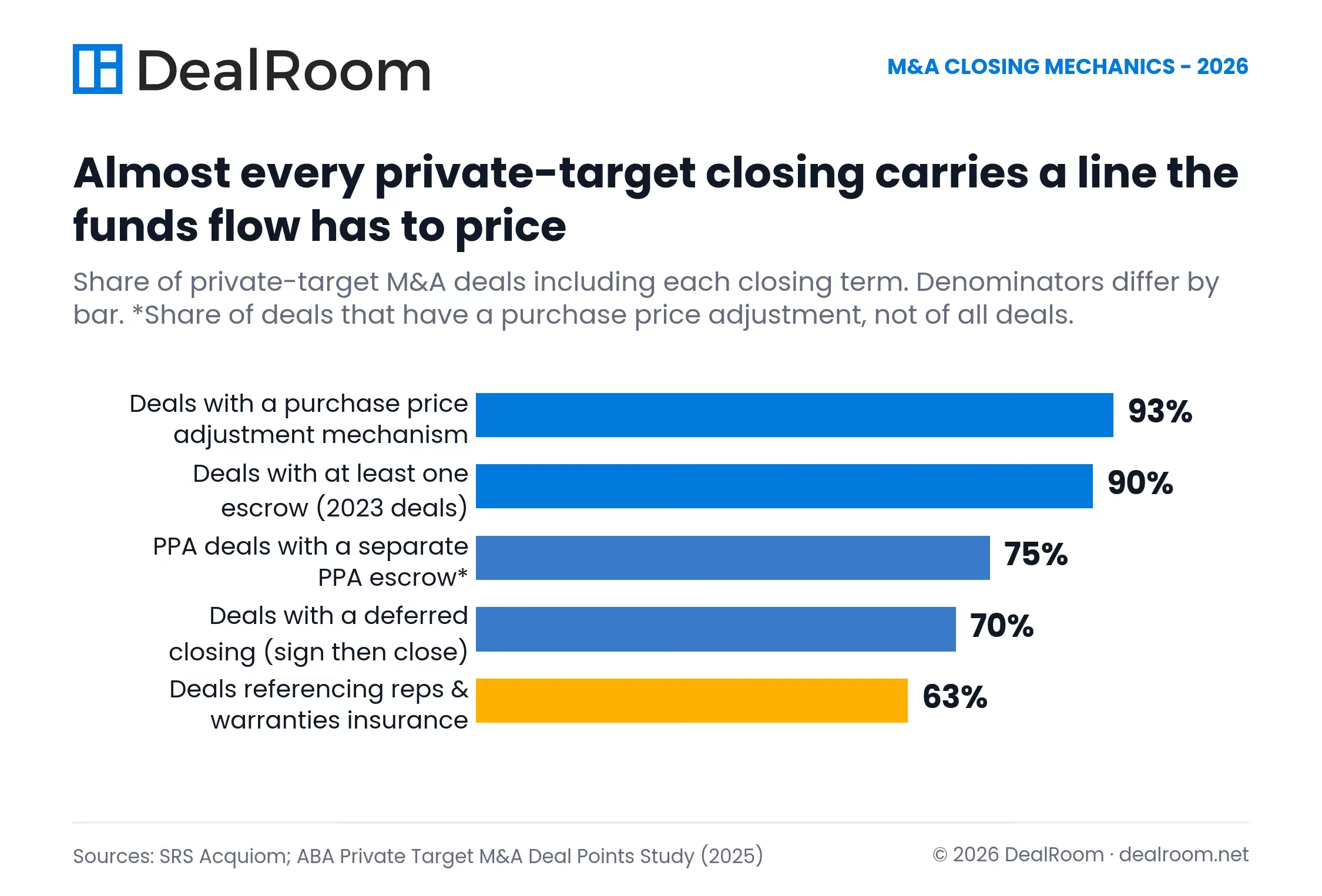
Funds flow is captured in a separate document that usually comes later because deals rarely close on signing. According to the ABA’s 2025 Private Target M&A Deal Points Study, 70% of the 139 agreements surveyed contained a deferred closing. That gap between signing and closing is when payoff letters are requested, escrow accounts are opened and wire instructions are confirmed.
What goes on a flow of funds statement?
Sources. Buyer or sponsor equity, senior debt drawn at close, mezzanine or preferred capital, seller rollover equity, seller notes and target cash, if applicable and legal to use to fund the transaction. Rollover equity is interesting to highlight: It shows up as an offsetting figure on both sides and no cash needs to wire.
Uses. The uses side is longer and it is where the disputes live.
Gross purchase price. The headline number before any adjustments. Everything below this will either reduce the price or redirect it elsewhere.
Working capital adjustment. The seller provides an estimate at closing (this is the number you will see on the funds flow) and the buyer will provide a “true-up” statement anywhere from 30 - 120 days after closing. Womble Bond Dickinson has a great article on how net working capital is normalized during M&A due diligence. For purposes of our conversation, assume the closing number is an estimate: SRS Acquiom reports that 93% of deals have a purchase price adjustment mechanism, and 89% of those deals made an actual adjustment.
Debt payoff. One line per lender, including all accrued interest, per diem, breakage cost and the governing payoff letter. Never an aggregated number.
Transaction expenses. Legal fees, advisory and success fees, quality of earnings, insurance and paying agent fees. Regarding the latter, SRS Acquiom’s pool of more than 2,900 transactions shows that from Q1 through Q3 2024 the buyer paid the paying agent fee 63% of the time, seller 25% of the time and the parties split it 8% of the time.
Escrow and holdback. SRS Acquiom’s latest published frequency report covering deals from 2023 showed 90% had at least one escrow, and more than half had two or more with a typical duration of between 12 and 18 months.
Employee option cashouts and management payments. See below. Routing can vary widely here.
Net wire per payee. The terminal column: amount, receiving bank, ABA or SWIFT code, account number and reference.
How representations and warranties insurance rewrote the escrow line
One data point that highlights the modern funds flow better than any other: Based on deal terms data from SRS Acquiom, the median size of the general indemnification escrow was 10% of transaction value on 2024 deals done without representations and warranties insurance, compared to just 0.35% on deals done with R&W insurance. Reporting on the same firm’s study of working capital metrics, Fasken notes that 75% of 2024 agreements with a purchase price adjustment included a separate PPA escrow, which was set at a median of approximately 1% of transaction value.
Buyers and sellers should now assume insurance will be used. The ABA’s 2025 survey found references to representations and warranties insurance in 63% of agreements, an increase from 55% in the previous study. The impact on funds flow is a premium paid at closing and a much smaller escrow line.
Employee options, 280G and the payments that route through payroll
Two line items catch teams out.
Option/equity payouts are divided by tax character, not by individual. SRS Acquiom’s preface to tax reporting and payments to employees outlines this principle: compensatory amounts (ex. vested options exercised at closing) are considered W-2 income taxed through the surviving corporation or a payroll admin that withhold taxes, while investment-character payments (e.g., purchased shares) are processed by the paying agent on a 1099-B without payroll withholding. This is why you typically see one lump wire from multiple optionholders to the company’s payroll account instead of dozens of individual wires from each optionholder.
Section 280G must be cleared prior to funds flow locks. See Baker Tilly's golden parachute FAQ for details, but here are the highlights: If payments to disqualified individuals exceed three times a predetermined base amount (typically the five year average of W-2 or 1099 compensation), then the disqualified individual is hit with a 20% excise tax and the company loses its deduction.
Private companies can mitigate this problem by holding a shareholder vote with approval by more than 75% of the voting power (excluding the individuals receiving the golden parachute payments). Because that vote must occur before closing, the 280G analysis must be completed before the payment schedule is finalized. Always confirm these mechanics with your tax counsel. The exception fails at exactly 75%.
Wire fraud and the funds flow
The funds flow document contains exactly what a business email compromise attacker seeks. Attackers compromise a real mailbox or spoof a lookalike domain, read the entire thread to monitor when the topic is hottest and reply-to chain is longest, then time their "revised instructions" message for when people are responding from mobile devices.
Payoff letters represent the largest dollar value target of a single fraud. According to CertifID’s 2026 State of Wire Fraud report, mortgage payoff frauds had the highest median loss at $389,125 surpassing both buyer cash-to-close and seller net proceeds. The FBI’s IC3 2025 report lists 12,368 real estate fraud complaints valued at $275.1 million. One closing involved compromised instructions to wire more than $1.3 million.
The party that eats the loss is not determined by the deal's terms. The American Bar Association's summary of attorney liability for wire fraud applies the impostor rule of UCC sections 3-404 and 3-406: The loss is allocated to the party best positioned to prevent the fraud. A party who received conflicting wire instructions and failed to confirm by phone has been deemed negligent.
Three simple controls will do most of the heavy lifting:
- Confirm each set of instructions by calling back a number independently obtained from the email.
- Make sure that two people approve any transfer exceeding a predefined amount.
- Identify a single person who has received confirmation of any change, and distribute that person's name along with the initial draft.
Fedwire timing and why Friday closings are exposed
Wires don’t move 24-7. The Fedwire Funds Service is available Monday through Friday, except on Federal Reserve holidays, with a cut off time for customer initiated transfers of 6:45 p.m. ET and a close of 7:00 p.m. ET. The Federal Reserve is working on expanding Fedwire hours to 22 hours a day, six days a week, for implementation in 2028 or 2029. Until then, this limitation will be in place for the foreseeable future.
This means that a Friday cut-off allows zero time for recovery. If a wire is sent to an incorrect account at 4:00 p.m. on Friday, the recall doesn't start until Monday. Plan closings mid-week when possible under the purchase agreement and initiate funds movement early in the day, well before the cutoff time.
Build the funds flow before you need it
Working capital estimates, payoff letters, escrow instructions, 280G clearance and wire verification all flow into one document on one day. Each was somebody else’s workstream until that point. Teams that build a skeleton funds flow at signing discover the gaps when there's still time to bridge them.
Our flow of funds template includes the sources and uses structure, the payee schedule and formulas for payouts and fee distribution, so creating the closing version is a fill-in exercise, rather than something that needs to be built from scratch. Our financial due diligence checklist includes the working capital and quality of earnings inputs that feed into it, and our buy-side M&A process guide explains where closing fits in the larger picture.
Frequently asked questions
Who prepares the flow of funds for an M&A deal?
Buyer’s counsel usually prepares it, and all parties sign off prior to closing. The buyer is the designated owner on typical private M&A closing checklists.
When is the flow of funds finalized?
Purchase agreements typically require delivery at least three business days prior to closing. The first draft will generally be circulated one week out. The final version will be locked one to three business days prior to the closing date.
What’s the difference between a flow of funds and a sources and uses table?
Sources and uses is a consolidation of all financing arrangements used to determine if there are enough funds for a deal to close. The flow of funds is a comprehensive document that lists each payee, amount and wiring instructions. One line item in sources and uses could be broken out into multiple lines in the funds flow.
Does the flow of funds have to balance?
Yes. Total sources must equal total uses, dollar for dollar. Otherwise, a dollar is left without a payee, preventing the deal from closing.
How is the working capital adjustment represented on the flow of funds?
The working capital figure used on the closing funds flow is the seller's estimate. The final calculation is received 30 to 120 days after closing and is settled separately, typically from a dedicated PPA escrow.
How do you prevent wire fraud at closing?
Confirm all wire instructions via call-back to a phone number you have independently verified. (Never use a phone number listed in an email.) Use dual authorization for large transfers, and consider any change of instructions mid-process suspicious until confirmed by voice.









.png)

.avif)

.avif)
.avif)
.avif)
.avif)