








Deal value from strategic acquirers rose 38% in 2025 as global M&A rebounded to $4.8 trillion, the second-highest total on record, according to Bain & Company. Corporate acquirers led that rebound, which means the corporate development team you build is the engine behind your company’s inorganic growth. The stakes on that hire are high. PwC’s 2025 Global CEO Survey found that 42% of CEOs believe their company will not be viable beyond the next decade if it stays on its current path, a reinvention gap we track in our State of M&A report. Closing it usually runs through the acquisitions, partnerships and divestitures your corp dev team has to source and execute.
I have spent over a decade in M&A, first as an advisor on distressed deals, then building DealRoom in 2012 and interviewing more than 400 practitioners on the M&A Science podcast about how they hire and structure corporate development teams. The pattern is consistent: the strongest corp dev people are not the fastest modelers, they are the ones who can carry a deal through a skeptical organization. The questions below are built to surface that.
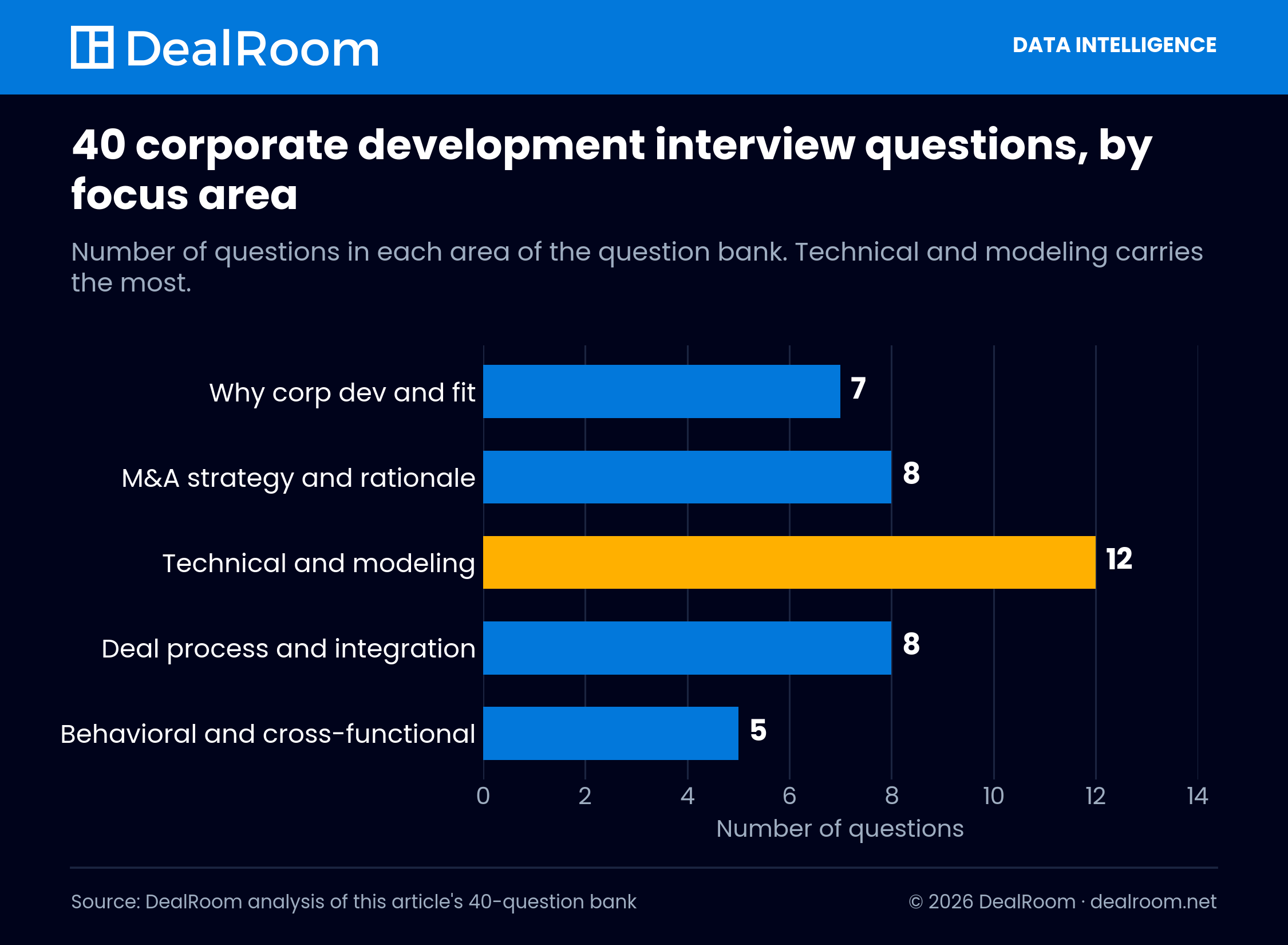
Corporate development interviews differ from private equity interviews in one important way. You are not just hiring someone who can value a company, you are hiring someone who can win internal buy-in, manage diligence across departments and think about a deal as the start of an integration rather than the end of a transaction. Use the five areas below (motivation and fit, M&A strategy, technical modeling, deal process and behavioral and cross-functional questions) as a bank of interview questions, not a script. Each question includes why it matters, what a strong answer looks like and a source.
What a corporate development role covers
Corporate development teams own a company’s inorganic growth: acquisitions, divestitures, joint ventures, minority investments and strategic partnerships. Day to day, that means building and maintaining a target pipeline, valuing companies and modeling transactions, coordinating due diligence across finance, legal, HR and operations, preparing board materials and often handing off to (or running) integration after close. Unlike bankers or private equity investors, corp dev professionals work for a single company and answer to its executives, so every deal has to fit a long-term strategy the team will still be living with years later.
The weight of each corporate development skill shifts with seniority. Analysts and associates spend most of their time on modeling, research and diligence support, so technical questions should carry more of the interview. Managers and directors run processes and own target relationships, which makes deal process and stakeholder questions more revealing. At the VP level and above, the job is mostly strategy, executive persuasion and team leadership. Pick from the sections below with that balance in mind rather than asking every candidate the same set.
Why corporate development and fit questions
These questions test whether a candidate wants corporate development specifically or is simply looking for a way out of banking hours. The answers reveal whether the person understands the long-term, one-company nature of the role.
1. Why corporate development rather than private equity or banking? The single best fit question. Look for a candidate who wants to stay with one company and grow its business year after year, rather than switching between clients or chasing carry. A strong answer shows they understand corporate development is about building an owner’s business over time, not chasing carry across a series of funds. Source: Mergers & Inquisitions.
2. What is the biggest difference in challenges between corporate development and investment banking? This separates candidates who understand the job from those who assume it is banking with better hours. The best answer names internal buy-in: in corp dev the hard part is not connecting a buyer and seller, it is getting every department to agree, since some are naturally averse to deals. Source: Mergers & Inquisitions.
3. Walk me through your background and what drew you to this industry. Every interview opens here. Look for a coherent story that lands logically at your company and shows genuine interest in your sector, not a recital of past roles. Source: Indeed.
4. Do you see yourself in corporate development five years from now? Corp dev rewards people who stay and build institutional knowledge. Look for real commitment to the function and your company, rather than someone using the seat as a short stop. Source: Indeed.
5. Why our company specifically? This question tests preparation. Look for a candidate who understands your growth strategy, your recent deals and where acquisitions could fill gaps. Someone who cannot connect your strategy to a deal thesis has not done the work. Source: Mergers & Inquisitions.
6. What mindset does a successful corporate development professional need? Reveals self-awareness. Look for strategic thinking, patience and the diplomacy to move a deal through a matrixed organization, not just analytical horsepower. Source: Indeed.
7. How do you work with stakeholders who are skeptical of a deal? Corp dev lives or dies on cross-functional influence. Look for a concrete example of bringing a reluctant function, such as finance, legal or a business unit, onto a deal by addressing their real concerns rather than overriding them. Source: Mergers & Inquisitions.
M&A strategy and deal rationale questions
This is where you learn whether a candidate can think like a strategist, not just a modeler. Corp dev exists to grow the company, so the reasoning behind a deal matters as much as the math.
8. Why would a company acquire another company? A foundational strategy question. Strong answers go beyond “growth” to specific rationales: cost and revenue synergies, entering a new geography or market, acquiring talent or intellectual property, diversifying revenue and vertical or horizontal integration. Source: Wall Street Prep.
9. How would you decide between building, buying or partnering to enter a new market? Tests strategic judgment, the core of corp dev. Look for a candidate who weighs speed, cost, capability gaps and risk and who does not reflexively reach for an acquisition when a partnership or organic build would serve better. Source: Corporate Finance Institute.
10. What are synergies and which are more reliable, cost or revenue? A must-ask. Look for the candidate to define both, then argue that cost synergies are more credible because they are concrete and actionable, while revenue synergies depend on customer behavior and take years to materialize with uncertain results. Source: Wall Street Prep.
11. How is a joint venture or partnership different from an acquisition? Corp dev teams run partnerships, not just buyouts. Look for a candidate who explains that a JV involves less due diligence but more deal analysis, since you are not acquiring a company and that the governance and economics of a JV can be far more complicated to structure. Source: Mergers & Inquisitions.
12. How would you build and prioritize an acquisition pipeline for us? Sourcing is central to corp dev. Look for a repeatable approach: define the strategic criteria, map the market, rank targets by fit and feasibility and keep relationships warm before a process starts rather than reacting to bankers’ pitches. Source: Mergers & Inquisitions.
13. Pitch an acquisition our company should make. The strategist’s test. Look for a clear thesis: which target, what capability or market it adds, how it boosts your metrics over time and the key risks. The specific name matters less than a real value-creation argument. Source: Mergers & Inquisitions.
14. Who is likely to pay more for a target, a strategic buyer or a financial buyer? Tests understanding of your own advantage. Strong answers explain that strategic buyers can usually pay more because they capture synergies a financial buyer cannot, though platform-backed sponsors pursuing add-ons increasingly close that gap. Source: Wall Street Prep.
15. What most often makes a deal fail to create value? Reveals whether the candidate thinks past signing. Look for integration failure, overpaying on optimistic synergy assumptions and cultural mismatch, rather than a purely financial answer. Source: Wall Street Prep.
Technical and modeling questions
Corp dev candidates value companies and model transactions, so technical range matters. As Mergers & Inquisitions notes, anything from a DCF to a full LBO is fair game.
16. Walk me through a merger model. The core technical screen. Look for a clean framework: calculate offer value, set the consideration mix, make assumptions on financing and synergies, run purchase accounting, then combine the two companies to reach pro forma EPS and an accretion or dilution conclusion. Source: Wall Street Prep.
17. What is accretion/dilution analysis and what does it actually tell you? Tests whether the candidate understands the headline metric. A deal is accretive when pro forma EPS exceeds the acquirer’s standalone EPS and dilutive when it falls below. Look for the nuance that accretion alone does not prove value was created and many strategically sound deals are dilutive at first. Source: Wall Street Prep.
18. What is the rule of thumb for whether an all-stock deal is accretive or dilutive? A fast test of intuition. Look for the P/E comparison: if the acquirer’s P/E is higher than the target’s, an all-stock deal is generally accretive and if it is lower, the deal is dilutive because the shares issued outweigh the earnings acquired. Source: Wall Street Prep.
19. Is it better to finance a deal with cash, debt or stock? Tests financing judgment. Look for a candidate who reasons from both sides: the buyer weighs cost of capital, credit capacity and relative P/E, while sellers usually prefer cash unless they want tax deferral or upside in the combined entity. Source: Wall Street Prep.
20. What is goodwill and how is it created in a deal? A purchase-accounting check. Look for the candidate to explain goodwill as the premium paid above the fair value of the target’s net identifiable assets, that it is not amortized and that it can be written down through impairment if the acquirer overpaid. Source: Wall Street Prep.
21. What is purchase price allocation? Tests deal-accounting depth. Look for an explanation that PPA assigns fair value to the acquired assets and assumed liabilities after close, writes assets up to fair value, creates the associated deferred taxes and books the remaining excess as goodwill. Source: Wall Street Prep.
22. What is a control premium and why is it paid? Look for the candidate to define it as the excess over the target’s unaffected share price, measured before deal rumors and to explain it is necessary to persuade shareholders to sell and reflects the value of control. Source: Wall Street Prep.
23. What are the main ways to value a company? A fundamentals check. Look for the three standard approaches, comparable companies, precedent transactions and a discounted cash flow, plus a sentence on when each is most useful in an M&A context. Source: Corporate Finance Institute.
24. Walk me through a discounted cash flow. Confirms modeling fundamentals. Look for projecting unlevered free cash flow, discounting it at the weighted average cost of capital, adding a terminal value and bridging from enterprise to equity value. Source: Corporate Finance Institute.
25. Contrast an asset sale, a stock sale and a 338(h)(10) election. A deal-structuring test that matters for corporate acquirers. Look for the trade-offs: an asset sale gives the buyer a step-up and better tax treatment but risks double taxation for the seller, a stock sale is simpler and taxed once for the seller and a 338(h)(10) lets both sides treat a stock sale as an asset sale for tax purposes. Source: Wall Street Prep.
26. If we issue $100 million of debt to buy $50 million of equipment, walk me through the statements. Tests whether the candidate can trace a transaction cleanly. Look for the balance-sheet mechanics at close (cash and debt up, then equipment up and cash down) and the year-one flow-through of interest expense and depreciation, each creating a tax shield. Source: Wall Street Prep.
27. How would you value the synergies in a proposed acquisition? Corp dev often owns the synergy case that justifies the premium. Look for a candidate who separates cost from revenue synergies, phases them realistically over time, discounts them and stress-tests the assumptions rather than plugging in a round number to make a deal work. Source: Wall Street Prep.
Deal process, diligence and integration questions
Corporate development owns the deal end to end, so these questions test whether the candidate can run a process, not just build a model.
28. Walk me through the M&A deal process from first contact to close. Tests process command. Look for a clear arc: strategy and sourcing, initial outreach and valuation, a letter of intent, due diligence, negotiation and signing, then close and integration. A candidate who jumps straight to modeling has missed the job. Source: DealRoom.
29. What are the three common sale process structures? Tests market fluency. Look for the broad auction (maximize competition), the targeted auction (a short list of strategic-fit buyers) and the negotiated sale (a single preferred partner, with more certainty and confidentiality). Source: Wall Street Prep.
30. What goes into due diligence and what matters most? Corp dev coordinates diligence across the company. Look for coverage of financial, legal, commercial and operational diligence and a point of view that the most important findings are the ones that change the price or kill the deal, not a checklist for its own sake. Source: DealRoom.
31. What belongs in the board deck or approval memo for a proposed deal? Tests whether the candidate can package a recommendation for decision-makers. Look for the strategic rationale, valuation and returns, synergy case, key risks and diligence findings, integration plan and a clear recommendation, not just a model output. Source: Wall Street Prep.
32. How would you approach post-merger integration? The part of the deal where value is won or lost. Look for a candidate who plans integration during diligence, sets clear ownership and synergy targets and protects the parts of the target that made it worth buying. Source: DealRoom.
33. A deal we announced last year in this space struggled. Would you have done it and why? Tests independent judgment on real deals. Look for a candidate who has followed your industry closely enough to have a view and who can argue whether the acquirer should have done the deal rather than repeating the press release. Source: Mergers & Inquisitions.
34. How would you keep a target relationship warm before a formal process begins? Proprietary sourcing is a corp dev advantage. Look for relationship discipline: staying in contact with priority targets, understanding their goals and being the first call when they consider a sale, rather than waiting for a banker-run auction. Source: Corporate Finance Institute.
35. How do you think about compensation and structure for a corporate development team? A useful question for senior candidates and a check on market awareness. Corp dev associates typically earn $120,000 to $160,000 in total compensation, with directors around $300,000 to $400,000 in major markets, per Mergers & Inquisitions. Figures run lower at smaller companies and outside financial hubs. Look for realistic expectations tied to your company’s size. Source: Mergers & Inquisitions.
Behavioral and cross-functional questions
Corporate development is a relationship job inside your own company. These questions test the soft skills that decide whether a technically strong candidate will actually get deals done.
36. Tell me about the most successful deal or project you worked on. Look for a candidate who quantifies the impact, explains their specific contribution and draws a lesson, rather than claiming credit for the whole team’s work. Source: Indeed.
37. Tell me about a deal or project that failed and what you learned. Reveals accountability. Look for ownership of the part they controlled and a concrete change in approach afterward, not a blameless story or a disguised humblebrag. Source: Indeed.
38. Describe a time you used problem-solving to resolve a conflict. Corp dev is full of competing internal interests. Look for a structured answer, ideally using the situation, action and result method, that shows the candidate can defuse tension and reach a workable outcome. Source: Indeed.
39. How would your colleagues describe you? A simple culture-fit check. Look for collaborative traits backed by specific examples, since corp dev people spend most of their time persuading colleagues rather than working alone. Source: Indeed.
40. How would you present a deal recommendation to executives who disagree with you? The defining corp dev skill. Look for a candidate who leads with the strategic case, meets objections with evidence and can hold a position under pressure while staying open to being wrong. Source: Mergers & Inquisitions.
Hiring for the whole deal
The best corporate development hires can value a company, but what sets them apart is the ability to carry a deal from first conversation through integration while keeping a skeptical organization on board. Use these questions to test the full range: why they want the role, how they think about strategy, whether their technical work holds up and how they handle the people side of a deal. A candidate who treats signing as the finish line will struggle in a role where most of the value is won or lost after close.
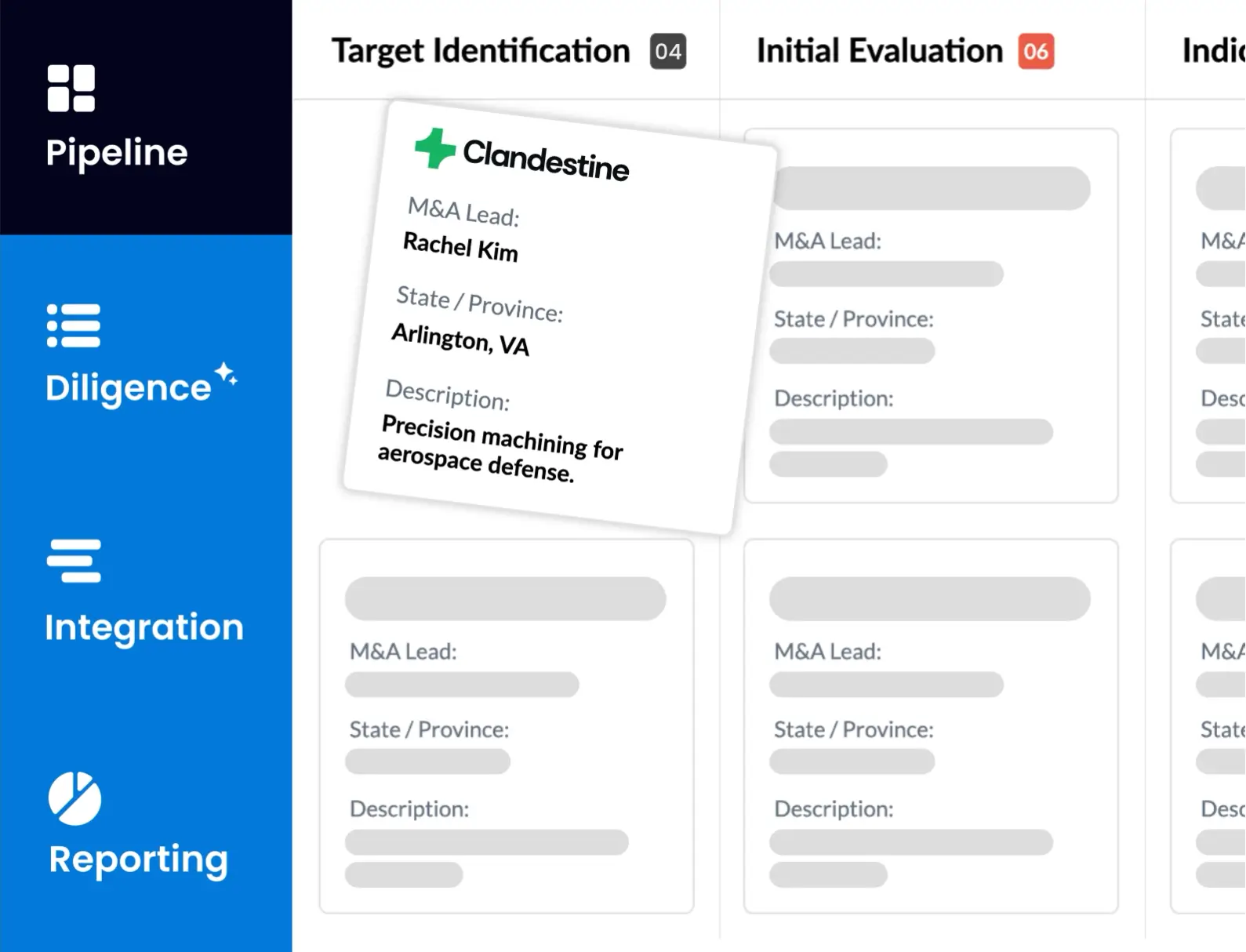
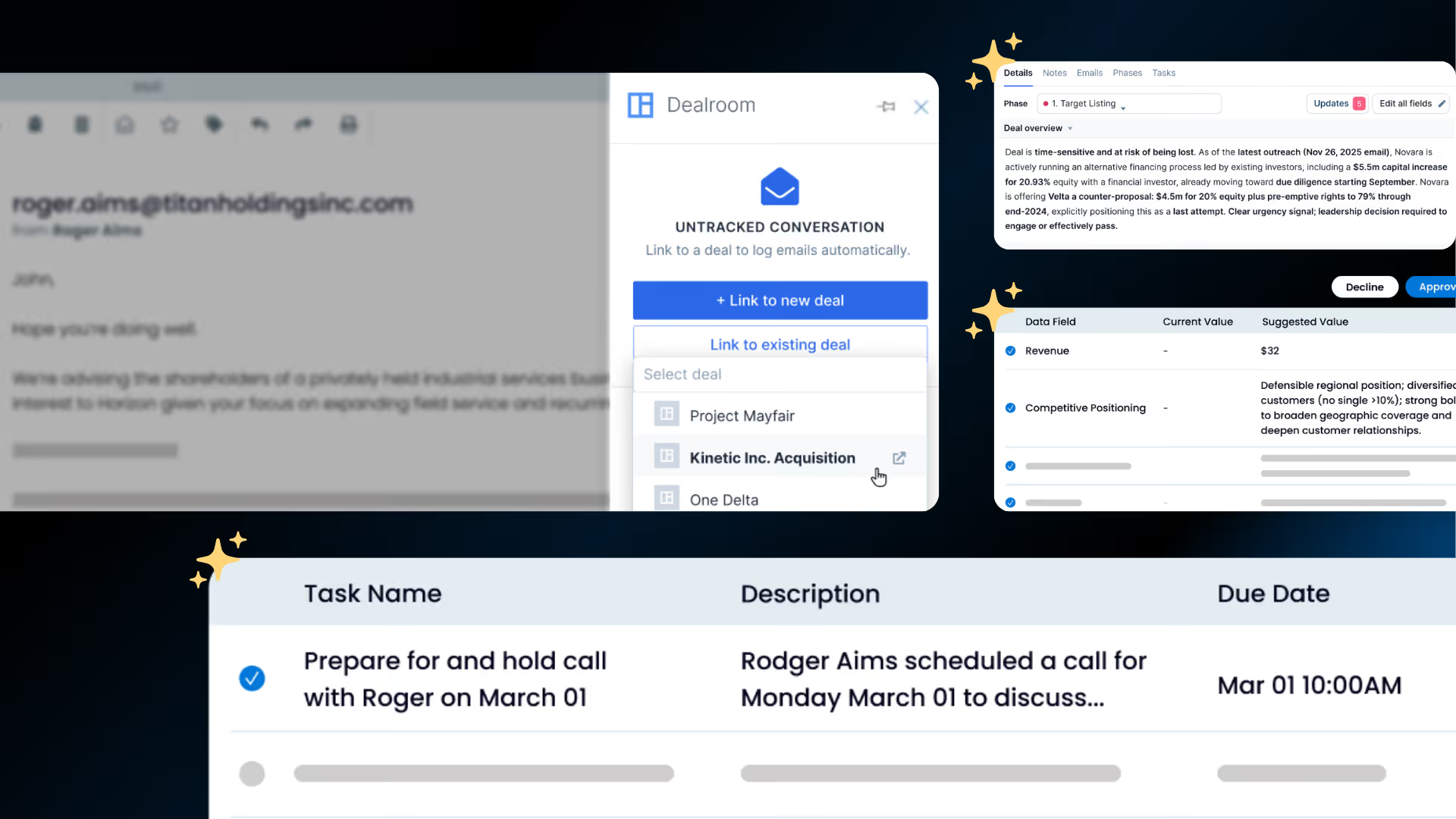
A strong hire also needs a strong process behind them. Many corp dev teams still run deals through Excel trackers, shared drives and email chains, which leaves even great people chasing status updates instead of driving decisions. DealRoom’s M&A platform for corporate development teams brings pipeline management, due diligence and post-merger integration into one workspace, so your new hire can manage targets, coordinate diligence across departments and track synergies from a single place. Take a platform tour to see how it fits your team.
Frequently asked questions
How is a corporate development interview different from a private equity interview?
Both test valuation and modeling, but corporate development leans harder on strategy, cross-functional influence and integration. You are hiring someone to grow one company from the inside, so buy-in and process skills weigh as heavily as technical range.
What is the most important corporate development interview question?
“How is the challenge here different from banking?” is the fastest tell. A candidate who names internal buy-in understands that the hard part of corp dev is organizational, not analytical.
How technical should a corporate development candidate be?
Fluent enough to build a merger model, a DCF and to reason through accretion and dilution and purchase accounting. Because corp dev values companies and structures deals, even LBO mechanics can come up, though strategic judgment matters more day to day.
Should I give a case study?
Yes, for most roles. A short target-evaluation case, either on-site in 30 to 60 minutes or as a take-home, shows whether a candidate can reach a clear recommendation and defend it. Judge the logic and the argument more than model polish.
How do I test for integration thinking?
Ask how a candidate would plan integration during diligence and what they would protect in the target after close. Candidates who treat signing as the finish line rather than the starting line will show it here.