.jpeg)
DealRoom for Private Equity
One hub for M&A across your portfolio
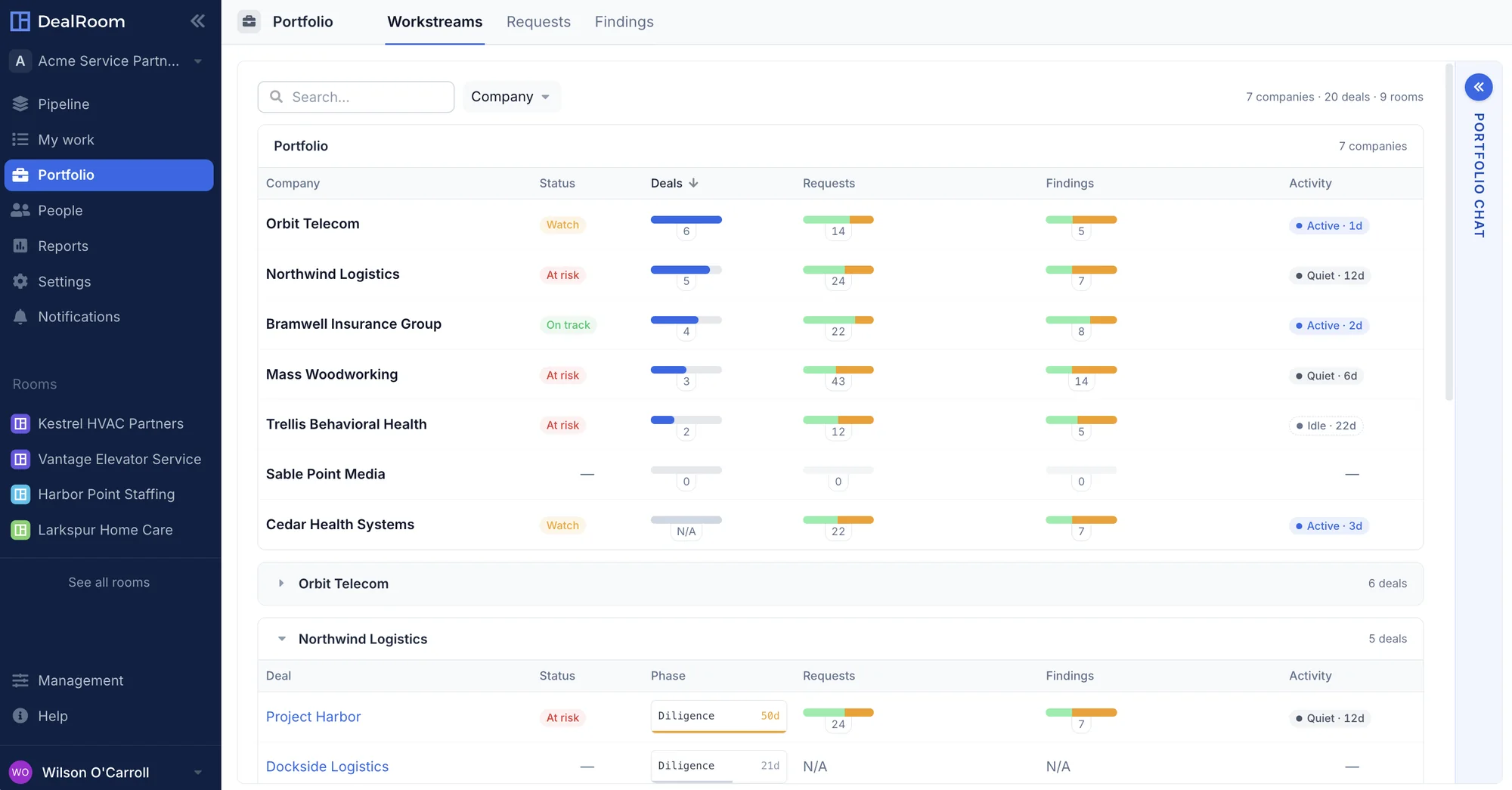

See every deal across the portfolio

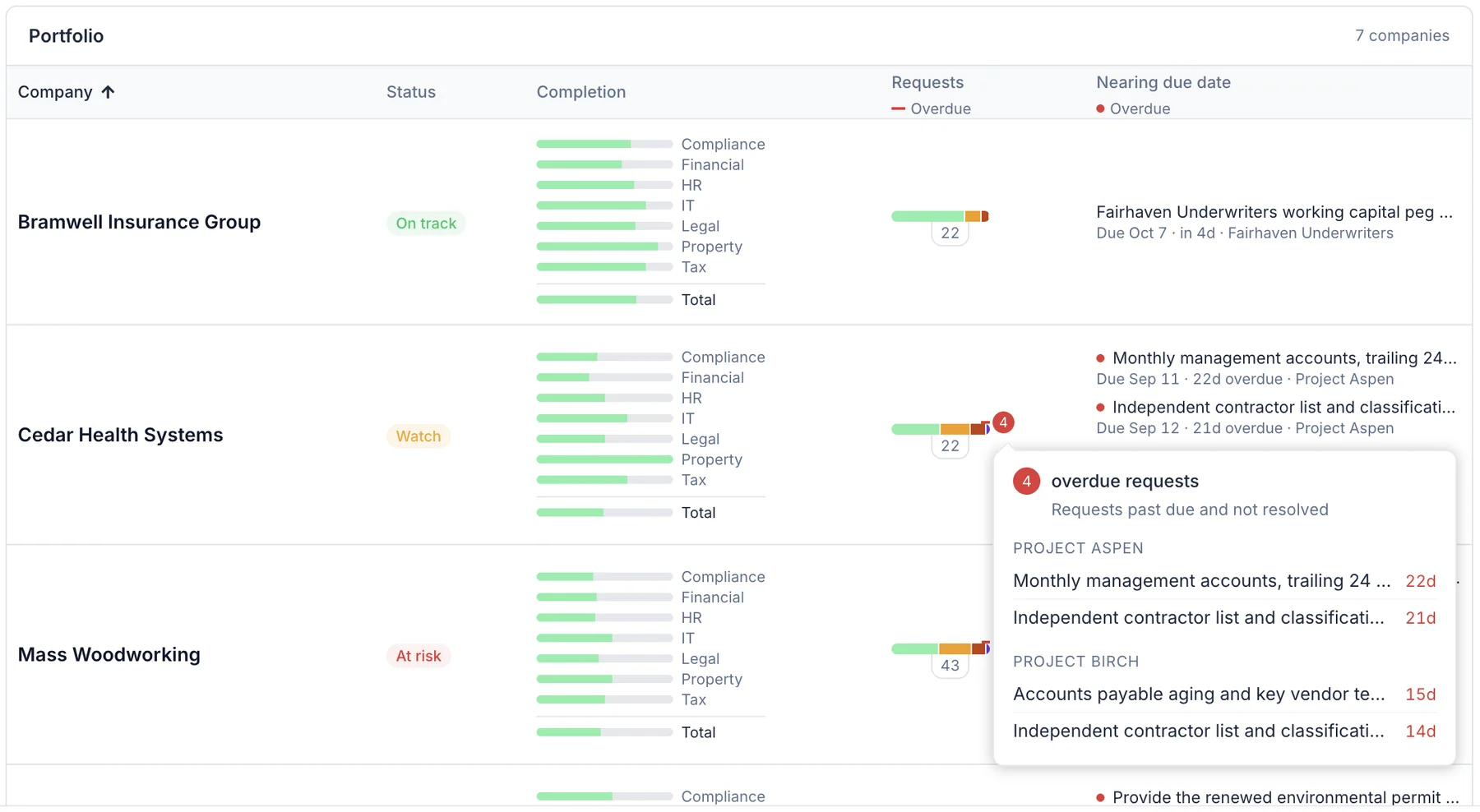
Drill into what needs attention

Run more deals with the same team
Trusted by 350+ private equity and corporate development customers









One M&A operating system across your portfolio
Standardize how portfolio companies run deals, see progress and risk in real time, and step in where sponsor attention is needed.
Chase teams for deal updates
Piece together status across calls, emails and spreadsheets.
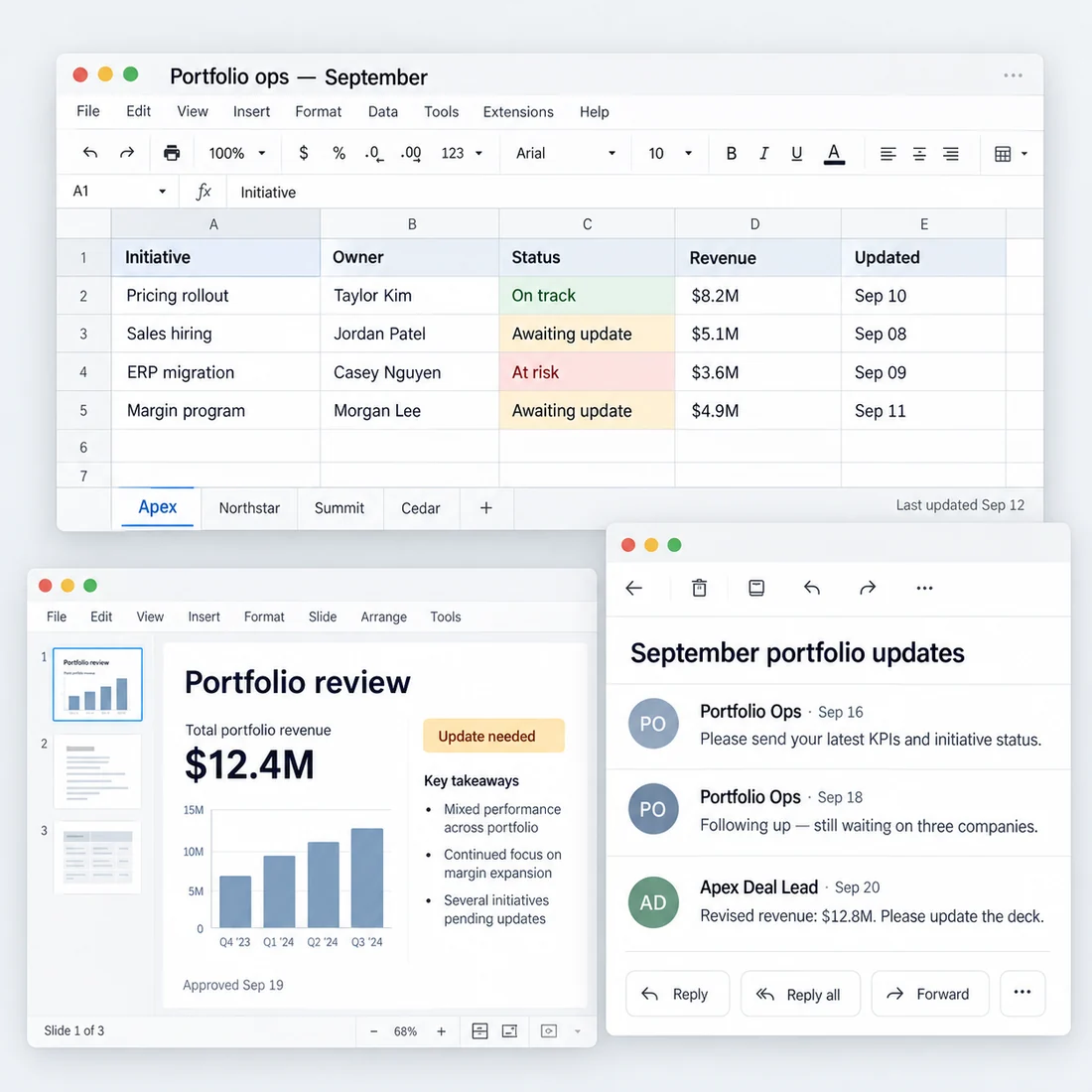
See every deal in one live view
Track deal progress, diligence and open risks across every portfolio company.
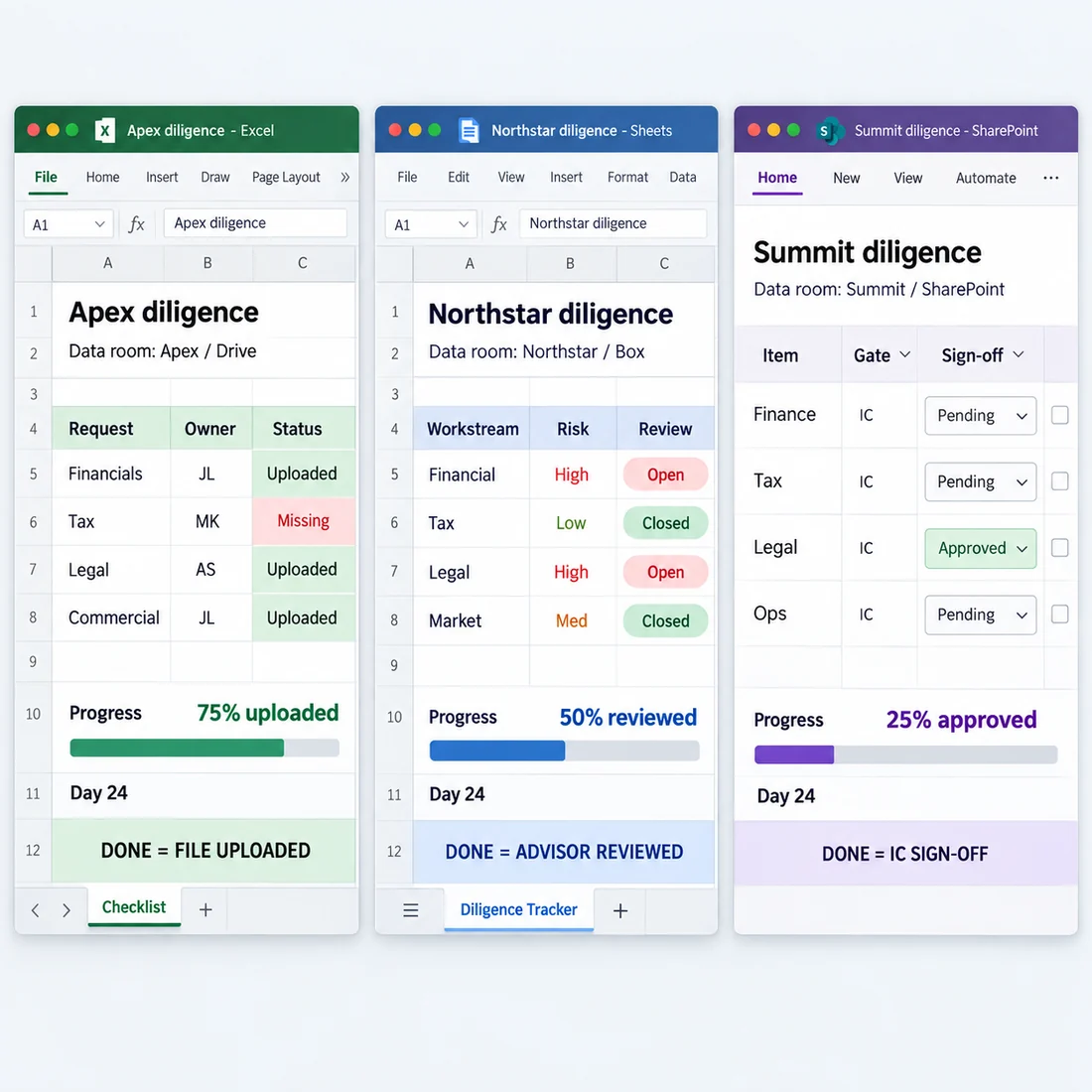
Rebuild the process for every deal
Each company starts with different workflows, trackers and expectations.
See every deal in one live view
Track deal progress, diligence and open risks across every portfolio company.
Work starts over for integration
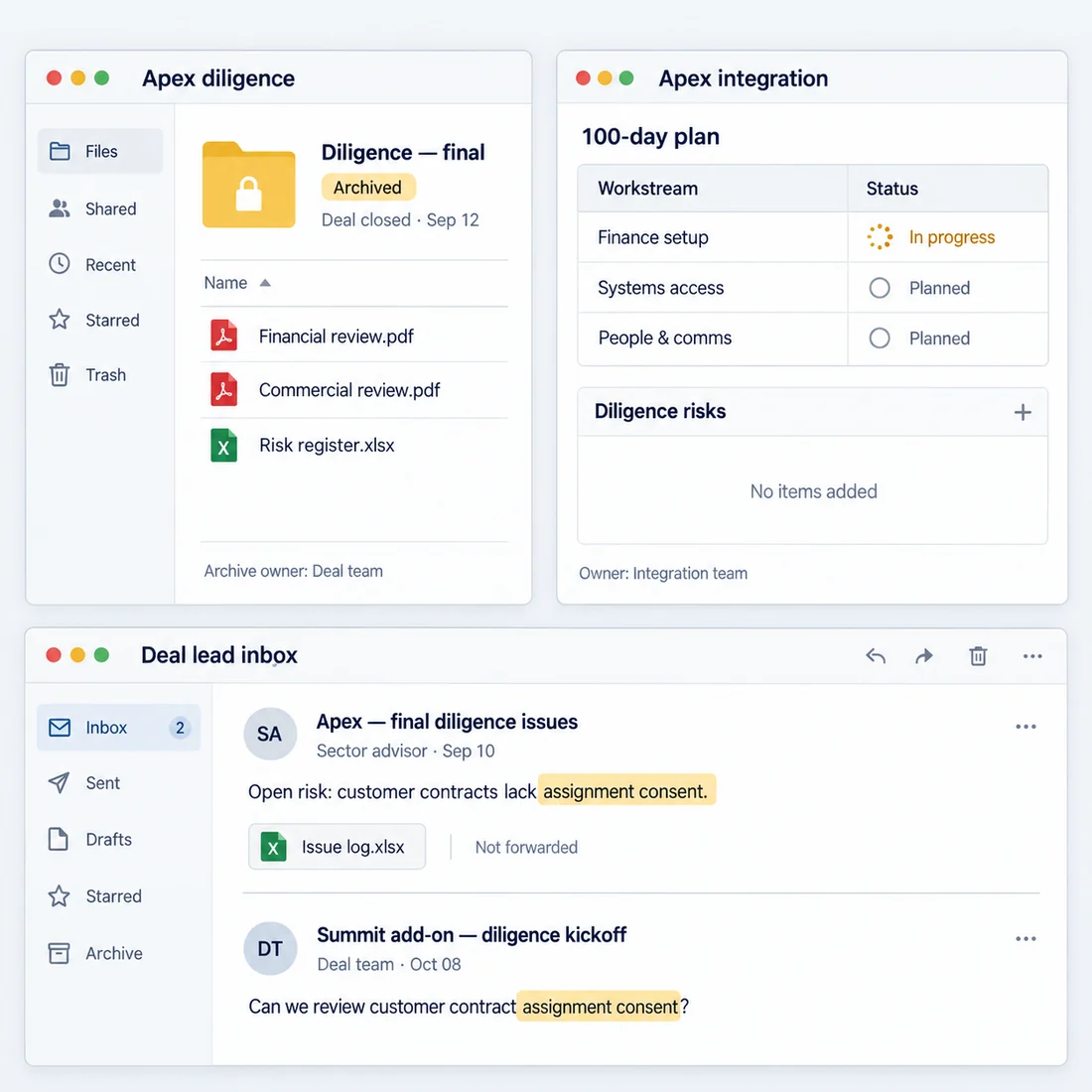
Risks uncovered in diligence get handed off manually or forgotten.
Turn findings into post-close action
Carry risks, owners and supporting context directly into integration.
Work starts over for integration
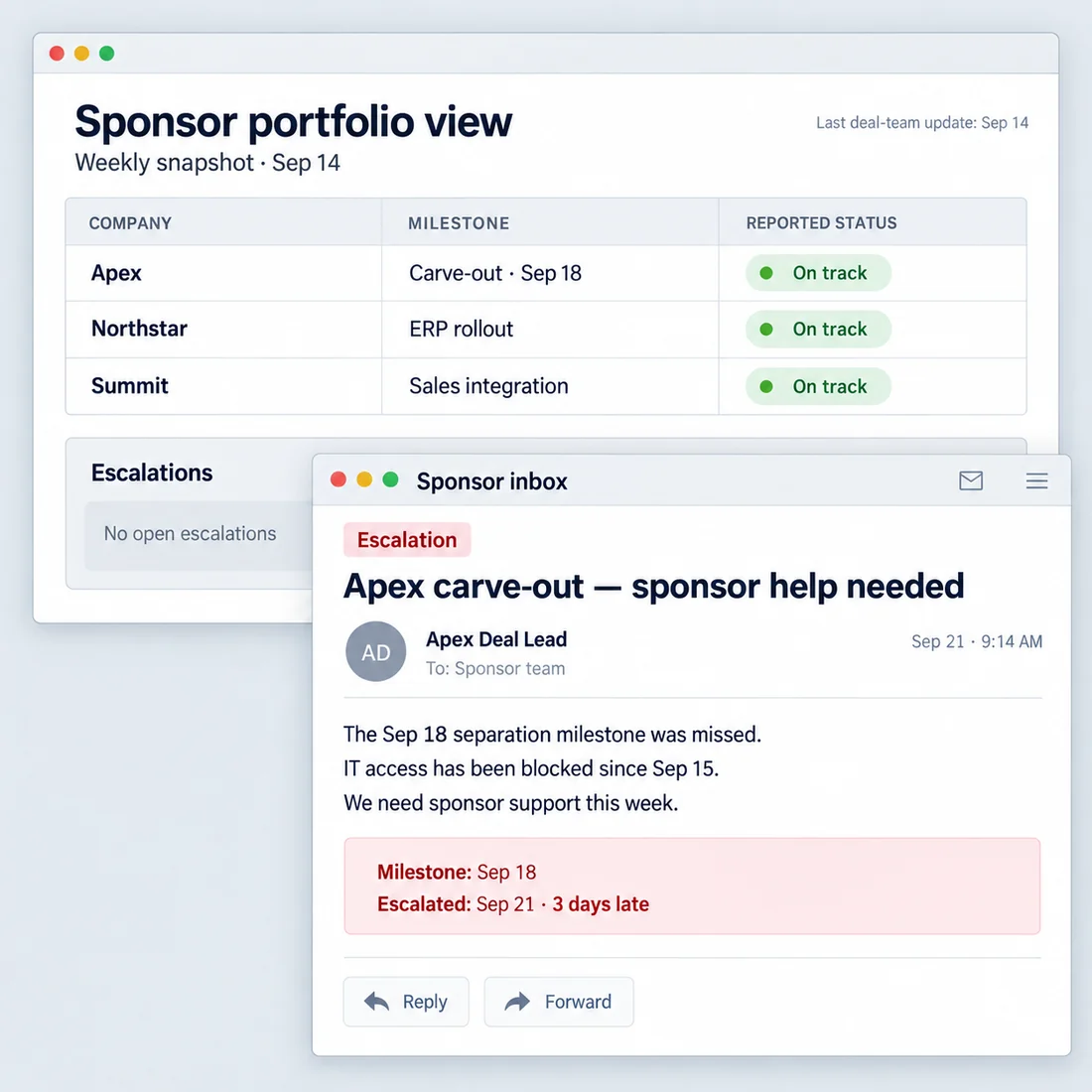
Sponsor attention comes only after a deal or workstream is already off track.
See what needs attention now
Surface stalled work, overdue requests and unresolved risks across the portfolio.
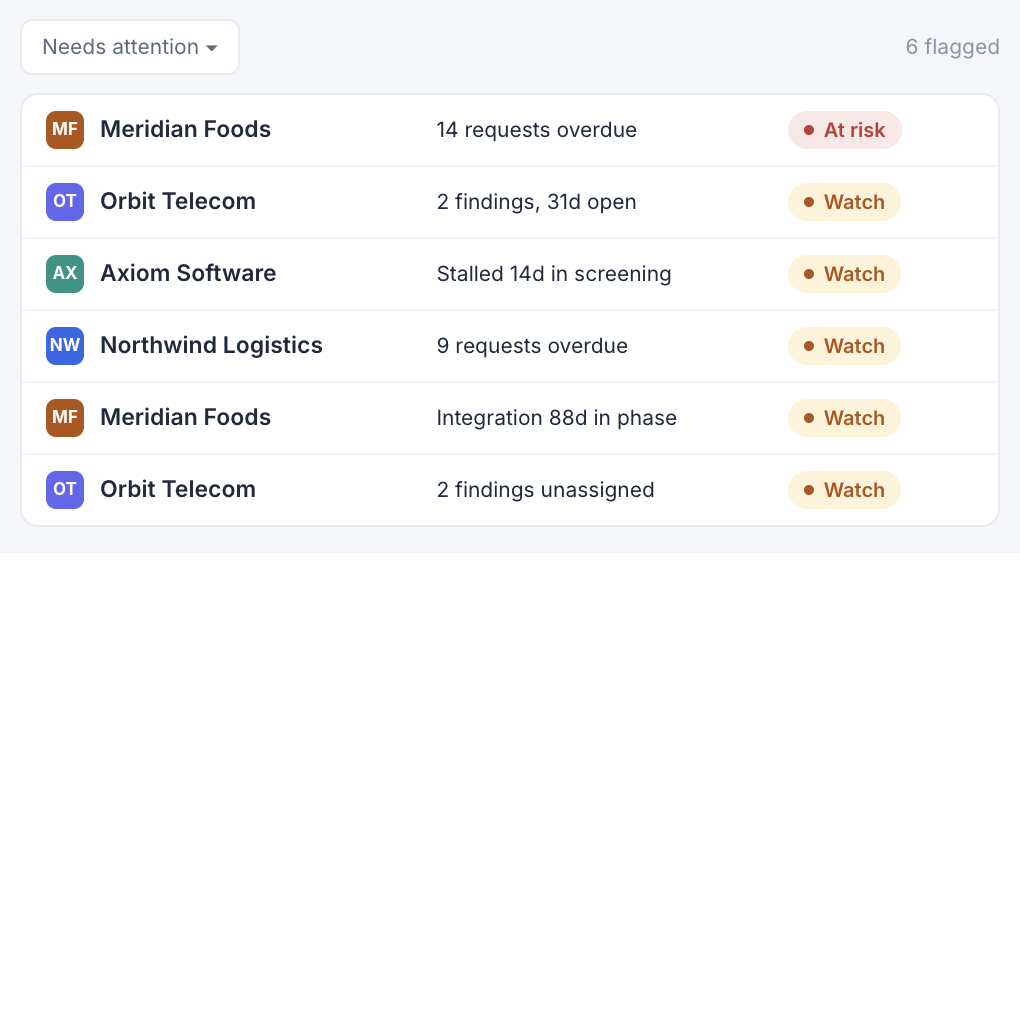
Top-line metrics across the portfolio, full detail inside any company
The portfolio view and the company view are the same data at two altitudes. Click a company for its rooms, phases and owners. One more click and you are in the deal itself.
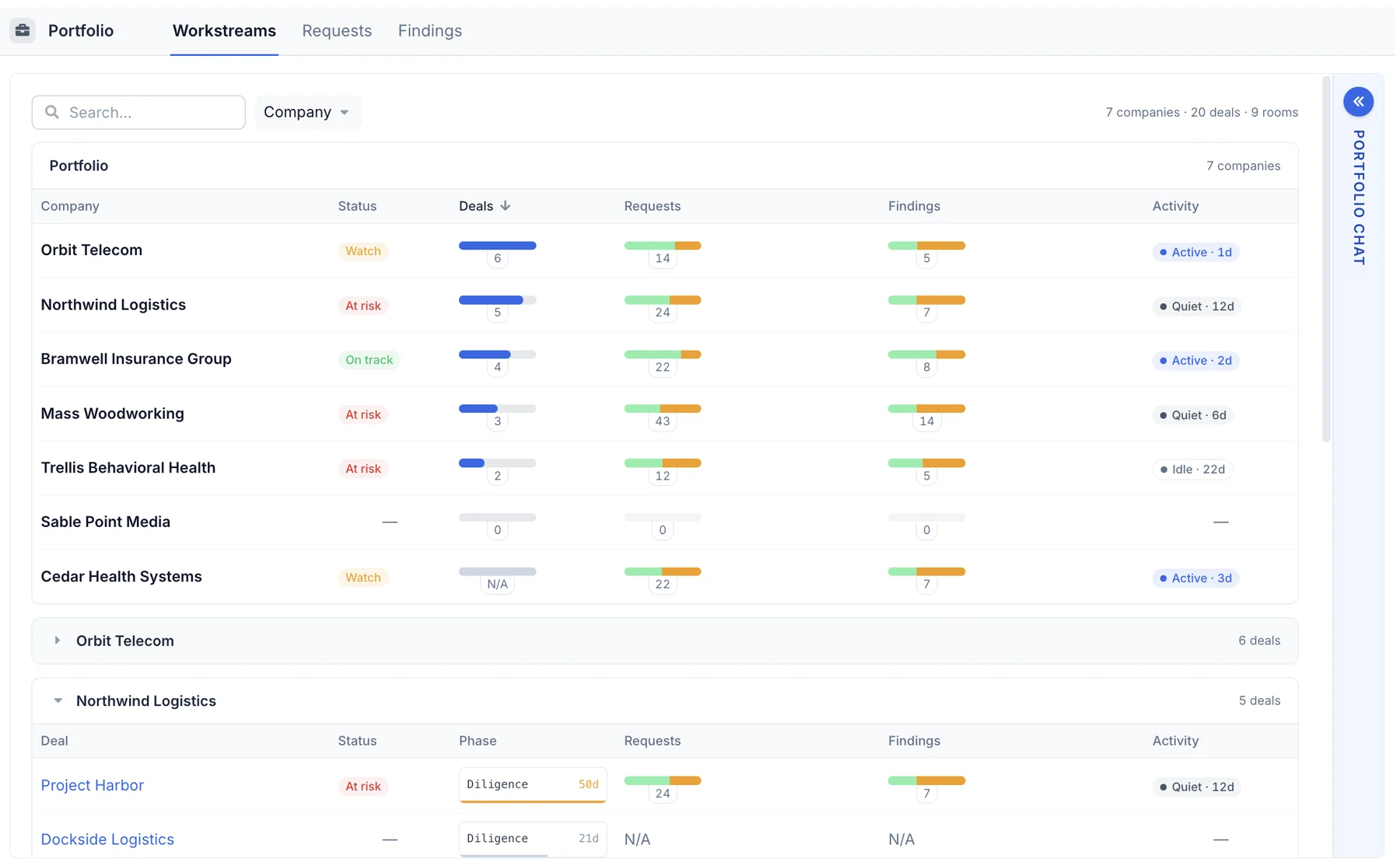
Every deal in a portfolio company, in one place
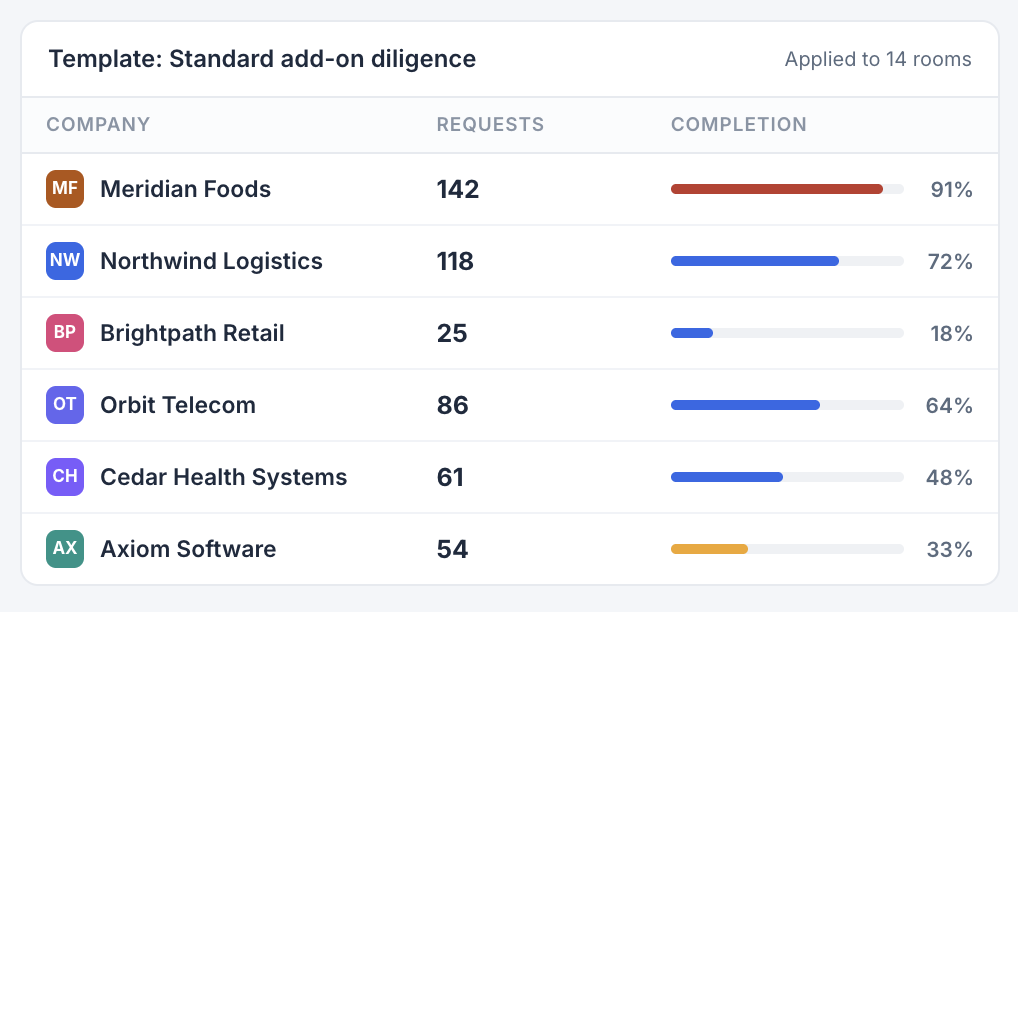
Add-ons, carve-outs, tuck-ins and the integrations that follow them sit under the company they belong to, each with its phase, request load, findings and last activity.
- Deal phase and days in phase, straight from the pipeline
- Request and finding counts that reconcile to the portfolio row above
- Deals with no diligence room yet still show up in the list
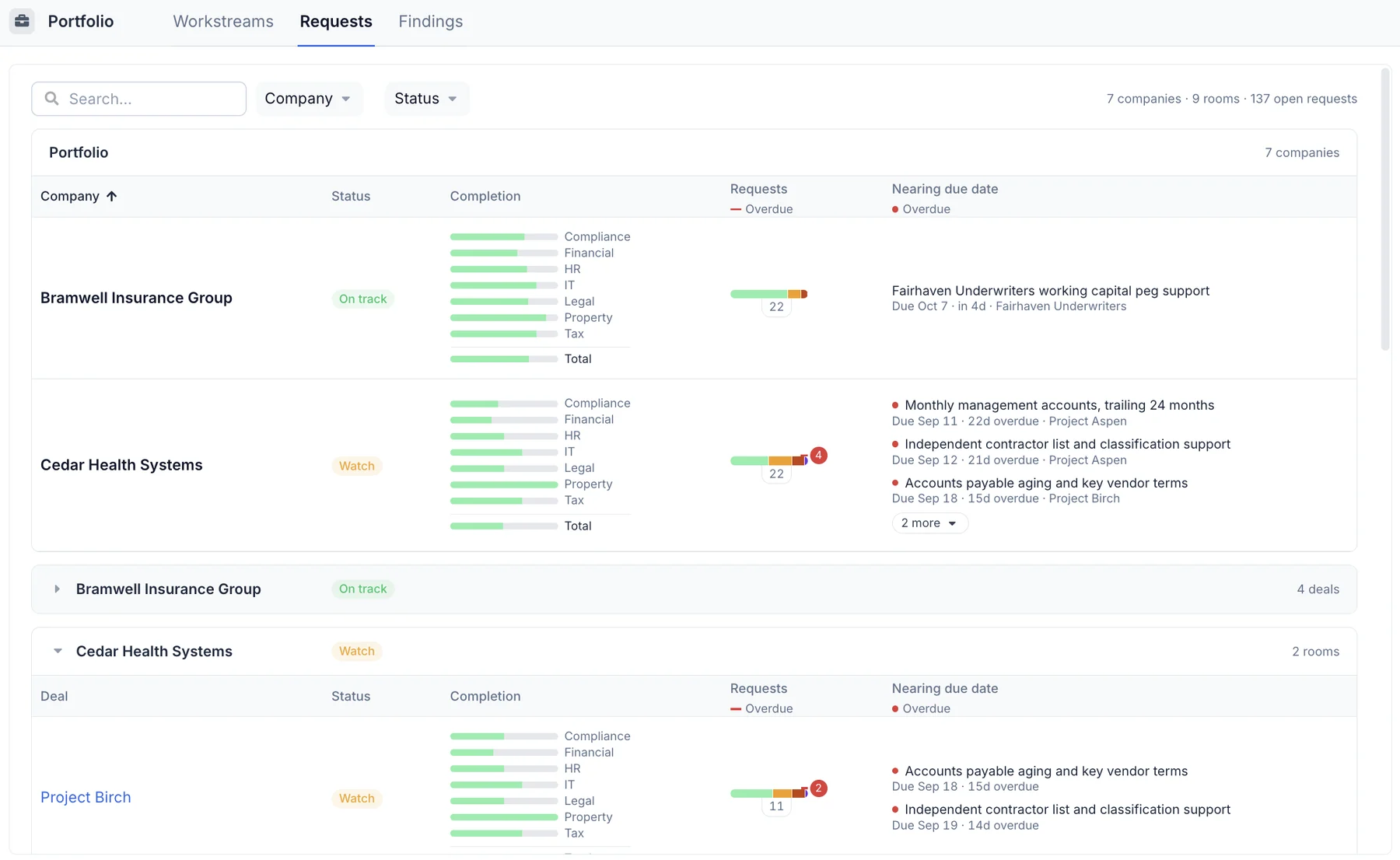
Know which company is behind, and on what
The list ranks by attention needed, overdue first and then open. Monitor diligence across functional areas.
- Overdue count and average request age per company and per room
- Completion that reconciles from portfolio to room to individual request
- Open the room worklist without leaving the portfolio view
Risks and issues that outlive the deal
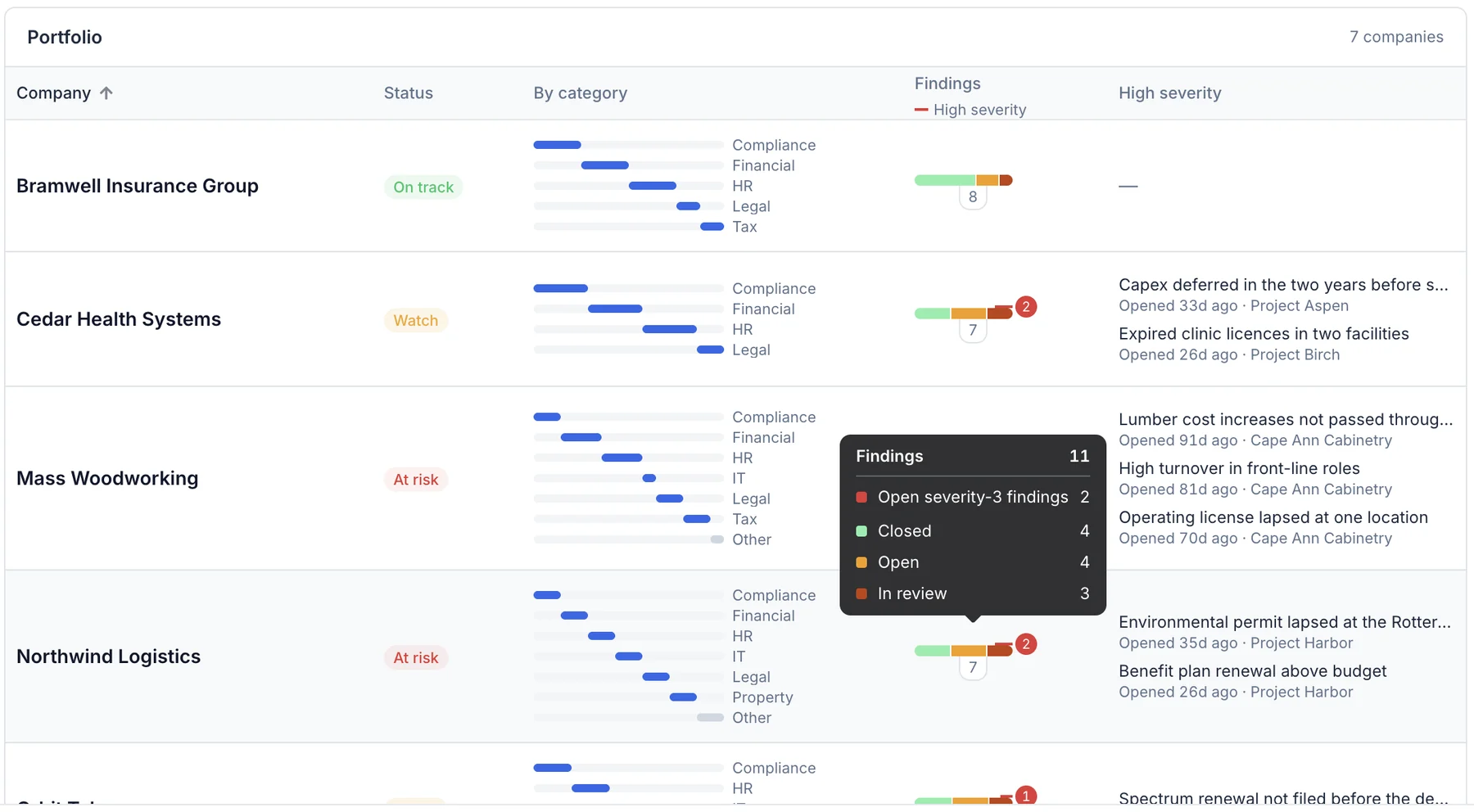
Findings are tracked per room and rolled up per company, categorized the way diligence teams already work. High severity items rank to the top, and each one stays linked to the documents and requests that produced it.
- Severity, category and age across every company in the portfolio
- Quickly scan the high severity items to keep your teams on track
- Findings carry from diligence into the integration plan instead of closing with the deal
Use your AI tools to work across your portfolio M&A
Connect ChatGPT, Claude, Copilot, and other AI tools to live DealRoom data so you can analyze diligence, research opportunities, monitor deal activity, and prepare updates without exporting files or rebuilding context.
Portfolio reporting without the collection email
Ask for the state of every portfolio company and get it from the live rooms, with links back to each deal. No downloads. No manual updates.
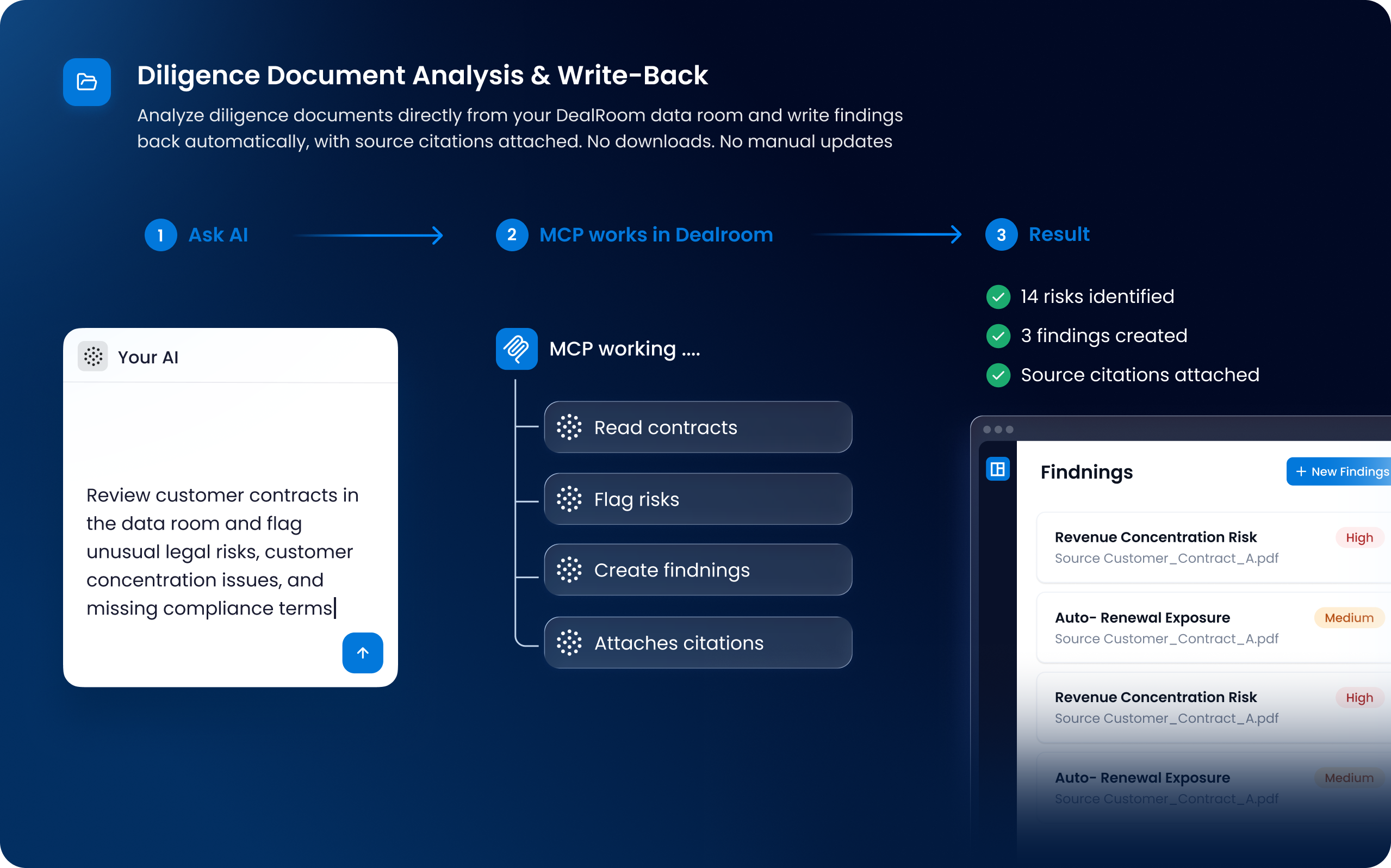
Find the risks that have gone quiet
Sweep every room in the portfolio for high severity findings that are aging, see who owns them, and assign the ones that have no owner.
Chase the requests holding a deal up
Pull overdue requests across companies by area, then create the follow-ups inside DealRoom without leaving your AI tool.
Stand up the room for the next add-on
Create a diligence room from your own template and generate the request list in one instruction, under the permissions that company already set.
Trusted by private equity teams scaling M&A
Case study
How PE-backed Easton Select Group closed 6 deals in 5 months using DealRoom
DealRoom has become the backbone of our diligence process. It serves as the central hub connecting the PE team, the operating company, and the seller—all working within the same shared space.

6
Deals closed in five months
$10M
EBITDA acquired
Frequently asked questions
What does DealRoom give a private equity firm that it does not give a corporate acquirer?
A portfolio layer. Corporate teams run one pipeline. A sponsor runs many, one per portfolio company, each with its own deal team and its own pace. DealRoom keeps each company in its own rooms under permissions that company controls, then rolls the deal counts, request completion and findings up to one portfolio view.
How is this different from asking each portfolio company for a status update?
Nothing is collected or submitted. Request completion is computed from the live requests in that company’s room the moment you open the page, and it is computed the same way for every portfolio company, so 72% at one company means what 72% means at another. What the sponsor sees is governed by the permissions each portfolio company sets on its own rooms, so the roll-up covers what that company has granted and nothing past it.
Do portfolio companies need their own DealRoom instance?
No. Each portfolio company gets its own rooms inside the sponsor workspace and administers the permissions on them. A portCo deal team sees its own deals and not its sister companies’. The sponsor sees a roll-up of what each company has granted, with the same role-based controls and audit trails applying on both sides.
What can the AI actually do with our portfolio data?
Read and write, inside exactly the access rights that person already has in the DealRoom UI. MCP is not a side door around permissions: it runs as the connected user, so a room, folder, request or document they cannot open in the product is one their AI cannot read either, and the same role-based controls and audit trails apply to every call. Within those limits, one MCP connection covers the whole portfolio, not one connection per company, so an AI can answer across every portfolio company at once or narrow to a single room, cite the source document, then create requests, log findings and assign owners. DealRoom AI also runs natively on documents inside diligence, so neither capability depends on exporting data somewhere else.
How does diligence work carry into integration, and why does that matter more for a sponsor?
Findings stay attached to the deal record after the room closes. A risk flagged in confirmatory becomes a tracked item in the integration plan, with its supporting documents and the request that surfaced it still attached.
That link carries more weight for a sponsor than for a corporate acquirer. A corporate buyer absorbs a missed synergy into a much larger P&L and has no deadline for fixing it. A sponsor underwrote specific numbers at IC, has to deliver them inside the hold period, and will be re-diligenced by the next buyer at exit. Entry diligence findings that were never closed reappear in the exit quality of earnings and come out of price.
In a buy-and-build the stakes accumulate with every add-on. If each one keeps its own ERP and its own close process, what goes to market at exit is a holding company rather than a scaled platform, and it gets valued that way. Carrying the diligence record into the integration plan is what lets the platform absorb the add-on, and it means the next deal in the same sector does not start from a blank template.
Is the data secure enough for LP-sensitive information?
DealRoom runs on enterprise-grade security: role-based permissions down to the folder and request level, full audit trails on every view and change, and data controls that govern what external advisors and sell-side counterparties can reach. Each portfolio company sets those controls on its own rooms, so what reaches the sponsor roll-up is what that company has granted.
Run M&A across your portfolio from one connected system
Trusted by 350+ customers