





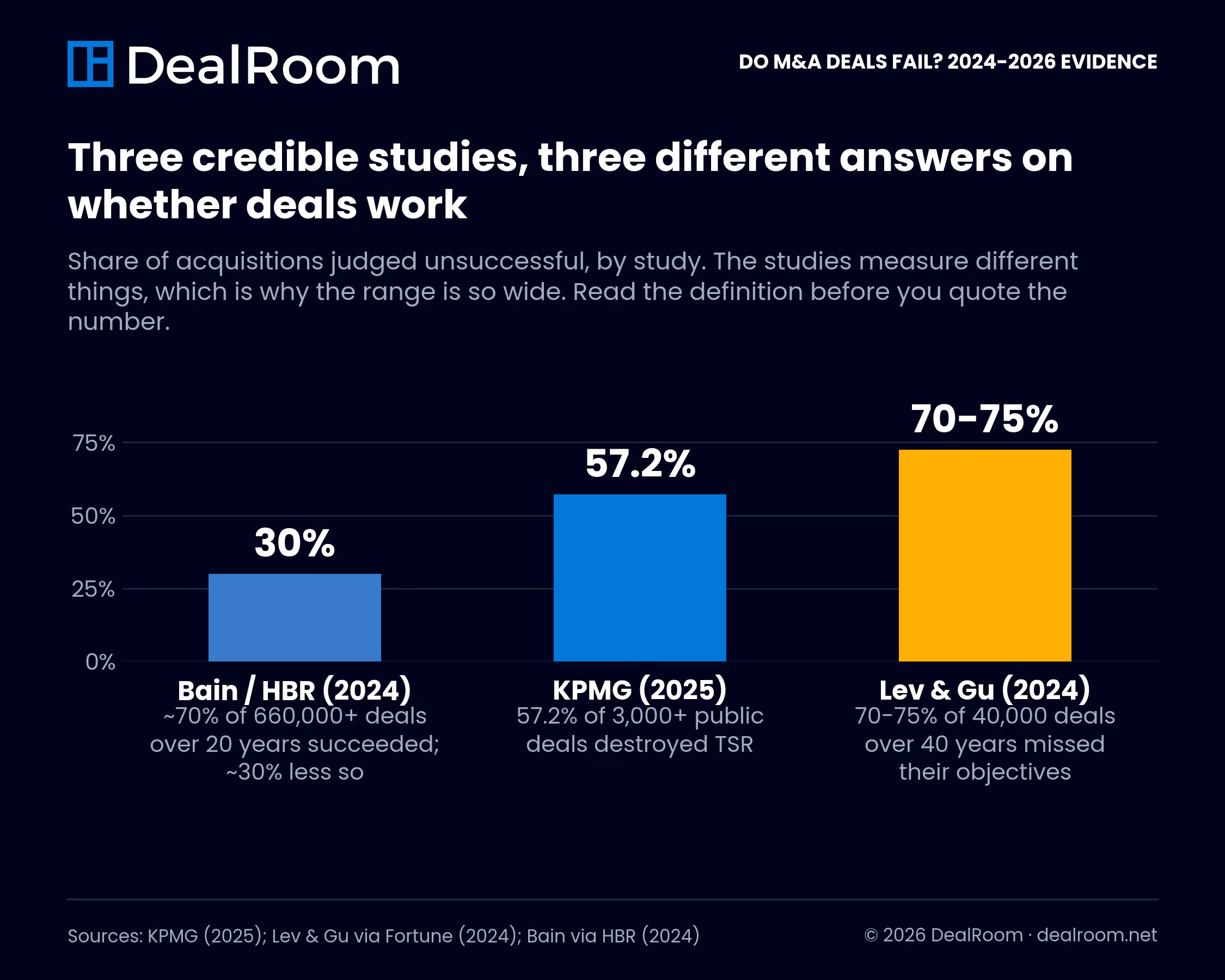
KPMG reviewed more than 3,000 public-to-public deals above $100 million closed between 2012 and 2022 and found that 57.2% of acquirers ultimately destroyed shareholder value, with total shareholder return falling an average of 7.4% in the two years after close. Behind many of those losses is a question that went unasked. The acquirer followed the diligence process, but nobody asked the one thing that would have changed the answer.
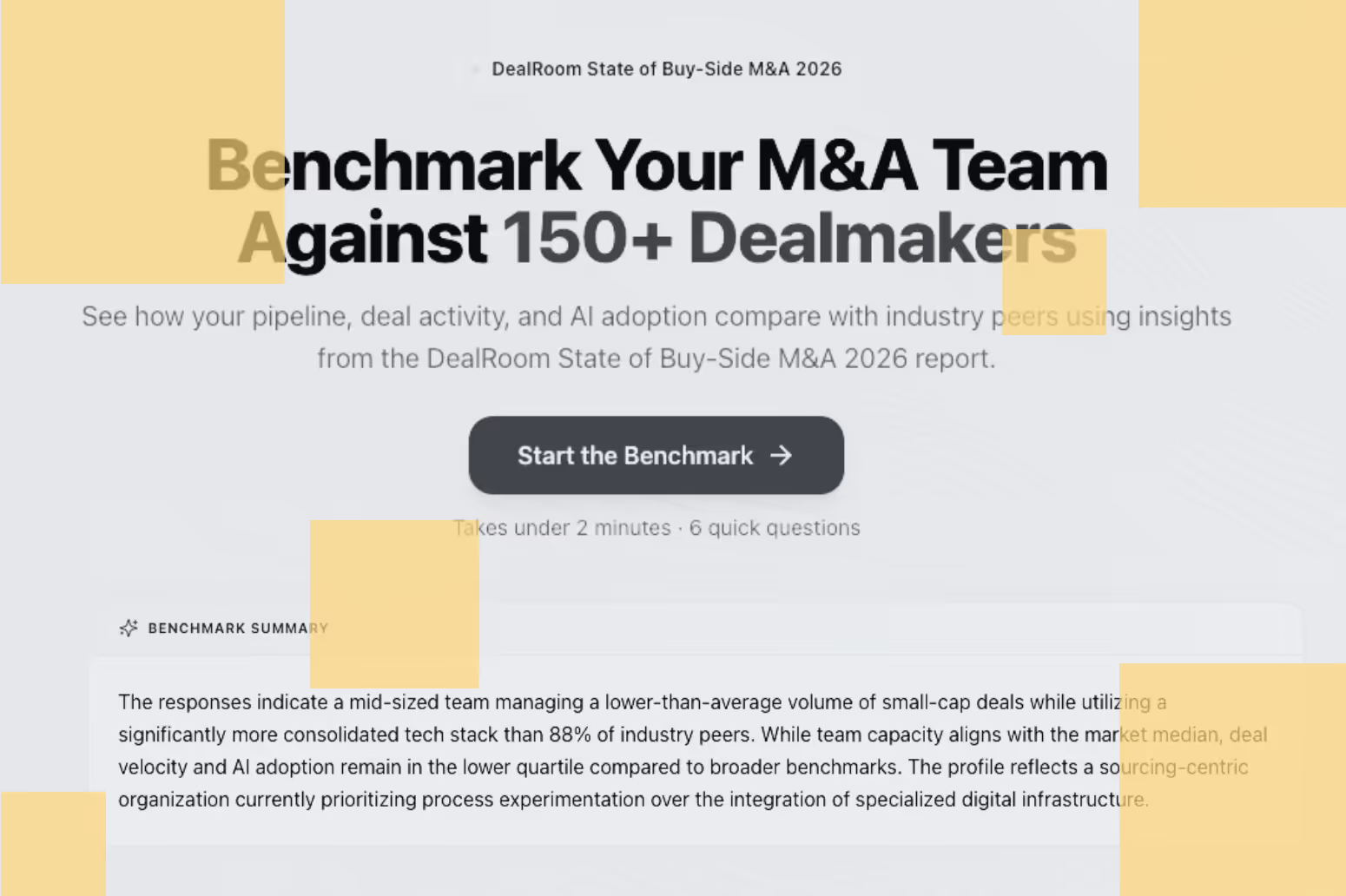
I have spent over a decade in M&A, first advising on deals at my own boutique practice, then building DealRoom in 2012 and interviewing more than 400 practitioners on the M&A Science podcast. Across those conversations, the pattern holds: the teams that get burned are usually the ones who accepted a management answer without testing it. In our State of Buy-Side M&A 2026 report we found 59% of respondents describe current buyer sentiment as optimistic, which means more teams are moving on more targets. Optimism is exactly when question discipline slips.
The 40 questions below are organized by workstream. Each one includes why it matters, what a strong answer sounds like and a named source. Two things to note before you use them. First, roughly the first half belong to screening, before you sign a letter of intent, when the cost of walking away is low. The second half belong in the data room. Second, a question is only as good as your ability to grade the answer, which is why every entry tells you what to listen for rather than just what to ask.
What is a target account question?
A target account question is any question you put to, or about, the company you are considering buying. Some go directly to the seller and management team. Others you answer yourself through outside-in research, customer and supplier interviews or the documents in the data room. In every case, the goal is to test the deal thesis against evidence rather than against the seller’s narrative.
That makes these questions different from a due diligence checklist. A checklist tells you which documents to request. A target account question tells you what you’re trying to learn from those documents, and which answer would change your view of price, structure or whether to proceed at all.
The most useful questions share three traits. They’re specific enough that a vague answer is obvious. They can be checked against a second source, such as a contract, a tax return or a customer conversation. And they’re tied to a decision, so you know in advance what a weak answer means for the deal. Every question in the list below is built to meet that standard.
Strategic fit and deal rationale
These five run before anything else. If they don’t resolve cleanly, no amount of diligence downstream will rescue the deal.
1. Why are we doing this deal, stated as a testable sentence? Harvard Business School’s David Fubini argues a rationale must be concrete and testable, framed as: by acquiring company X, we can use assets a, b and c to grow in y ways. Look for named assets and a named growth mechanism. “To grow” is not a rationale and cannot be validated after close.
2. Are we buying this company to improve our current business model or to replace it? Clayton Christensen’s New M&A Playbook draws the line that most acquirers blur. Deals that absorb a target’s resources to hold a premium position or cut costs should be priced on the performance boost they actually deliver, and buyers overpay when they are unrealistic about that boost. Deals that use the target’s business model as a platform for growth are a different instrument and look expensive on conventional math. Confusing the two is the most reliable route to overpaying.
3. Would we have found this target if we had screened the market systematically? Bain’s diligence research holds that a clear deal thesis and clear alignment to strategy are the two factors most associated with successful deals. A strong answer is that the company was already on a proactively built screen. A weak one is that a banker sent the book. Our deal sourcing guide covers how to build the screen that makes this answerable.
4. What are the big risks we cannot get wrong here? EY frames diligence around exactly this question in its guidance on M&A due diligence questions to ask before signing, asking what the big risks to the transaction are that you cannot get wrong. Look for specific, testable kill criteria written down before the data room opens. Risks named after diligence starts tend to be the ones diligence happened to find.
5. What do we know about creating value here that other bidders do not? Bain describes superior diligence as faster, deeper and more focused, citing a manufacturing example where outside-in research uncovered more than twice the original cost-synergy estimate. If your answer is the same as every other bidder’s, you are in a price auction rather than a value case.
Business model, revenue quality and customers
Revenue quality is where screening questions earn their keep, because the answers are checkable from the outside before you spend money.
6. What share of revenue sits with the top five customers? US GAAP already sets the market’s alarm threshold. ASC 280-10-50-42 requires a public entity to disclose any single external customer at 10% or more of revenue. Look for named contracts with remaining term, renewal history and switching costs for each.
7. What happens to the business if the largest customer leaves? SCORE’s questions to ask when buying an existing business puts this plainly. A strong answer models the gross margin impact and the fixed-cost absorption problem. A weak one says the relationship is strong.
8. How do the target’s best customers describe its strengths and weaknesses? This requires primary customer interviews rather than management’s account of them. Strategex’s 10 questions to ask every acquisition target asks how the target’s best customers perceive its strengths and its areas for improvement. Where that diverges from management’s version, trust the customers.
9. Why do customers choose this company over the alternatives? Benchmark International’s management meeting questions frame this as a differentiation test. A price-based answer means the margin is not defensible under a new owner who will not have the seller’s cost structure.
10. What is net revenue retention, and what is gross retention underneath it? For any recurring-revenue target, the pair matters more than either number. Wall Street Prep notes a financially sound SaaS business shows net revenue retention above 100%, with top performers above 120%. Net retention above 100% sitting on gross retention in the low 80s means upsell is masking churn.
11. Which individual employees hold the revenue relationships? Benchmark International’s management meeting questions ask whether key customer relationships sit with the owner, the management team or someone else, and whether non-compete and non-solicitation agreements protect them. The real question is whether those customers leave when those people do. Look for a named map of accounts to people, then check it against the retention terms in question 33.
Financials and quality of earnings
These six are data-room questions. Ask them with a financial due diligence checklist open so the document requests go out in one batch.
12. Does reported EBITDA convert to actual free cash flow? Baker Tilly’s guidance on quality of earnings studies makes the point that earnings tied up in accounts receivable have not been realized. Look for a bridge from EBITDA to cash, with working capital movement and capex shown separately.
13. Can every proposed EBITDA add-back be traced to an original document? Baker Tilly’s rule is that estimates should not be accepted. This is the single question that most often changes price. A strong answer produces the invoice, the contract or the payroll record for each add-back. A weak one produces a schedule the seller’s advisor built.
14. What is normalized net working capital and what peg are we setting? SRS Acquiom’s deal research finds working capital purchase price adjustments now appear on more than 90% of private-target deals, with the average adjustment owed to buyers around 0.9% of transaction value. Look for a twelve-month normalized calculation with seasonality, one-time items and deferred revenue treated explicitly.
15. Has any material accounting policy changed in the last three years, and why? Policy changes are a standard vehicle for managing earnings ahead of a sale. HCVT’s guidance on quality of earnings analysis asks whether accounting policies and methods are consistently applied. Look for the change, the reason and the restated comparison.
16. Can you show three years of audited financials and three years of tax returns? SCORE flags the divergence test directly: an owner who claims unreported income may be dishonest in other areas, too. The two document sets disagreeing is more informative than either one alone.
17. Which two or three assumptions is the forecast most sensitive to? Wall Street Prep’s guide to M&A due diligence includes review and sensitivity of key assumptions across the income statement, balance sheet and cash flow statement in financial diligence. Look for management to name the assumptions themselves. A seller who cannot identify the fragile inputs in their own model has not stress-tested it.
Market, competition and growth
18. Is the market growing, flat or shrinking, and what share does the target hold? SCORE’s version separates market position from company performance. Look for a defensible market definition. Targets often define the market narrowly enough to claim leadership in it.
19. If sales are rising, is the increase from market growth or from price? This is the sharpest question on SCORE’s list. Price-led growth in a flat market is a durability problem dressed as a growth story, and it usually reverses when a new owner cannot hold the pricing.
20. What are the industry’s key buying attributes, and how does the target score on each? Strategex’s framework forces an evidence-based competitive position rather than a management narrative. Look for third-party validation, ideally from the customer interviews in question 8.
21. What unmet needs exist in this market that the seller has not priced in? Strategex’s 10 questions to ask every acquisition target uses this to size the upside the seller is not charging for. This is where a proprietary view justifies a competitive bid.
Operations, technology and cybersecurity
Cybersecurity questions are absent from almost every published acquisition question list, which is why they’re worth asking early.
22. Has the target had any security incident, data breach or regulatory fine? Deloitte’s guidance on due diligence through a cybersecurity lens opens here. Undisclosed breach history is a live indemnity and reputational exposure that survives close. Look for incident logs and notification records, not a verbal assurance.
23. What security controls exist, and how are they actually performing? Deloitte’s second question separates documented policy from operating effectiveness. Look for penetration test results, patch cadence and evidence that multi-factor authentication is enforced rather than available.
24. Is the technology platform scalable, or are we buying a capex line? EY’s IT diligence question matters because a target running end-of-life systems converts an assumed cost synergy into a capital project. Look for the roadmap, the technical debt register and the annual maintenance spend.
25. Who are the key suppliers, and will their contracts transfer on the same terms? Supplier concentration is the mirror image of customer concentration and is systematically under-diligenced. SCORE treats it as a standalone category. Look for change-of-control language in the top five supply agreements.
26. Does the business own or lease its facilities and equipment, and can we assume those terms? This question is also from SCORE. Change-of-control clauses in leases and equipment finance can reprice a deal quietly, after the valuation has been agreed.
Legal, regulatory and compliance
27. Which material contracts require consent to assign or trigger on change of control? The American Bar Association’s guide to legal due diligence in M&A transactions treats this as the core contract review task. One missed consent can hold up close or hand a counterparty a renegotiation.
28. Can any material contract be terminated without cause on 30 days’ notice or less? Also from the ABA. Short-fuse termination rights mean the contracted revenue in your model is not contracted. Look for the notice period and the historical termination rate side by side.
29. What intellectual property does the target actually own, and is the chain of title clean? The ABA’s guidance on IP due diligence covers the cases that catch buyers: intellectual property owned or used by an affiliate that is not being acquired and intellectual property owned by or jointly owned with a third party.
30. What restrictive covenants or indemnification obligations survive the deal? Non-competes and exclusivity clauses inherited at close can block the expansion thesis the deal rests on. The ABA flags these alongside assignment consents for exactly that reason.
31. What is the target’s interaction with government officials, and who acts on its behalf? WilmerHale’s analysis of FCPA considerations in M&A notes that the quality of pre-acquisition diligence is one of the most critical factors the Department of Justice weighs in a charging decision. Successor liability is real, and the diligence record is the defense.
People, culture and key person risk
Nearly half of the respondents to Bain’s M&A Practitioners’ 2023 Outlook Survey listed cultural fit or difficulty integrating management teams as a primary reason their past deals had failed. These five questions are how you get ahead of that.
32. Why is now the right time for you to sell? Benchmark International’s opening question and SCORE’s “why is this business for sale” are the same test. Check the answer against the financials. Adverse selection shows up in the gap between the two.
33. Which employees are genuinely critical to deal value, and are they staying? McKinsey’s work on talent retention and selection in M&A advises keeping the critical-role list tight: typically, less than 2% of staff should receive retention incentives. Spreading packages wider buys nothing. A strong answer names each critical person and shows their signed retention terms.
34. How much of this business depends on the owner personally? SCORE’s buying a business due diligence checklist treats owner dependence and the non-compete as linked items. This is the defining risk in lower-middle-market deals. Look for the owner to describe what breaks when they leave, specifically.
35. If you were in my position, what would worry you about buying this business? This question comes from Benchmark International’s list of management meeting questions, which notes that it can reveal concerns the owner or management team hasn’t raised. A candid answer can point you in one meeting to issues that diligence might otherwise take weeks to uncover. Pay equal attention to an evasive answer: a seller who deflects or claims there is nothing to worry about is telling you something, too.
36. What is the culture here, and how hard will it be for this team to execute our post-close plan? Strategex’s culture question ties culture to execution rather than to values statements, asking how hard it will be for existing management and staff to execute the future roadmap. Look for evidence of how decisions actually get made. Our guide to cultural integration in M&A covers how to test this before signing rather than after.
Integration, synergies and post-close
37. What are the sources and timing of each synergy, and how was each quantified? This is EY’s synergy question. A strong answer is bottom-up, owner-assigned and phased by quarter. A weak one is a percentage of the combined cost base. Bain’s 2026 research found 75% of frequent acquirers meet or exceed synergy targets, which tells you the discipline is learnable.
38. How long will integration take, what will it cost and who owns it? Bain treats integration planning as a diligence activity rather than a post-close one. Its midyear 2026 data shows deals above $10 billion take roughly seven months from announcement to close and a further 24 to 36 months to realize the bulk of run-rate cost synergies. Budget accordingly.
39. What baselines will we measure against after close? This is Strategex’s final question, and the one most teams skip. Without a pre-close baseline on synergy savings, revenue lift and customer satisfaction, you can’t prove or disprove the thesis afterward, which means you can’t learn from the deal, either.
40. How long will we need transition services, and what does each month cost? This is EY’s TSA question. Long transition services agreements are where projected cost synergies go to die. Look for a month-by-month exit plan agreed before signing, with a named owner on both sides.
How to use these questions
Don’t run all 40 questions at once. Take questions 1 through 21 into screening and management meetings, where the cost of walking away is a few weeks of work. Take 22 through 40 into the data room once you have a letter of intent (LOI), and assign each to the workstream owner who will actually grade the answer.
The Bayes Business School M&A Research Centre analyzed more than 900 transactions announced between 2013 and 2023 and found average due diligence processing time rose from 124 days to 203 days, 64% longer than a comparable 2013 study. Medium-length processes produced the best outcomes, completing at a lower average premium and delivering a 4% higher twelve-month return than the market index, while short and long processes both returned below it. More time is not the answer. Better questions, asked earlier, are.
For the document requests behind these questions, our master due diligence checklist covers every workstream, and our due diligence process guide sets out the six-week sequence they fit into.
Turn questions into better deals
The 40 questions above share one goal: to surface the answer that would change your decision while changing it is still cheap. That only works if the questions are asked consistently, the answers are recorded where the whole deal team can see them and every response is graded by the person accountable for that workstream.
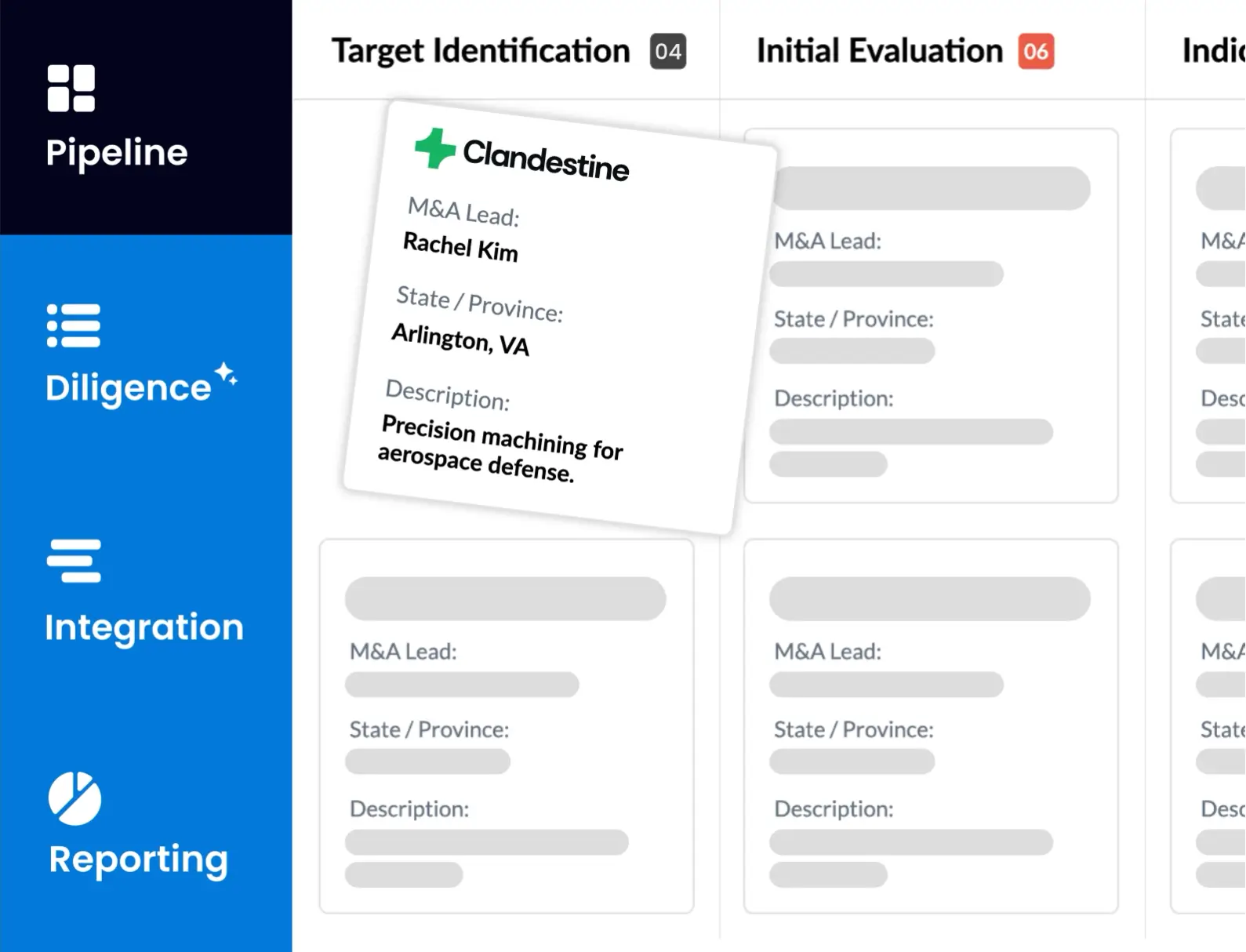
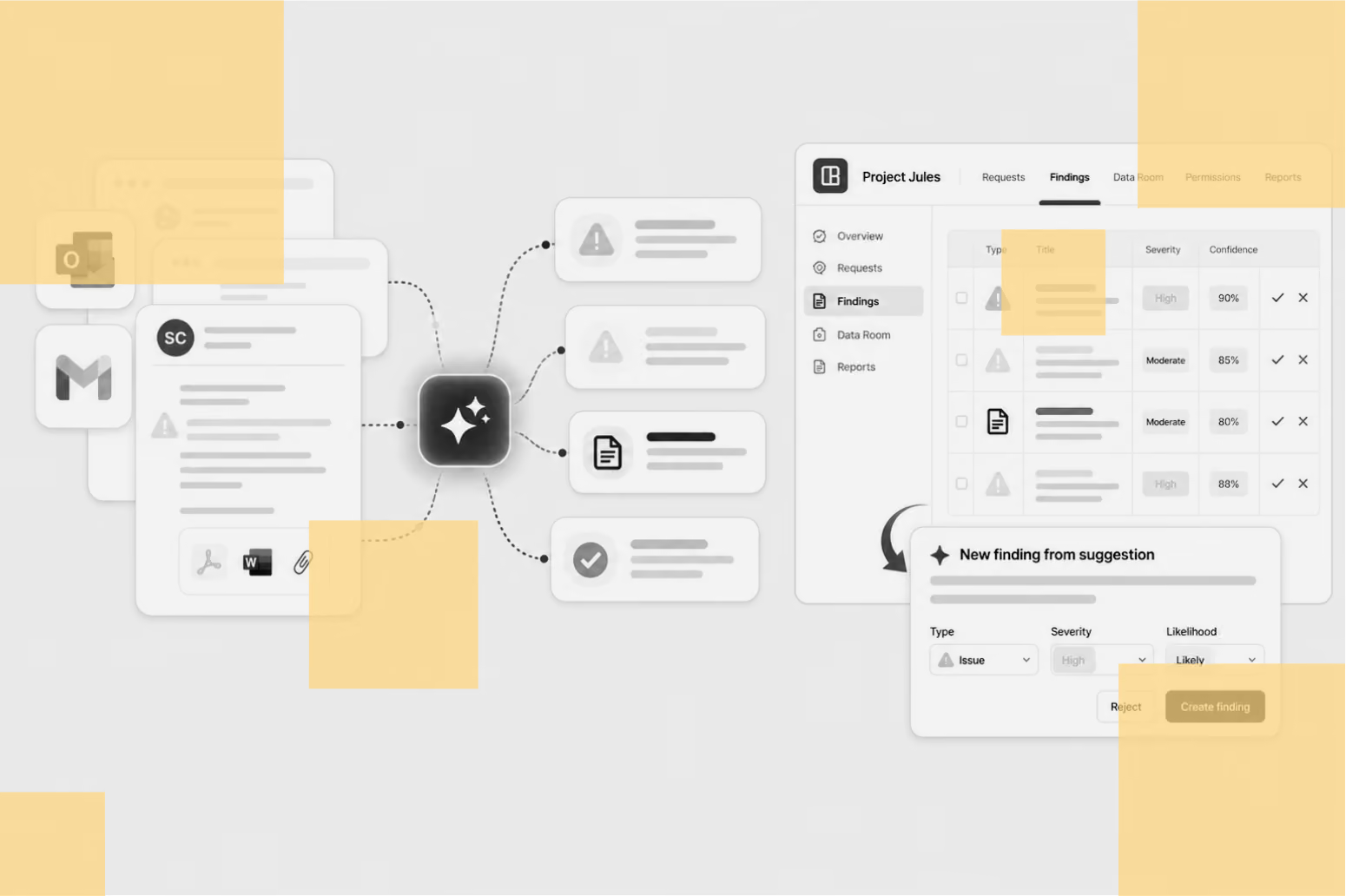
That is the problem DealRoom was built to solve. Pipeline gives you one place to track every target from first screen to signed LOI, so the strategic and revenue questions in the first half of this list are answered and logged before a deal moves forward rather than reconstructed afterward. Once you’re in the due diligence process, the wider DealRoom M&A platform connects those findings to document requests, workstream owners and integration planning, so what you learned in screening carries through to close and beyond.
To see how teams use DealRoom to run tighter, more disciplined deals, take the platform tour.
Frequently asked questions
What questions should you ask before acquiring a company?
Start with the five strategic questions: why this deal, whether the acquisition improves or replaces your business model, whether the target came from a systematic screen, what the big risks you cannot get wrong are and what you know about creating value that other bidders do not. If those do not resolve, the rest of the process is expensive theater.
What are the biggest red flags when evaluating an acquisition target?
Revenue concentrated in a few customers with short contract terms, EBITDA add-backs that cannot be traced to source documents, growth driven by price rather than volume in a flat market, an owner who cannot describe what breaks when they leave and undisclosed security incidents.
How long does M&A due diligence take?
Bayes Business School found average due diligence processing time across 900+ transactions rose to 203 days in the period studied, up from 124 days a decade earlier. Middle-market processes are shorter. The research found medium-length processes outperformed both short and long ones on premium paid and subsequent return.
What is the difference between screening questions and due diligence questions?
Screening questions are asked before a letter of intent, when walking away costs weeks rather than months, and they can usually be answered from public information, management meetings and customer conversations. Due diligence questions require the data room and are asked once exclusivity is in place.
How do you assess cultural fit before closing an acquisition?
Ask how decisions actually get made rather than what the values statement says, then check the answer against observable evidence: meeting cadence, approval thresholds, turnover in the layer below the founder and how the last failed project was handled. Nearly half of Bain’s 2023 survey respondents cited cultural fit or management integration difficulty as a primary reason past deals failed.