.jpeg)



.avif)





AI is already becoming part of everyday M&A workflows.
Corp dev teams use ChatGPT and Claude to review diligence documents, research targets, and synthesize findings. Legal teams use tools like Harvey to review contracts. Finance teams lean on Microsoft Copilot for analysis and reporting.
But despite how powerful these AI tools are, there’s still one major problem:
The AI and the systems of record for deal data (like DealRoom, a data room, Excel) are disconnected.
Teams still have to:
- Download documents from their system of record
- Upload them into their preferred AI
- Run analysis
- Copy findings back into their system of record
- Repeat the process again and again
The AI helps with the analysis and execution.
But humans still handle all the manual movement between systems.
That’s exactly the problem MCP is designed to solve.
So, What is MCP?
MCP stands for Model Context Protocol.
It’s an open standard that allows AI tools to securely connect with external systems, applications, and business data in real time.
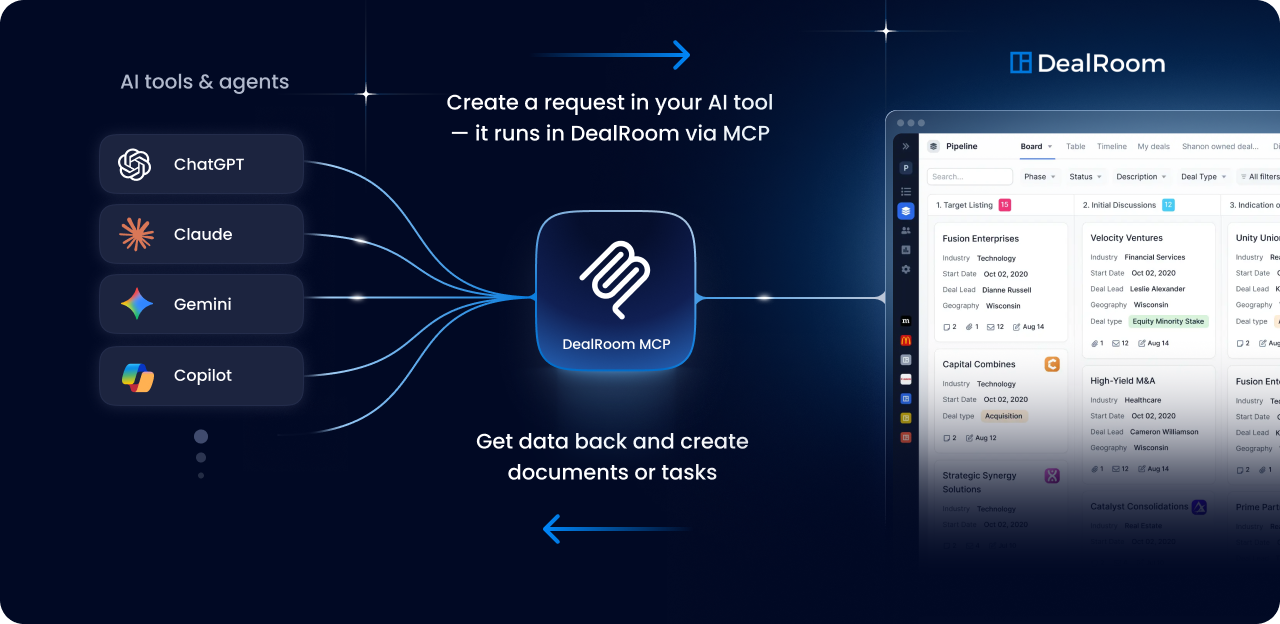
Instead of AI working in isolation, MCP allows AI agents to interact directly with the systems where the deal data lives.
That means AI can:
- Read documents
- Access pipeline records
- Analyze deal activity
- Create deal records & tasks
- Update findings
- Write outputs back into systems automatically
Without manual exports, uploads, or copy-paste workflows.
In simple terms: MCP connects your AI to your business systems.
Why MCP Matters
Large Language Models, like those that power ChatGPT or Claude, are powerful, but they only know:
{{cards-list_start}}
- What they were trained on
- The files and context manually provided to them
{{cards-list_end}}
They don’t automatically know:
{{info-list_start}}
- Your pipeline status
- Your diligence findings
- Your deal documents
- Your current workflows
{{info-list_end}}
Without MCP, AI works on snapshots.
With MCP, AI works on live systems.
That changes everything.
Before MCP vs After MCP
Before MCP, a corp dev analyst reviewing contracts during diligence might:
- Download files from the data room
- Upload them into ChatGPT or Claude
- Ask AI to identify risks
- Copy findings into spreadsheets or notes
- Re-enter everything into their system of record (an M&A Platform, excel, etc.)manually
After MCP, the workflow becomes:
“Review customer contracts in the data room and flag unusual legal risks, customer concentration issues, and missing compliance terms.”
The AI agent:
{{info-list_start}}
- Reads the documents directly
- Analyzes the contracts
- Creates findings
- Links source citations
- Generates follow-up requests
- Writes everything back automatically
{{info-list_end}}
No downloading.
No uploading.
No disconnected workflows.
MCP Changes AI From “Assistant” to “Operator”
This is the biggest shift.
Traditional AI mostly answers questions.
MCP-enabled AI can perform work inside connected systems.
That means AI stops being a separate side tool and becomes part of the operational workflow itself.
For M&A teams, this matters because deals involve:
{{info-list_start}}
- Thousands of documents
- Multiple stakeholders
- Diligence requests
- Pipeline updates
- Leadership reporting
- Cross-functional collaboration
{{info-list_end}}
And most corp dev teams are expected to manage all of it with lean teams.
MCP removes the friction between AI and execution.
{{highlight_start}}
Where DealRoom MCP Fits In
DealRoom MCP connects DealRoom directly to MCP-compatible AI tools such as ChatGPT, Claude, Copilot, Harvey, and Hebbia. Instead of AI working outside your M&A workflow, AI agents can securely read from and write to your pipeline, data room, findings, requests, and tasks directly inside DealRoom. That means teams can analyze diligence documents, research targets, summarize pipeline health, generate findings, and update deal records without manually moving files or re-entering information. The result is faster workflows, stronger analysis grounded in actual deal data, and a system of record that stays current automatically. Learn More →
{{highlight_end}}
Final Thought
MCP is quickly becoming the standard for how AI tools connect with enterprise software.
And for M&A teams, that means the future workflow is no longer:
“Open your platform, then use AI.”
It becomes:
“Work inside AI while your systems stay connected underneath.”
The teams that move fastest in the next era of M&A won’t just use AI.
They’ll use AI connected directly to their workflows, systems, and deal infrastructure in real time.
That’s the real promise of MCP.








.png)
.avif)

.avif)
.avif)