.jpeg)









Deal value by financial investors increased by 31% in 2025 as global M&A activity bounced back to $4.8 trillion, the second-largest amount on record. Private equity firms are carrying $1.3 trillion in global buyout dry powder, according to consulting firm Bain & Company. That means the analysts and associates you hire this year will be making decisions about where a lot of that money lands. Don't hire the wrong one. It's costly. When you make a bad hire in a deal seat, the cost isn't the salary. It's the bad deal they talk you into or the lucrative one they don't close.
My career in M&A began on the bottom rungs first working at a boutique shop and then running my own advisory practice through the distressed cycle after 2008. After starting DealRoom in 2012 and then later the M&A Science podcast where I have interviewed over 400 M&A practitioners on how they actually hire and build deal teams, I can tell you that interviews for these roles are sharper than ever. The overhang of distressed assets combined with higher cost of capital is changing who buys companies and at what price. In our annual State of M&A report, we analyze how that trend is reshaping M&A. As a result, interviews for M&A roles have gotten a lot more granular. Here are the questions that separate candidates who can talk about deals from those who can actually do them.
Treat this as a cheat sheet, not a script. The most effective private equity interviews flow through four topics: motivation and fit, deal sense, technical and LBO modeling skills and knowledge of your firm and the industry. Every question below is explained as to why it matters and what a great answer looks like, as well as a reference you can point a hiring panel to.
The PE recruiting landscape is evolving rapidly
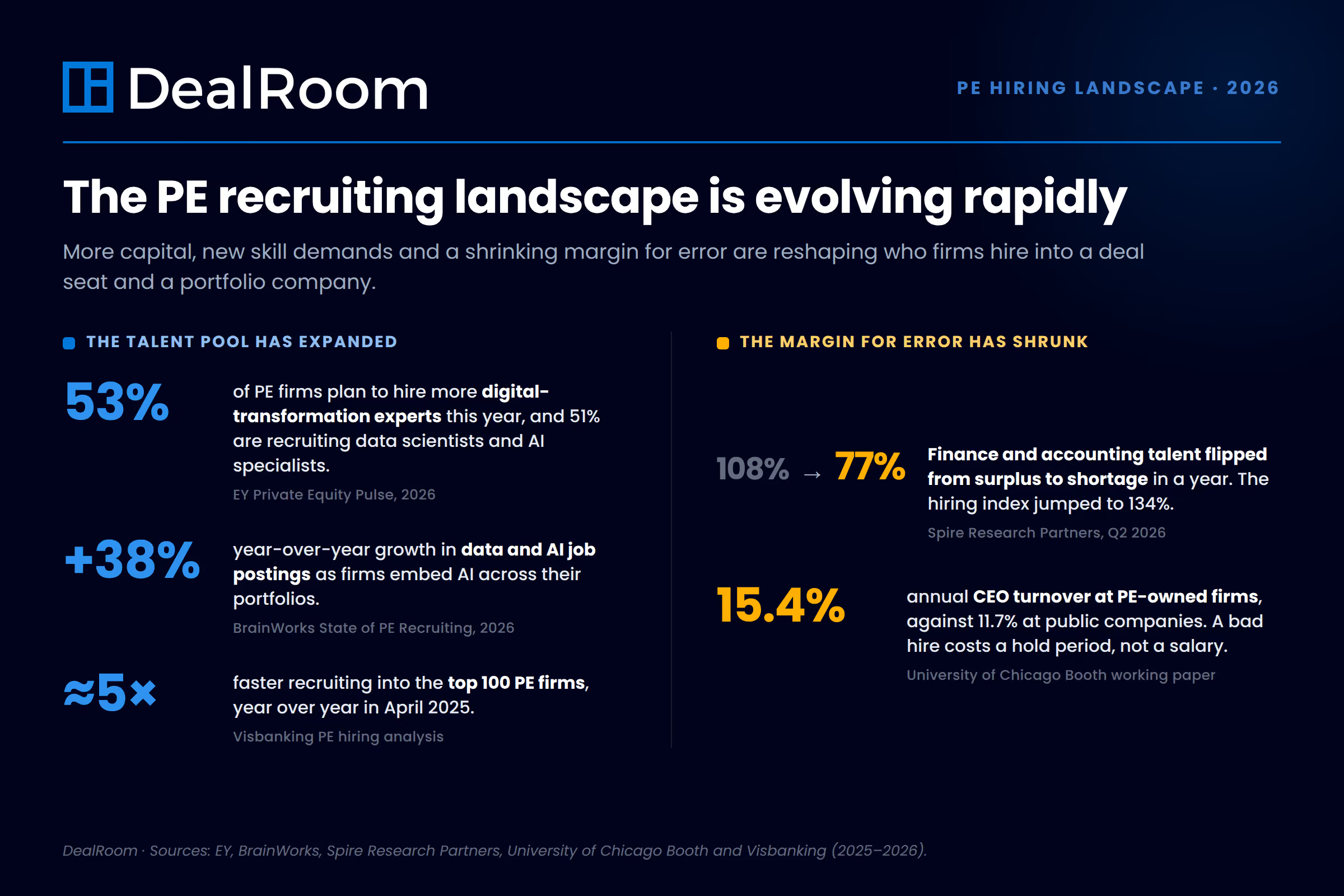
Recruiting for PE roles isn’t going to look like it did even two years ago. Firms are managing more capital than ever before, chasing entirely new skill sets, and fighting for talent in a market that changes from one quarter to the next.
Begin with the AI shift. Portfolio companies aren’t hunting solely for finance generalists anymore. EY’s most recent Private Equity Pulse survey found that 53% of PE firms plan to hire more digital-transformation experts this year than last. Another 51% are recruiting data scientists and AI experts. BrainWorks’ 2026 recruiting report confirms the trend: Data and AI job postings increased 38% from last year as firms look to embed generative AI into their portfolios. If you’re running PE interviews that only focus on LBO mechanics, you’re screening for half the job.
Sector specialization has also intensified. Technology and software account for over 20% of aggregate buyout value. Healthcare, industrials, energy, financial services and consumer follow behind, continuing to drive healthy hiring. As a result, candidates are increasingly required to have true subject matter expertise versus modeling skills that easily translate across industries.
Volume and timing have become less predictable, not more. One recruiter's analysis of PE hiring showed that recruitment into PE positions at the top 100 firms accelerated almost 5x year-over-year in April 2025. Timing-wise, despite gradually beginning earlier each year, on-cycle recruitment into junior roles actually began later than normal in 2026, showing that not even the most "locked in" portion of the hiring calendar is immune to change.
Pressure doesn’t rest solely on the investment team, either. In a Q2 2026 survey of CFOs and controllers, finance and accounting talent went from a surplus to a shortage practically overnight: the Talent Shortage Index plummeted to 77% from a 108% surplus in 2025, while the Hiring Index soared to 134%. Hiring top talent for portfolio company leadership is now just as competitive as deal-team hiring, if not more high-stakes.
That last point is more significant than it sounds. Research published in a University of Chicago Booth working paper looking at the market for CEOs showed that PE-owned firms experienced a 15.4% annual CEO turnover rate compared to 11.7% at public companies. Translation: instead of roughly eight and a half years, a portfolio company CEO will spend closer to six and a half years in the job. Bad hires at the top aren’t just costing you a salary. They’re costing you a hold period.
All together, you have a talent pool that has expanded (more responsibilities, more industries, more need), while the margin of error for a bad hire has decreased. These interview questions are designed to help you succeed in that environment.
Fit and motivation questions
Recruiters and hiring managers use these questions to see if someone just wants private equity or if they simply want to leave banking. They also reveal how self-aware candidates are and whether or not they think like owners.
1. Why private equity and why now? This is, hands down, the most predictive fit question. If a banker says, “I want to be on the buy side,” without clarifying what that means, they are parroting a quote. Seek out someone who realizes that private equity is about owning companies and improving them during a multi-year hold period, not executing a transaction and forgetting about it. The best answers tie the investor mindset to something tangible the person has actually experienced. Source: Street of Walls.
2. Walk me through your resume. Interviews always start here, and it is a test of narrative discipline. You should be looking for someone who can tell you a cohesive story that logically ends up at your firm in two minutes, without reading bullet points. Bad answers meander or over-elaborate on previous positions. Source: Mergers & Inquisitions.
3. Why our firm specifically? This is what distinguishes people who applied to every opportunity from those who researched you. Search for mentions of your strategy, sector focus, fund size or a specific portfolio company. If they cannot tell you why your firm is different from the fund down the street, they didn't do their homework. Source: Street of Walls.
4. What are the traits of a successful private equity investor? Answers reveal how an applicant views the role. Seek candidates who discuss judgment, patience and ambiguity over raw modeling speed. Ideal responses highlight the investor mindset: sourcing, developing a thesis and being proven correct about a business for years. Source: Street of Walls.
5. Do you invest your own money? Tell me about a position you hold. Someone who thinks like an investor will have investments outside of work. Look for an actual thesis on an actual holding. Remember, you're not grading returns. You're assessing whether they can justify a decision when their own money is at stake. Source: Street of Walls.
6. Describe a time when you had to work with someone who wasn't doing their fair share. Teams in private equity are small so one bad node is felt throughout. You want to hear that they confronted the issue head on in a productive way rather than avoided the problem or blamed a teammate. Source: Street of Walls.
7. Are you risk-averse or risk-seeking, and under what conditions do you take risk? This questions investment temperament. Watch for nuance in the answer. Good investors take calculated risks when the asymmetry is in their favor and walk away when it isn't. A categorical answer on either side is a red flag. Source: Street of Walls.
8. Where do you see yourself in five years? When you are hiring someone with a long hold-period mentality, that commitment is important. Search for honest curiosity to stay and build equity, rather than someone filling a seat for two years before starting business school. Source: Street of Walls.
Deal experience and investment judgment questions
You find out here if a candidate can take a view. Someone can memorize all the LBO mechanics and still lack any instinct for whether a business is worth owning.
9. Walk me through a deal on your resume. The heart of any private equity interview. Listen for command of the numbers (revenue, EBITDA, the multiple paid), as well as the story behind those numbers. The candidate should be able to talk through the rationale for the investment, the structure employed, and what he or she personally did. Generic answers here are almost always a sign of shallow experience. Source: Mergers & Inquisitions.
10. Would you have invested in that deal? Why or why not? The follow-up that matters more than the walk-through. Look for someone who gives you an independent opinion, not the bank's marketing pitch. If a candidate says, "yes, because we pushed it through," they didn't get it. You want someone who will argue both sides then land on a conclusion. Source: Mergers & Inquisitions.
11. Pitch me a company you would buy today. Expect a concise thesis: why this business, why now, how does a sponsor make money and what are the risks. The company itself is less important than your line of reasoning and understanding of value drivers. Source: Wall Street Oasis.
“You could be looking at five companies under the same brand and be tasked with finding synergies. You’ve got to show that you’re comfortable dealing with messiness, communicating a plan, and building a vision of where the business will be in the long term.”
- Dan Baker, Senior Director at ECA Partners, via M&A Community
12. What are the key risks in that deal and how would you mitigate them? Leading with risk is something great investors do. Seek deal-specific risks like customer concentration or cyclicality with a realistic mitigation plan rather than a boilerplate list. Those are risks that comprehensive financial due diligence should uncover before your firm makes a commitment. Source: Mergers & Inquisitions.
13. What deal breakers would cause you to abandon a target? Good, strong answers include concrete warning signs: excessive cyclicality that makes it difficult to forecast cash flow, customer concentration greater than roughly 5% to 10% of revenues from a single customer and/or high customer or employee churn. Search for a candidate that connects each flag to the underlying risk it represents, just like a structured due diligence process is designed to unearth. Source: Wall Street Prep.
14. If you could ask the CEO of a company you were about to purchase three questions, what would they be? This reveals if the candidate can quickly get to the heart of a business. You'd want to see questions related to the durability of the moat, biggest threat to the model and where the CEO would invest the next dollar. Source: Street of Walls.
15. Company A has a projected IRR of 23% and Company B has 30%. What two questions do you ask before making a decision? Beware candidates jumping at Company B. Smart candidates will ask questions about the assumptions driving the returns. How much leverage? Exit multiple? How much of the return is coming from multiple expansion vs. actual operational improvement? Source: Street of Walls.
16. Given one million dollars to invest today, how would you invest it? This is a free-form test of investment philosophy. There is no right answer. Seek out logical responses that consider risk, time frame and confidence. This reveals how a candidate thinks when given a blank slate. Source: Street of Walls.
Technical and LBO modeling questions
I also look for these to confirm the candidate can do the work. The depth of knowledge should correspond to the level of the seat: an associate should speak with complete fluency about modeling, while an analyst shouldn't be expected to know as much but should understand fundamental concepts.
17. What is a leveraged buyout, and how does debt enhance returns? The bread and butter question. A leveraged buyout is the purchase of a company with majority debt and a minority amount of sponsor equity. The holding period for a buyout is typically five to seven years, and the target IRR is generally around 20% to 25%, according to Wall Street Prep. Look for candidates to note that debt is less expensive than equity and the interest expense is tax deductible. Therefore, by utilizing more debt, the sponsor can pledge less equity capital and increase returns. Source: Wall Street Prep.
18. Give me an example of a paper LBO. Technical screens always start with this. Identify a candidate who can eyeball entry price, project cashflow, pay down debt, and compute an exit return mentally or on paper. Both structure and speed are important. Source: Mergers & Inquisitions.
19. Describe the three levers that drive returns in an LBO. This tests the candidate's ability to identify where the money is actually made. Good answers should include all three levers: deleveraging, EBITDA growth through operations/add-on acquisitions, and multiple expansion from entry to exit. Source: Wall Street Prep.
20. What makes a business an ideal LBO candidate? Stable, predictable cash flow. Non-cyclical, mature industry. Recurring revenue. Strong management team. Low capital intensity. If a candidate can name these and tell you how each attribute feeds the ability to utilize significant debt, they know the difference between theory and practice. Source: Wall Street Prep.
21. Walk me through the sources and uses in an LBO. This confirms that the candidate understands how a deal is financed. Typically, you want to see a clear split between the two. Uses include the equity purchase price, transaction fees, and financing fees. Sources include the debt tranches, sponsor equity, management rollover, and any excess cash. Source: Wall Street Prep.
22. Why would you consider both IRR and cash-on-cash multiple when evaluating returns? Tests return literacy. A solid response will cover how the multiple disregards time value and IRR takes timing into consideration. The multiple becomes more important on shorter holds, and IRR offers a better window into performance on longer holds. If someone only mentions one of these measurements, they have a gap in their knowledge. Source: Wall Street Prep.
23. A company triples its money in five years. Approximately what is the IRR? This question is a quick mental-math check. The answer is approximately 24.6%, according to Wall Street Prep. Look for a candidate who either knows the common approximations or can reason to an approximate answer. Source: Wall Street Prep.
24. If you could sensitize two variables in an LBO, what would they be? This question tests if the candidate knows what moves returns. The best answer is entry and exit multiples since these can often move returns more than operating assumptions. Source: Wall Street Prep.
25. What credit ratios do you review to determine a borrower's health? This question assesses the candidate’s debt fluency. Look for leverage ratios such as Total Debt to EBITDA, commonly in the 4.0x to 6.0x range with senior debt near 3.0x, and interest coverage ideally above 2.0x, per Wall Street Prep. Source: Wall Street Prep.
26. What does rollover equity mean, and why is it a positive? You want a candidate who explains that when management rolls over some of their proceeds back into the new deal, it lessens the equity the sponsor needs to put in and, more importantly, it aligns the incentives of the people running the company with a belief in the business. Alignment: that's the magic word. Source: Wall Street Prep.
27. What is a dividend recapitalization? This question tests the candidate’s understanding of return timing. A good response explains how issuing new debt in order to pay the sponsor a dividend prior to exit allows the sponsor to pull forward returns (thus increasing IRR), but adds additional refinancing risk to the business. Source: Wall Street Prep.
28. What is PIK interest? Make sure the candidate knows that PIK interest is not paid with cash but is rather added to the principal balance of the loan and that it carries a higher rate because of increased risk to the lender. Source: Wall Street Prep.
29. Why is an LBO analysis commonly referred to as a floor valuation? This tests conceptual depth. The answer: LBO assumes solving for the highest possible price a sponsor can pay and still achieve their target return, so it basically tells you the floor price of what a business is worth to a financial buyer (versus what a strategic buyer could pay given synergies). Source: Wall Street Prep.
30. How does an add-on acquisition create value? Look for the roll-up logic: a platform company acquires smaller companies at lower multiples. Those earnings are then valued at the platform's higher multiple, creating instant arbitrage on top of any synergies. Source: Wall Street Prep.
Accounting and finance fundamentals
Even a strong modeler can be uncertain on the statements underneath the model. The right answers to these questions are your proof that the plumbing works.
31. Walk me through the three statements if depreciation goes up $10. The traditional accounting test. You're looking for a clean explanation. On the income statement, pretax income drops and net income falls (with an assumed tax rate). On the cash flow statement, net income is down, but depreciation added back, so cash goes up by the tax savings amount. On the balance sheet, cash is up, net PP&E down, and retained earnings drops, and it all balances. Source: Street of Walls.
32. Take me through how you would calculate free cash flow. This confirms the candidate knows what actually pays down debt. Look for EBITDA less cash taxes, less CAPEX, and less change in working capital. If a candidate can't build free cash flow, they can't build an LBO. Source: Street of Walls.
33. What is the distinction between senior debt and subordinated debt? This is a capital-structure hierarchy question. The ideal answer should include priority in repayment as well as security and the trade-off that senior debt is cheaper and safer for the lender while subordinated debt carries a higher rate for higher risk. Source: Street of Walls.
34. What are the main ways to value a company? Go through a quick fundamentals check. Look for the three standard approaches: comparable company analysis, precedent transactions and a discounted cash flow, with a sentence on when each is most useful. Source: Street of Walls.
35. How does an add-on's lower purchase multiple impact the blended entry multiple? This tests if a candidate can think through roll-up math, which is central to how firms perform diligence on both a platform and its targets. Look for candidates to explain that purchasing earnings at a cheaper multiple than the platform's own pulls down the blended multiple, thereby increasing returns. Source: Wall Street Prep.
Firm and market awareness questions
The final group of questions assesses whether a candidate will fit into how your firm operates, from sourcing through value creation.
36. What is our firm’s investment strategy and where do we focus? A preparation test disguised as a question. If a candidate has done their homework and reads your portfolio before the interview, they can explain your strategy back to you. This demonstrates that they approach the interview process as if it’s the diligence process itself. Source: Street of Walls.
37. How do private equity firms create value in a portfolio company? This reveals whether a candidate looks past the model to the operating aspect. Answers should include the full picture: operational improvements, add-on acquisitions, deleveraging and multiple expansion, with an emphasis on which your firm focuses on most. Source: Wall Street Prep.
38. There is a lot happening in the private equity landscape currently. How does that impact our investment decisions? This reveals whether the candidate reads the room. In our State of M&A report, we discovered that dealmakers are navigating the increased cost of financing and a larger gap between buyer and seller expectations. Answers should reflect awareness of dry powder, the exit backlog, and how rising rates impact leverage opportunities. Source: DealRoom State of M&A report.
39. Does sourcing factor into this position? How would you go about it? A lot of funds want associates to source deals as well. Find someone who actually wants to source AND has a strategy for how they would go about it, as opposed to someone who thinks the job is just about executing deals handed to them. Source: Street of Walls.
“BD and deal origination has grown tremendously as a practice in PE over the last decade. GPs want to see that candidates can turf up deals using different methods, rather than just receiving a CIM from a bank.”
- Graham Banks, Head of Business Development at Cogenuity Partners, via M&A Community
40. What separates a good associate from a great one? A closing question that shows self-reflection and expectations. Look for responses that demonstrate more than technical ability. Look for ownership, discretion, and how they recognize and flag an issue before it happens. Source: Street of Walls.
Frequently asked questions
How many questions should you ask in a private equity interview? First rounds should be between 45-60 minutes and include 8-12 questions across fit questions, deal experience, and a technical screen (often a paper LBO). Later rounds dig deeper. Interviewers often throw in a modeling test or case study. Build a consistent scorecard using the bank above rather than asking every question.
What is the most important private equity interview question? “Would you have done that deal?” It tells you more about a candidate than any other question. Can they describe a transaction, or can they form an independent investment view? The latter is what the job actually requires.
Do I interview someone on technical modeling in the first round? For associate positions, I prefer to screen via a paper LBO or short modeling screen early. Technical deficiencies are very difficult to train. For analyst positions, interview the candidate on the fundamentals and judgment first, and test modeling depth on a later round or a take-home case.
How can I distinguish preparation from true fit? Ask follow up questions that dig deeper than the prepared answer. Someone who memorized an answer to "Why private equity?" will still fumble when you ask them what specifically about your firm's strategy interests them or make them argue the other side of their own deal.
How technical should I expect a fresh banking hire to be? A competent banking analyst should know the three statements, free cash flow, a paper LBO, and should be able to work the return and credit- ratio questions above. Deep portfolio-operations or sourcing experience is reasonable to develop on the job. Knowing the broader M&A career path helps you understand where a candidate is going.









.png)

.avif)


.avif)
.avif)
.avif)
.avif)