.jpeg)









From deal identification to due diligence to value-creation activities within portfolio companies, artificial intelligence (AI) is causing disruption to traditional investing techniques by enabling firms to process transactions more quickly and efficiently. Industry reports indicate firms that implement AI technologies for document processing can improve deal processing times by 50-80%.
In fact, artificial intelligence has now emerged as the third driver of value creation in PE, joining financial engineering and operational excellence. If you’re deploying these technologies effectively, you’ll start to see the effects trickle through all phases of your investing, from deal sourcing to exit planning.
Investors who have adopted AI report cost savings annually, along with improvements to decision-making and operational efficiencies. That’s real money in your pocket.
Investors are starting to see the effects of AI beyond just cost savings. Nearly two-thirds (67%) of investors believe AI will change the way they do business in the next five years. And over half of all investors believe deploying AI is mission-critical for their firms right now (82%). Those who deploy early will have the advantage of increased dealflow and better positioning to manage their portfolios.
How effectively you deploy AI throughout your firm may very well determine whether your firm is a leader or a follower in this new technology-fueled landscape.
Strategic Impact of AI Across the Private Equity Investment Lifecycle
AI tools are being used by private equity firms throughout the investment cycle. Machine learning is being applied to mine large volumes of unstructured data to identify potential targets. Natural language processing can automate much of the diligence process that traditionally took weeks or months. Here’s how AI impacts each stage of the PE investment process.
AI-Powered Deal Sourcing and Origination
Large PE firms have developed their own proprietary AI sourcing engines to uncover targets. Their algorithms crawl databases far larger than any human could search on their own. These AI engines evaluate quantitative information like financial metrics as well as qualitative data, such as patterns learned from previous successful and unsuccessful investments.
Data is ingested from numerous sources, deals are ranked, and the system continuously learns from each deal your team reviews. The more deals your team reviews, the more intelligent the system becomes.
AI sourcing platforms can:
- Parse structured data from company databases, online news feeds, and industry reports
- Find patterns in financial performance, market positioning, industry trends, and more
- Provide natural language processing interfaces so partners can query the database in conversational English
- Ingest alternative data such as web traffic, job postings, and more
The result? Your analysts spend more time working on the most promising deals instead of manually screening thousands of unsuitable targets. Some firms claim their platforms have enabled them to evaluate 3-5 times more targets with no increase in headcount. This has a dramatic impact on your deal flow.
Accelerating Due Diligence Through AI
The diligence phase is transformed from a tedious grind into a much more efficient process. Machine learning algorithms, particularly large language models (LLMs), can analyze thousands of pages of contracts, financial statements, due diligence questionnaires (DDQs), and regulatory filings in a matter of hours.
LLMs boost productivity by 35-85% on activities like competitive analysis, financial statement modeling, and understanding market sizing. Generative AI extracts key contract provisions, highlights risk areas, and even drafts summaries for the investment committee.
More advanced platforms will run deal simulations ahead of presenting to the investment committee. The system analyzes hundreds of hours of previous investment committee (IC) meeting minutes and internal memos to predict questions the committee will have. This allows deal teams to come to the IC with the data needed to support their thesis.
In some cases, leading-edge firms are experimenting with using AI bots as non-voting members of the investment committee. The bots provide an objective counterpoint to groupthink and help identify blind spots in the deal team’s thinking. This can help reduce confirmation bias but won’t make decisions for human investors.
Improving Investment Decisions with AI Forecasting
Forecasting models powered by AI can run hundreds of data points to produce scenario-based forecasts that help partners make better decisions. These forecasts pull in data from macroeconomic indicators, industry trends, and company data to model potential outcomes under different market conditions.
Partners can run multiple exit scenarios, including trade sale, sponsor-to-sponsor transaction, continuation fund, and more, to see what produces the highest returns for limited partners. AI forecasting can model these outcomes using real-time data feeds and automated valuation multiples formerly only known to expensive consultants.
Generative AI can assist in drafting your investment memos and presentation slides by summarizing research and financial analyses. It won’t make decisions for you, but at least you can be confident that you didn’t miss anything.
Firms using AI say they’re able to make investment decisions faster and see greater alignment between deal teams and investment committees. AI removes the guesswork from investments and provides quantitative backing to qualitative hunches. AI tools aid decision-making, but they don’t replace the human judgment that’s the foundation of every successful PE firm.
AI Adoption and Implementation in Portfolio Companies

While many firms have experimented with AI, private equity firms are now starting to deploy AI across their portfolios. However, currently only 20% of portfolio companies have adopted AI in a manner that creates tangible, bottom-line returns.
By connecting AI initiatives to overall strategy and executing on change management, PE firms can realize enormous value from AI deployments.
Value Creators: Driving Revenue Growth and Efficiency
Portfolio companies are already seeing top-line revenue increases from AI-enabled products and services. Some AI-powered monitoring platforms are already seeing millions of dollars of annualized cost savings for enterprise customers, along with increased retention and recurring revenue.
Others, like Vista Equity Partners, are envisioning as high as 60% combined growth and margin for AI-enabled software companies. We’ve written before about how this could become the new Rule of 60, up from the traditional Rule of 40 benchmark.
AI is also contributing to revenue growth by enhancing products and customer experience. The inclusion of an AI auto-fill feature for photo books led Shutterfly to generate $5 million in additional revenue in the tool’s first year.
PE firms are also using AI to accelerate sales through predictive analysis. Some firms use AI to analyze location and consumption data to identify optimal retail sites. Knowledge management platforms are also using AI to surface top-tier prospects and convert information into tangible business development successes.
Cost Savings: Increasing Productivity and Operational Efficiencies
Companies are also using AI to cut costs through AI-driven automation efforts. From content generation to marketing to software development, firms are finding new opportunities to use AI tools to reduce headcount reliance. Firms we’ve spoken with have seen dramatic improvements in production costs and easily measurable increases in lead generation and engineering productivity by implementing AI tools.
In addition to automating tasks, many companies are embedding AI into the workflows of employees to help them make decisions more quickly. AI tools offer real-time data analysis and recommendations that allow employees to act faster. By relieving employees of certain tasks and automation, AI can also free up employees to focus on higher-value work.
As with any new technology, change management is of the utmost importance. For AI to be accepted by employees, firms must have specific guidelines around AI usage. Beyond establishing guardrails, firms must work to build trust with employees if they hope to gain adoption within the company. Successful implementation requires strong governance around AI usage and usually a dedicated resource, such as a center of excellence or internal team focused on implementation and tracking progress.
AI Use Cases in Portfolio Company Functions
While every industry can benefit from AI, different businesses will use AI solutions for different tasks. Life science companies and healthcare organizations are using AI to accelerate drug discovery and optimize clinical trials. Software companies are looking at AI solutions to refactor legacy codebases and extend the lifecycle of existing products while decreasing technical debt.
AI is also being used to improve workflows. In particular, many business software companies based in high-labor-cost countries are looking to utilize AI to improve workflows. Advanced AI systems have graduated beyond simply displaying information for users. Now they can analyze that information and suggest next steps.
AI-powered routing and automation are streamlining customer care workflows, reducing costs while improving response times. Gartner predicts that AI technologies could reduce customer service expenses by up to 30% by 2029.
Retail and consumer brands are looking at site selection and inventory optimization while also personalizing marketing efforts with AI. The key is to align AI use with your biggest business objectives. Deploying AI technology for its own sake will likely lead to failure. When AI is used to solve pivotal business problems or provide exceptional value, that’s where you will see a greater return.
Challenges and Best Practices for Scaling AI in Private Equity

Some common themes emerged when PE firms started scaling AI: technical limitations, internal stakeholder pushback, and data security/governance. Successful efforts involve proactive change management, talent enablement, and strict security protocols around confidential deal and portfolio company information.
Key Challenges to Successfully Scaling AI
AI’s integration into PE firms is slowed by technical debt and legacy systems that are incompatible with leading machine learning environments. Data is often siloed within portfolio companies or different departments within the firm, making centralized data compilation for AI model training challenging.
Deal data and portfolio company data are typically not standardized, presenting technical challenges from the start. You’ll likely need to invest in tools to ingest data from various sources and ensure it stays clean.
Budget constraints, particularly within mid-market firms that may lack buying power compared to larger GPs, also make for AI scaling challenges. Developing a center of excellence can consolidate AI resources and budgets at the firm level versus duplicating resources across teams.
You should identify highly focused use cases and run smaller pilots proving out ROI before scaling AI firm-wide. This will allow you to adjust your strategy and gain internal advocacy.
Change Management and Personnel
Resistance from investment professionals fearing AI will make their skillset redundant is another hurdle to clear when scaling AI. Investment professionals should be included in conversations about how AI will enhance decision-making but not replace humans. AI doesn’t have gut feelings and cannot build investor relations.
Training should also include hands-on experience with the tools your organization plans to implement. Allow teams to test AI capabilities with synthetic or historical data before using it on live deals.
LPs are beginning to expect GPs to demonstrate AI abilities as part of their value-creation story, which can create external pressure to adopt AI. However, focusing on external expectations will not help if your firm doesn’t have the proper skills in-house.
Waterfall processes can kill AI initiatives if no one takes ownership of projects. Assign AI “champions” within each team to liaise with your engineering or technology team.
Ensuring Data Security and Governance
Private equity firms work with some of the most sensitive information, including proprietary portfolio company information, confidential deal terms, and investor information. Any AI infrastructure you adopt must be compliant with data privacy laws in all applicable jurisdictions and protect LP and portfolio company data from exposure.
Limit access to both AI models and data using a least privilege model. Turn on automated logging to create an audit trail of who accessed what information and when. This holds users accountable when interacting with your AI stack.
Establish data retention guidelines for how long information is housed in AI training sets and when to purge older records. This mitigates regulatory risk and ensures AI training data doesn’t become stale.
AI vendor management is important when relying on third-party platforms. Just because you’re moving your processing to another company doesn’t absolve you of security responsibilities. Thoroughly vet AI vendors and ensure your contract reflects your security requirements.
Frequently Asked Questions
What are some notable examples of AI applications in private equity firms?
AI-Powered Sourcing Engines: PE firms deploy AI sourcing engines to mine vast datasets for investment targets, which are ranked using objective metrics combined with patterns learned from historical deals. These systems can often do the heavy lifting of early triage, allowing teams to focus on the top opportunities.
AI Deal Simulations: Simulate your deal thesis before investing capital by modeling what-if scenarios like product expansions or operational pivots with AI. There are firms that have leveraged AI tools to conduct location analysis for retail portfolios based on consumption and customer datasets.
AI in Portfolio Companies: Applications of AI include go-to-market recommendations, pricing, and customer insights within portfolio companies. Software development within portfolio companies can be reduced by up to 50% with AI-powered programming assistants.
How are private equity firms incorporating AI?
Some private equity firms are developing their own AI sourcing tools. These firms are leveraging their institutional knowledge and the historical investments of their closed-end funds to build bespoke models rather than purchasing off-the-shelf software.
Alternatively, some PE firms are investing in AI-first companies within verticals such as warehouse robotics or software, then deploying that technology into their portfolio companies. For example, applying automation to logistics or warehouse fulfillment across e-commerce and manufacturing verticals.
There are even firms that have introduced AI platforms as non-voting members of their investment committee. By digging into data on deals and market trends, these AI systems combat groupthink and identify oversights.
What are the most effective AI tools currently being used in private equity?
Today’s top AI tools for private equity include AI-enhanced due diligence platforms that can reduce competitor analysis and financial due diligence from weeks to days, enabling teams to operate at warp speed.
GenAI-enabled Q&A interfaces allow your team to ask questions in conversational English to help digest complicated data sets with little to no technical knowledge. These AI platforms will continue to learn as they are exposed to more data and understand which recommendations are validated over time.
Virtual data room platforms can create tailored presentations for multiple buyers at exit. AI-powered assessment platforms can assess exit strategies by modeling trade sale, sponsor-to-sponsor, or continuation fund outcomes across a variety of market conditions.
What are 3 ways private equity firms use artificial intelligence to create value and increase returns?
1. Identify cost savings: AI can automate tasks to reduce costs and allow firms to analyze more deals with the same resources. As routine work decreases, teams can spend more time focusing on strategy vs. the nuts and bolts.
2. Increase top-line growth: AI applications like pricing optimization and customer analytics can help portfolio companies increase revenues. Additionally, sponsors who deploy AI early and have demonstrable top-line growth prior to exit have been shown to achieve higher EBITDA and exit multiples.
3. Improve market timing: AI algorithms can help identify public market windows by parsing through valuation multiples, macroeconomic indicators, and public market conditions to identify favorable IPO windows and when strategic buyers are willing to open their wallets. Traditionally, this type of analysis required expensive third-party advisors.
Can AI potentially automate significant parts of the private equity industry?
AI is already automating many of the data-intensive tasks throughout the investment process, from deal screening to portfolio company monitoring. Tasks like diligence that used to take months can now be done in weeks (if not days) with deeper insight than ever before.
AI can do the triaging, pattern recognition, and scenario modeling, but the human element will always be needed to make that final investment decision. At the end of the day, AI is an augmentation tool: it assists you but doesn’t have the experience to identify complex transactions.
AI takes away the repetitive analysis, allowing you and your team to focus on building relationships, strategy, and creating value. Investments will always require boots-on-the-ground human intervention for operational improvements and turning companies around. AI just allows you to do it with one arm tied behind your back.
Key Takeaways
- AI is automating deal processes and helping firms reach new heights of accuracy across sourcing, due diligence, and portfolio company management.
- To truly succeed in your AI initiatives, look to implement AI across your entire investment lifecycle, including inside your portfolio companies, to truly extract value.
- To get there, firms must address common challenges around data, talent, integration, and strategic deployment to scale AI implementations.
Artificial intelligence is beginning to affect nearly every stage of the private equity deal lifecycle. Already, AI is helping firms source deals faster, improve diligence quality, and even create new opportunities for value creation within portfolio companies. But these are just early wins. To truly unlock value, AI will need to be implemented throughout the investment lifecycle.
The challenge with many organizations today is that their data is siloed. Half-finished analyses live in spreadsheets. Important decisions get made in your inbox. And workflows are lost across dozens of tools. Your AI implementations can’t have any real impact if your underlying operations are broken.
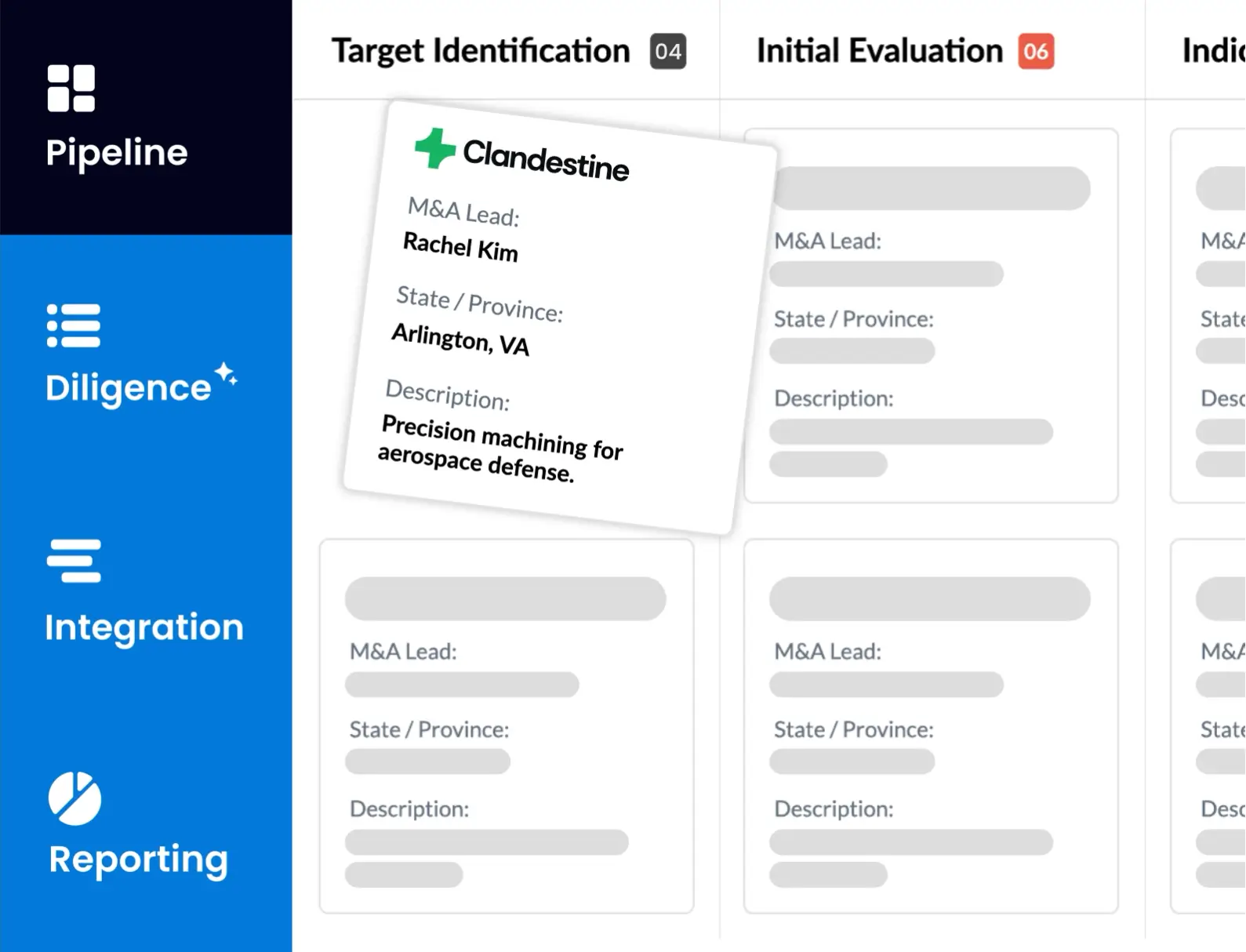
The DealRoom M&A Platform is built for the way modern deal teams work. We provide your team with a single, structured platform to operate deals from start to finish, from pipeline management, to due diligence, to post-merger integration.
DealRoom helps centralize your data, standardize your workflows, and gives your team greater visibility into every deal. Request a demo to learn how DealRoom helps operationalize AI across your deal lifecycle.









.png)


.avif)


.avif)