








AI adoption in M&A more than doubled in 2025, to 45% of the 300-plus M&A executives Bain surveyed. Payback is a different number. Only 6% of general partners say AI is delivering high impact in their own internal operations and investment processes today, while 70% expect high impact within three to five years, according to McKinsey’s Global Private Markets Report 2026.
AI deal sourcing is the use of machine learning and language models to build, filter and rank a pipeline of acquisition targets. The gap between those two numbers is where most buy-side teams are sitting right now, and closing it is an arithmetic problem before it is a technology problem.
I have spent over a decade in M&A, first as an advisor and since 2012 building DealRoom, and I have interviewed more than 400 practitioners on the M&A Science podcast. Sourcing is the function where the promise of AI is most obvious and the measurement is worst.
What is AI deal sourcing?
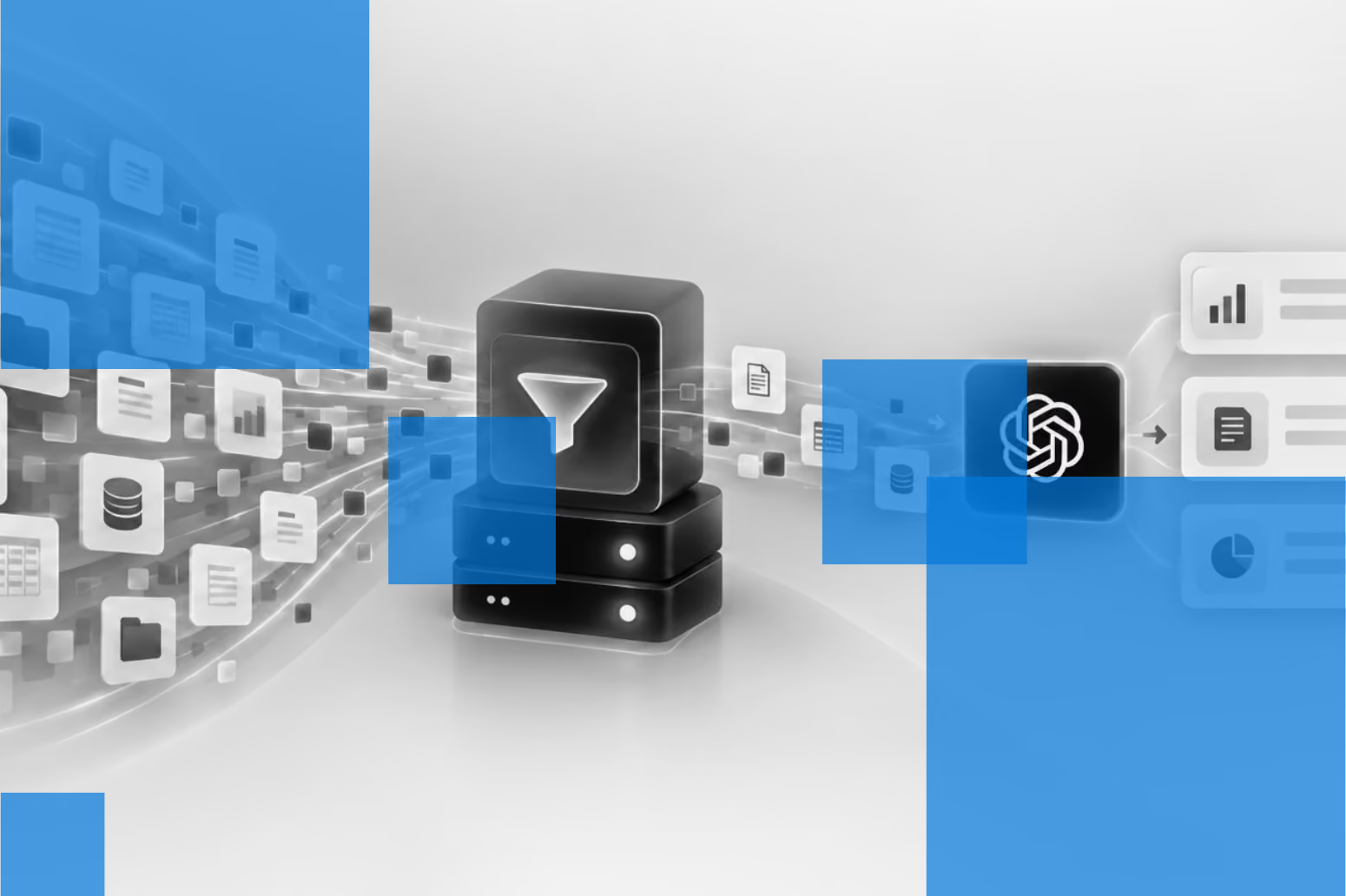
AI deal sourcing applies machine learning and language models to the three jobs that make up deal sourcing: expanding the universe of companies you know about, scoring that universe against an investment thesis and drafting the research and outreach that used to consume analyst weeks.
It does not replace relationships. It changes how many companies you can consider before relationships start to matter.
The funnel math
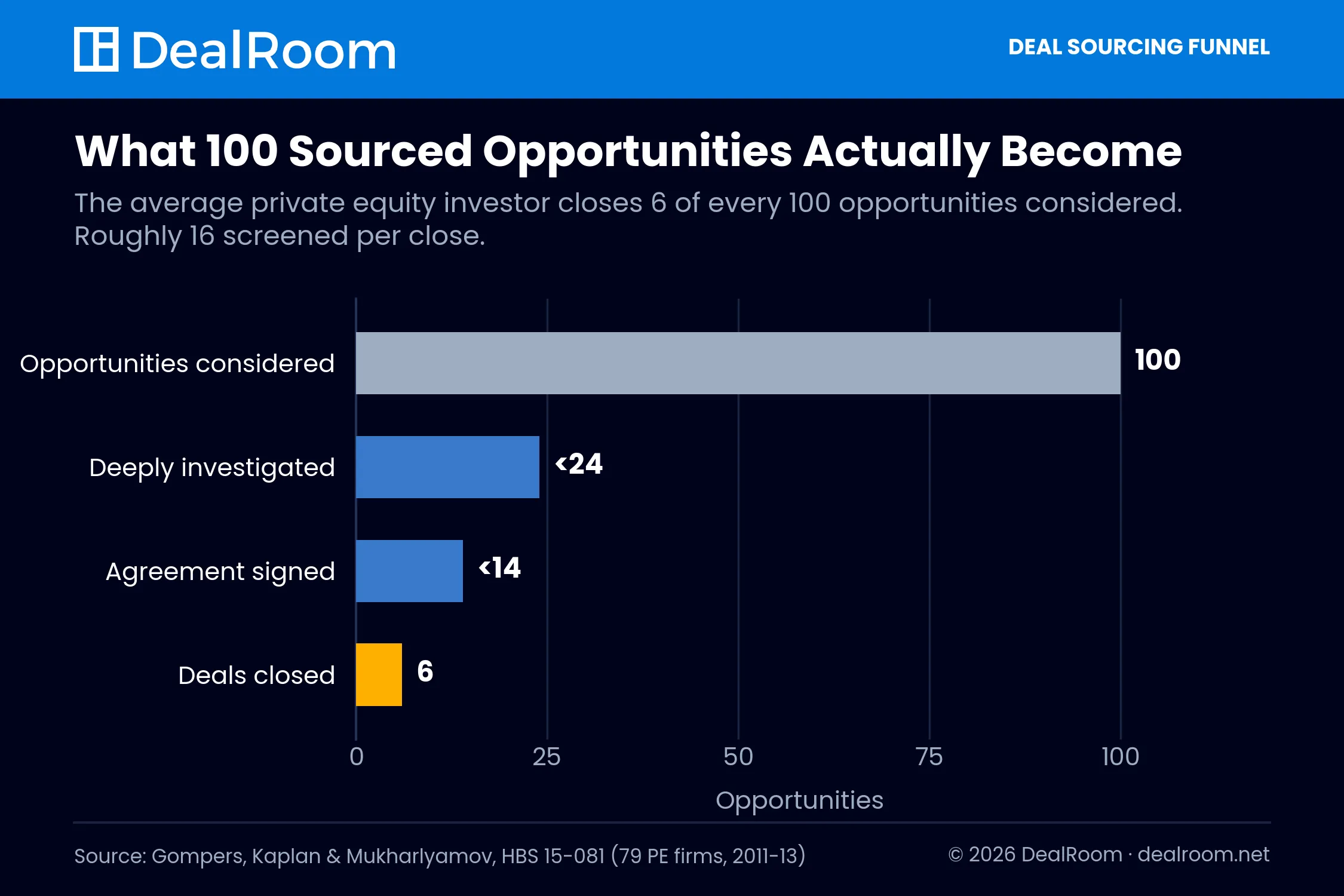
The most rigorous funnel data in the literature is also the oldest, and that matters. Gompers, Kaplan and Mukharlyamov surveyed 79 private equity firms between 2011 and 2013, publishing in Harvard Business School working paper 15-081 and later in the Journal of Financial Economics. For every 100 opportunities considered, the average PE investor deeply investigates fewer than 24, signs with fewer than 14 and closes 6. Nothing published since has replaced it at that level of rigor, so treat it as a structural benchmark from the pre-AI era rather than a current measurement of your own funnel.
Roughly 16 opportunities screened per closed deal. Every one of those 16 costs analyst hours. Does AI deal sourcing improve close rates? Not directly. It lowers the cost of the 16, which is a different and more defensible claim than the one most vendors make. That ratio is what AI attacks, and the same arithmetic runs through every one of the M&A pipeline stages downstream of it.
How to measure the ROI of AI deal sourcing
Measure AI deal sourcing on cost per qualified target and close rate by origin channel, not on hours saved. Hours saved is the number vendors report because it is the number that is always positive.
Divide your annual sourcing spend by the number of qualified targets produced, then compare that figure for the twelve months before the tool and the twelve months after. If cost per qualified target falls but close rate by channel does not move, the tool bought you volume, not deals.
The published evidence supports both outcomes. McKinsey reports some GPs seeing productivity gains of 30% to 40% in analyst-intensive tasks. Its State of AI 2025 survey found only 39% of organizations attribute any EBIT impact to AI at all, against 88% reporting regular AI use in at least one business function. PwC’s 2026 study of 1,217 senior executives found 74% of AI’s economic value is captured by 20% of organizations, and that leaders are two to three times as likely to say they use AI to identify and pursue growth opportunities.
That last finding is the one worth sitting with. The separation between leaders and everyone else is not model access. It is whether anyone instrumented the funnel before switching the tool on.
The target universe is far bigger than any pipeline
The number of companies a buy-side team could theoretically consider is larger than the number of deals that happen by three orders of magnitude.
In 2023, the latest year in the Census Bureau’s Business Dynamics Statistics, there were 5.58 million US firms with at least one employee and fewer than 500 employees. The National Center for the Middle Market defines the US middle market as businesses with revenue between $10 million and $1 billion and sizes that segment at nearly 200,000 businesses employing about 48 million people, a standing figure it has carried since its 2011 foundational research and repeated in the Year-End 2025 Middle Market Indicator.
Against those numbers, Bain counted 3,018 global buyout transactions in 2025, a 6% fall in count even as deal value rose 44% to $904 billion and average disclosed deal size hit a record $1.2 billion. Fewer, larger deals. The constraint has never been supply of companies. It is the cost of finding out which ones matter.
What AI is genuinely good at in sourcing
About 35% of dealmakers use generative AI for target identification and screening. That is the number that matters, and it is well below the headline.
Deloitte’s 2025 survey of 1,000 US senior corporate and private equity leaders found 86% had integrated generative AI into M&A workflows, with 65% of those adopters arriving within the past year. The stage-level numbers are lower: 40% for strategy and market assessment, 35% for target identification and screening and 35% for due diligence. Bain’s survey of more than 300 M&A executives found about one-third of dealmakers deploying AI systematically or redesigning M&A processes around it.
The firm that ran that survey reads the same data as a widening gap between adopters and everyone else:
“AI is quickly becoming indispensable to M&A. Early adopters are gaining a concrete advantage when it comes to dealmaking.”
Suzanne Kumar, Executive Vice President, Global M&A and Divestitures Practice, Bain & Company, January 2026
My reading is narrower. The advantage is concrete at the screening stage, where the task is defined and the output is checkable, and it is unproven everywhere the data thins out.
What the tools are demonstrably good at is screening at scale. Vismara, Latifi, Meinzinger and Pass tested LLM agents against human analysts on 61,814 ventures in the International Review of Financial Analysis and found the agents operating 537 times faster than a human VC analyst without sacrificing categorization quality, with a 70% increase in the Calinski-Harabasz Index and a Silhouette score of 0.35 against the human 0.37.
Speed on a defined screen is real. It is a narrower claim than the adoption headline implies, and a different claim from the ones made about AI in private equity across the rest of the deal lifecycle. Our examples of AI in corporate development cover what that looks like in a corporate team.
What data AI deal sourcing actually runs on
AI deal sourcing tools pull from four data layers, and each thins out as the target gets smaller. Layer one is licensed transaction and company data. Layer two is filings and registry data, which in the US covers public companies and very little else. Layer three is web text, job postings and news scraped at scale. Layer four is your own CRM history, the only layer your competitors do not also have.
The coverage cliff is the problem. In 2023, its most recent data year, the US Census Bureau counted 30,427,808 nonemployer establishments generating nearly $1.8 trillion, 78.4% of all US establishments. None of them file financials. Europe is no better: Eurostat found micro and small enterprises make up 99.0% of the EU business economy’s 33.5 million enterprises, with only 55,000 large enterprises across the whole bloc.
A model asked to rank companies it has no data on will still produce a ranking. That is the failure mode to design around.
The risks and limits of AI deal sourcing
The main risk is a confident wrong answer about a company with no public data. Stanford’s AI Index 2026 measured hallucination rates of 1.8% to 5.4% among the top 15 models on Vectara’s document-summarization benchmark, but 22% to 94% across 26 models on AA-Omniscience, a knowledge-recall benchmark. Some of that gap is the different model field. Most of it is the difference between summarizing a document you supplied and asking a model what it knows.
Retrieval does not close that gap on its own. Stanford RegLab tested leading retrieval-augmented legal research tools across 202 queries and found they hallucinated 17% to 33% of the time. Legal research is more similar to target screening than most people assume: both involve retrieving thin facts about specific named entities and stating them with confidence.
The downstream cost is measurable. McKinsey’s State of AI 2025, covering 1,993 respondents across 105 nations, found nearly one-third of organizations reported consequences from AI inaccuracy and 51% experienced at least one negative AI consequence.
How to evaluate an AI deal sourcing vendor
Evaluate on data coverage, citation behavior and security before you look at the model.
Ask for coverage counts inside your exact revenue band, geography and end market, not global totals. A platform with 40 million companies and 3,000 inside your screen is a platform with 3,000 companies.
Ask whether every scored field returns a source link and a refresh date. If a rank cannot be traced to a field and the field cannot be traced to a source, the output is unusable in an investment committee memo.
Ask the security questions early, because they are the ones that kill deployments late. Deloitte named data security at 67% and data quality and availability at 65% as the top two barriers to generative AI in M&A. Deloitte’s own reading of its survey leans on intent rather than outcome, and the wording is worth noticing:
“The 2025 Survey confirms that dealmakers are confident in GenAI’s potential to recast the look and feel of dealmaking, and are investing accordingly to realize its transformational benefits.”
Erik Dilger, Managing Director, Deloitte Financial Advisory Services LLP, October 2025
Confidence and investment are both measured in that survey. Realized benefit is not, which is why pilot design matters more than the budget line. Run a paid pilot against a list you already know, measure precision on the names you can check and reject any vendor that reports an accuracy figure without publishing the test set it was measured on.
How to build an AI deal sourcing workflow
An AI deal sourcing workflow runs in five stages: define the thesis as machine-readable screens, expand the candidate universe, score and rank against the screens, verify the top decile by hand, then track source-to-close by channel.
Stage one converts adjectives into fields. Revenue band, ownership status, end market, geography and a disqualifier list. If a screen cannot be written as a field with a value, it is not a screen. It is a preference, and no model will apply it consistently.
Stage two runs that screen across every data source you already pay for, plus web text and filing text. This is the only stage where breadth is the goal.
Stage three ranks candidates and requires a citation for every field used in the ranking. A rank you cannot audit is a rank you cannot defend to an investment committee.
Stage four is human. An analyst confirms ownership, revenue and a named contact for the top 10% before anyone reaches out. Skipping this stage is what produces the outreach that gets a firm blacklisted by a sector’s owners.
Stage five is measurement. Tag every target with its origin channel at creation, so within one year you can compare AI-sourced targets against banker-sourced and network-sourced targets on meeting rate, LOI rate and close rate. Without that tag the tool cannot be evaluated, only believed.
Where AI sourcing pays first: add-on acquisitions
Add-ons are where AI deal sourcing has the most room, because add-ons are small, numerous and rarely intermediated. PitchBook put add-ons at 72.9% of all US buyout activity in 2025 against a five-year average of 72.8%, inside 9,019 US PE deals worth $1,155.5 billion.
Targets that size usually have no banker, no teaser and no data room. There is no process to get into, which means sourcing cost per candidate is almost entirely analyst time, which is exactly the cost AI reduces. Bain counts 32,000 unsold portfolio companies worth $3.8 trillion with holding periods at exit running around seven years. Sponsors under that much exit pressure are the natural buyers for a machine-generated add-on list, which is a different exercise from classic M&A deal origination.
Corporate development, private equity and venture capital want different things
Buying the wrong shape of tool is a common and expensive mistake.
A corporate development team screens a narrow strategic universe and cares most about fit against a product roadmap. Recall matters more than breadth: missing the one adjacent competitor is worse than surfacing 500 irrelevant names.
Private equity teams screen a wide financial universe and care most about ownership status and revenue band. Precision matters more, because a false positive costs an analyst a day.
Venture capital screens the widest universe of all and cares most about early signal, where almost no structured data exists. The spend follows those differences: Deloitte found 88% of private equity respondents against 77% of corporate respondents had invested $1 million or more in generative AI for M&A.
The signal-to-noise problem nobody budgets for
AI raises sourcing volume faster than it raises sourcing quality, and the difference lands on the deal team as inbound noise.
In our State of M&A report we found that over a third of the pitch decks one DealRoom client received in 2023 were AI-related. That is a single-client observation from our own data rather than a market-wide measure, and it predates generative AI becoming standard in outbound. When every buyer runs similar screens against the same licensed data, candidate lists converge and outreach volume rises on both sides of the table.
Three defenses work. Apply a disqualifier list before ranking rather than after. Cap how many names enter outreach per week, so the constraint stays human attention rather than list length. Run a close-rate-by-channel report quarterly and kill any channel producing meetings but no LOIs.
Frequently asked questions
What is AI deal sourcing?
AI deal sourcing is the use of machine learning and language models to build, filter and rank a pipeline of acquisition targets. It does three jobs: expanding the universe of companies you know about, scoring that universe against an investment thesis and drafting the research and outreach that used to consume analyst weeks. It does not replace relationships. It changes how many companies you can consider before relationships start to matter.
How many targets does a firm screen per closed deal?
Roughly 16. Gompers, Kaplan and Mukharlyamov surveyed 79 private equity firms and found that for every 100 opportunities considered, the average investor deeply investigates fewer than 24, signs with fewer than 14 and closes 6. That survey was fielded between 2011 and 2013, so treat it as a pre-AI structural benchmark rather than a live measurement of your own funnel.
What percentage of dealmakers use AI for deal sourcing?
About 35%. Deloitte’s 2025 survey of 1,000 US senior corporate and private equity leaders found 86% had integrated generative AI into M&A workflows overall, but only 35% at the target identification and screening stage. Bain’s survey of more than 300 M&A executives found overall AI adoption more than doubled in 2025 to 45%.
Can AI find proprietary or off-market deals?
It can surface companies nobody has approached yet, which is a genuine advantage while it lasts. It cannot make the approach land, and the advantage decays as soon as the same data and the same screens are available to every other buyer running the same thesis.
What is the biggest risk in AI deal sourcing?
Confident wrong answers about companies with no public data. Stanford’s AI Index 2026 measured hallucination rates of 1.8% to 5.4% among the top 15 models on a document-summarization benchmark, but 22% to 94% across 26 models on AA-Omniscience, a knowledge-recall benchmark. Retrieval helps but does not solve it: Stanford RegLab found leading retrieval-augmented legal research tools hallucinated 17% to 33% of the time across 202 queries.
How do you measure whether AI deal sourcing is working?
Track cost per qualified target and close rate by origin channel, not hours saved. Tag every target with its origin channel at creation, then after twelve months compare AI-sourced targets against banker-sourced and network-sourced targets on meeting rate, LOI rate and close rate. If cost per qualified target falls but close rate by channel does not move, the tool bought volume rather than deals.
Does AI deal sourcing work for add-on acquisitions?
Add-ons are the best fit. PitchBook put add-ons at 72.9% of all US buyout activity in 2025. Targets that size usually have no banker, no teaser and no data room, so the sourcing cost is almost entirely analyst time, which is the cost AI actually reduces.