Due Diligence Definition (Types, Examples, & More)



Buyers walk away from roughly 1 in 5 M&A deals during diligence, according to Bain's 2025 Global M&A Report, which is why due diligence has become the single most consequential phase of any transaction.
Due diligence is the structured investigation a buyer, investor, lender, or partner runs to verify the legal, financial, operational, and strategic claims another party has made before signing a binding agreement. In a middle-market M&A transaction it spans nine distinct workstreams (financial, legal, commercial, operational, HR, IT, tax, environmental, and strategic fit), runs in parallel for 6 to 12 weeks, and typically costs between $200,000 and $2 million in advisor fees. This guide explains exactly what due diligence covers in M&A, real estate, startup investing, and public stock research, what each of the nine areas involves, how long each one takes, and how to know which areas your specific transaction actually requires.
What is Due Diligence?
Due diligence is the structured investigation a buyer, investor, lender, or partner conducts to verify the legal, financial, operational, tax, and strategic claims another party has made before signing a binding agreement. In a typical middle-market M&A deal, due diligence runs across nine parallel workstreams, takes 6 to 12 calendar weeks, and costs the buy-side $200,000 to $2 million in advisor fees, according to DealRoom benchmarks. The output is a written diligence report that lists confirmed facts, unresolved risks, and recommended price or deal-term adjustments.
If you're looking to learn more about due diligence, we've also built this due diligence type finder:
And this areas of due diligence explorer:
To let you learn more about the topic.
How the Due Diligence Process Works (Step by Step)
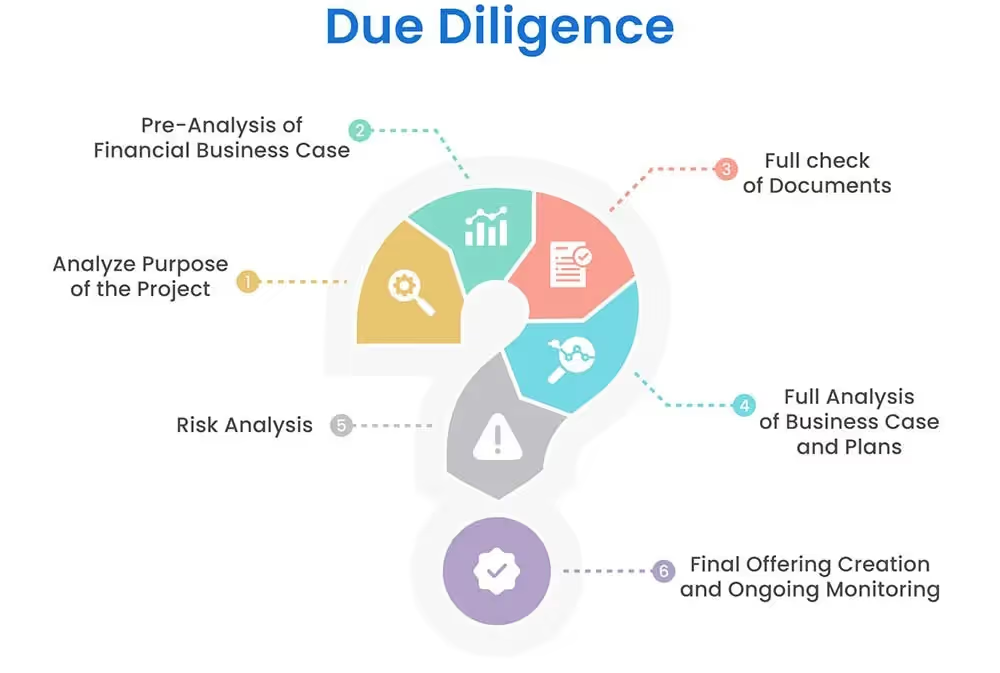
A complete due diligence engagement, whether for an acquisition, a venture investment, a real estate purchase, or a major partnership, follows the same six-step arc; only the duration and depth change with deal size.
Step 1: Scoping (Days 1 to 5). The buyer's deal lead defines which of the nine DD areas the deal actually requires, sets a budget for each workstream, and assigns internal owners and external advisors. The output is a DD scope memo and a master diligence checklist that lists every item to be requested from the seller.
Step 2: Request and Data Room Setup (Days 1 to 14). The buyer sends a comprehensive document request list (typically 200 to 400 line items in M&A) to the seller. The seller uploads documents to a virtual data room (VDR), permissioned by reviewer role. By Day 10 to 14, the data room should be 80%+ populated; gaps trigger follow-up requests.
Step 3: Review (Weeks 2 to 6). Each functional team (financial, legal, commercial, etc.) works through their assigned checklist items in parallel. Reviewers attach analysis, log questions to the seller, mark items complete or flagged, and surface issues to the deal lead in weekly meetings.
Step 4: Management Meetings and Site Visits (Weeks 4 to 6). The buyer's team meets management to fill information gaps the data room cannot, walks operating sites where physical inspection matters (manufacturing, real estate, lab facilities), and conducts customer reference calls.
Step 5: Reporting (Weeks 6 to 8). Each workstream produces a written report listing confirmed facts, open issues, quantified risks, and recommended deal-term changes. The deal lead consolidates these into an overall diligence summary that goes to the investment committee or board.
Step 6: Negotiation and Resolution (Weeks 6 to 10). Material findings translate into purchase price adjustments (typically reductions), reps and warranties, indemnities, escrow holdbacks, or specific closing conditions. Unresolvable issues become deal breakers; the buyer either walks or accepts the risk in writing.
In a middle-market M&A deal, this six-step process runs 6 to 12 calendar weeks end-to-end. Real estate diligence typically compresses Steps 1 to 6 into 30 to 60 days. Venture investments at the seed stage can complete the full arc in 1 to 2 weeks; growth-stage and pre-IPO rounds run 4 to 8 weeks.
Due Diligence Meaning in Law
In a legal context, due diligence is the standard of care a reasonable person would exercise to investigate a contract, transaction, asset, or counterparty before committing. The term originated in the U.S. Securities Act of 1933, which gave underwriters a "due diligence defense" against liability for material misstatements in a registration statement, provided they had conducted a reasonable investigation. Today, "performing legal due diligence" means systematically reviewing corporate records, contracts, IP filings, litigation history, regulatory licenses, and employment agreements to identify legal risk that could affect deal value or post-close operations.
Example of due diligence in law
- In domestic law, the exercise of due diligence by an individual or corporation may be a standard of conduct to defend an allegation of negligence in tort, or as a statutory defense, eg. to allegations of tax evasion.
What is Contingent Due Diligence in Real Estate?
A due diligence contingency in a real estate purchase contract is a clause that lets the buyer walk away (with their earnest money refunded) if they uncover material problems with the property during a defined inspection window. In residential transactions the window is usually 7 to 14 days; in commercial real estate it commonly runs 30 to 60 days because the inspection scope is broader. During the contingency period, the buyer typically conducts a physical inspection, an environmental Phase I assessment, a title search, a survey, and a review of leases, service contracts, and tax records.
Example of contingent due diligence
- The buyer conducting site visits and property inspections checks whether the deal will close depending on the outcome of this assessment is called contingent due diligence.
However, the final details of the decision making on moving forward are contingent on the buyer’s findings from investigation. This means that a company or individual may withdraw if they are not satisfied with their findings.
What is Due Diligence in Business?
In a business context, due diligence is the investigation a company performs before any major commitment that could materially affect its finances, operations, or reputation: acquisitions, equity investments, joint ventures, large vendor contracts, key hires, and licensing or franchising agreements. The depth and duration scale with deal size: a routine vendor selection might take 1 week and one analyst, while acquiring a $50 million business takes 8 to 12 weeks and a cross-functional team of 5 to 15 specialists across finance, legal, commercial, IT, and HR. The deliverable in every case is the same: a documented risk assessment that informs the go/no-go decision and the negotiated terms.
Example of due diligence in business
- In a corporate finance setting, the due diligence investigation is designed to provide a basis for reasonable investigation defense to parties (other than the issuer) who may have liability under Section 11 of the Securities Act of 1933
- Examples include purchasing new property or equipment, implementing new business information systems, or integrating with another firm.
Business audits often help surface and avert potential issues in the future. The process will also provide the basis and backup for any legal opinion the firm may be required to issue in connection with the transaction.
Organizations exercise due diligence by:
- Researching customer reviews and the seller’s reputation
- Considering the environmental impact of the due diligence transaction
- Supplementing purchases with insurances or warranties
- Evaluating price in comparison to competitors
What is Financial Due Diligence?
Financial due diligence is the deep-dive analysis a buyer commissions to verify the seller's reported earnings, cash flow, working capital, and debt before closing. The core deliverable is a Quality of Earnings (QoE) report that recalculates EBITDA after adjusting for one-time items, accounting policy differences, owner-related expenses, and run-rate changes; the QoE typically moves headline EBITDA by 5 to 15% in middle-market deals. Financial DD usually takes 3 to 6 weeks, costs $50,000 to $300,000 depending on deal complexity, and is led by a transaction services team at a Big 4 or specialist accounting firm.
Many people ask, what are the due diligence documents that should be collected? Here’s a list of a few of the materials and documents analyzed during the financial due diligence:
- Revenue, profit, and growth trends
- Stock history and options
- Short and long-term debts
- Valuation multiples and ratios in comparison to competitors and industry benchmarks
- Balance sheets, income statements, and the statement of cash flows
The ideal way to determine the market's attitude to your company's strengths and weaknesses is to answer financial due diligence questions and analyze the documents above using a financial due diligence checklist - playbook. With financial due diligence checklists, companies can make sure no oversights come back to haunt them once the deal is final. Check out what this checklist consists of here.

What is Due Diligence for Startups?
Due diligence for startups is the investigation a venture capital, growth equity, or angel investor runs before writing a term sheet or funding a round, focused on team quality, product-market fit, market size, unit economics, and the cap table. Unlike M&A diligence on a mature business, startup DD relies less on audited financials (which often do not exist) and more on customer references, code reviews, founder background checks, and analysis of the company's data room: pitch deck, financial model, customer cohort data, contracts, IP assignments, and prior funding documents. A typical seed-stage diligence takes 1 to 2 weeks; a Series B or later round can take 4 to 8 weeks because of the deeper financial and commercial review.
What is Due Diligence for Stocks?
Due diligence for stocks is the research an individual investor performs before buying shares in a publicly traded company, covering the company's financial statements, business model, competitive position, management quality, valuation multiples, and sector outlook. A standard ten-step retail DD checklist works through: company size, revenue and earnings trends, valuation (P/E, EV/EBITDA, P/S), competitors and industry, balance sheet strength, stock price history, share dilution, expectations (analyst estimates), risks, and ownership (insider and institutional holdings). Most retail investors complete this in 2 to 4 hours per stock using free sources like SEC EDGAR (10-K, 10-Q, 8-K), the company's investor relations site, and third-party platforms such as Yahoo Finance, Morningstar, or Seeking Alpha.
What Happens when Due Diligence Expires?
When the due diligence period (or contingency window) in a purchase contract expires, the buyer loses the right to terminate the deal without penalty for issues that could have been discovered during diligence. In residential real estate that means the earnest money becomes non-refundable and the buyer is contractually committed to close subject only to financing or appraisal contingencies if those are still active. In M&A, the equivalent moment is the signing of the definitive purchase agreement: any risks not flagged in the DD report and addressed through reps, warranties, indemnities, or escrow get borne by the buyer post-close.
Areas of Due Diligence
A complete due diligence engagement breaks the investigation into nine parallel areas, each owned by a different functional specialist: financial, legal, commercial, operational, human resources, IT/technical, tax, environmental, and strategic fit. Not every deal requires all nine; a software acquisition will lean heavily on IT, IP, and commercial DD, while a manufacturing carve-out will prioritize environmental, operational, and HR. Use the DD Type Finder Quiz above to identify which areas your specific transaction needs and the Areas of Due Diligence Explorer to see exactly what each one covers, who leads it, what documents they request, and the red flags they look for.
The goal of investigation in general transactions is to substantiate whether the purchase is a sound decision. Items examined may include:
- Warranties
- Inventories
- Customer reviews of the seller
Enhanced due diligence in mergers and acquisitions is considerably more extensive.
It audits areas such as:
- Financial records
- Business plans and practices
- The target company’s customer base
- Products or services in their pipeline
- Human resources statistics
- Sustainability and environmental impact
One high-vitality area that many businesses fail to accomplish in its entirety or even at all is a self-assessment. In a self-assessment, organizations ask themselves what their corporate needs are and what they hope to glean from the transaction. When executed properly, a self-assessment will commence integration down the right path.

Types of Due Diligence
Audits should be all-encompassing, which makes it difficult to even know where to begin or what to look at. Detailed are 8 types of investigations that should be undertaken to ensure comprehensive coverage of risks and pressure points.
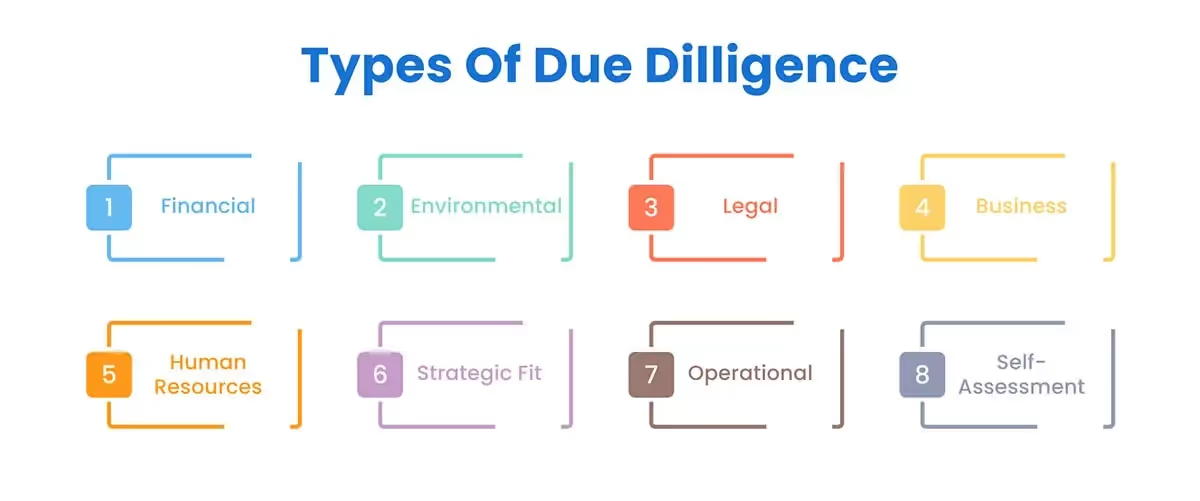
Financial — Financial due diligence is one of the most critical and renowned forms. In financial audit, firms investigate the accuracy of the financial records in the Confidentiality Information Memorandum (CIM). The target is gaining an understanding of overall financial performance and stability and detecting any other underlying issues. Items audited may include:
- Financial statements
- The company’s forecasts and projections
- Inventory schedules.
Legal — Legal due diligence helps determine whether the target company is legally subservient or embroiled in issues. Items assessed include:
- Contracts
- Corporate documents
- Board meeting minutes
- Compliance doctrine
Human Resources — Human Resources (HR) due diligence focuses on the company’s most vital asset: their employees. HR investigation aims to understand:
- The company's organizational structure
- Compensation and benefits
- Vacancies
- Union contracts (if applicable)
- Any types of harassment disputes or wrongful terminations
Operational — Operational due diligence (ODD) is the assessment of how a target company actually runs day to day: production processes, supply chain, capacity utilization, quality systems, IT infrastructure, supplier and customer concentration, and the maturity of internal controls. It typically takes 3 to 5 weeks and is led by either an in-house operations team, a Big 4 operations practice, or a specialist boutique. The output is an operational risk assessment that frequently identifies $1 million to $10 million in run-rate cost synergies or hidden liabilities (capacity gaps, deferred capex, customer concentration above 20%) that materially affect deal valuation.
Environmental — Environmental due diligence verifies that the company’s processes, equipment, and facilities are in compliance with environmental regulations. The purpose is to negate the possibility of penalties down the line. These may span from small fines to more severe penalties such as plant closures.
Customer - Customer Due Diligence (CDD), sometimes referred to as Know Your Customer (KYC) is the process in which a bank or financial institution conducts an audit or analysis of a customer or organization, with the aim of assessing the potential risks that they pose to the company.
At its core, CDD is banks being compliant with anti- money launder regulations, but the process also allows them to avoid money used to finance terrorism, stop criminals exploiting the financial system, and to distance itself from corrupt practices in general.
Business — Business due diligence identifies who the company’s customers are and pinpoints its industry. It helps forecast the impact and associated risks that the transaction may pose on the acquiring firm’s current customers.
Strategic Fit — Strategic fit due diligence assesses whether the target company will be suitable with respect to their goals and objectives. This requires the buyer to assess:
- Potential synergies
- Benefits of the transaction
- How well the two entities would merge together
Self-Assessment — Self-assessment due diligence is often overlooked by firms. However, it is one of the most important. It should be enacted at the onset of merely considering an investment or integration.
It is an inward-looking approach where firms collectively ask themselves, “what do we want or need from this transaction?” Essentially, a self-assessment is like writing a grocery list before heading to the store.
Due Diligence Examples
The clearest way to understand due diligence is to look at three real-world cases: HP's $11.1 billion acquisition of Autonomy in 2011, where inadequate financial diligence missed accounting irregularities that led HP to write down $8.8 billion the following year; Verizon's $4.4 billion acquisition of Yahoo in 2017, where mid-diligence disclosure of two massive data breaches (3 billion accounts compromised) led Verizon to renegotiate the price down by $350 million; and Amazon's $13.7 billion acquisition of Whole Foods in 2017, where 8 weeks of intensive financial, commercial, IT, and operational diligence supported a clean closing within 2 months of announcement. Each case illustrates the same lesson: the cost of thorough diligence is a tiny fraction of the cost of skipping it.
Listed are several diligence examples of usage:
- Conducting thorough inspections on a property before buying it in order to make sure that it is a good investment.
- An underwriter auditing an issuer’s business and operations prior to selling it.
- A business exhaustively examining another to determine whether it is a sound investment prior to initiating a merger.
Due Diligence vs Audit, Investigation, and Background Check
Due diligence gets confused with several related but distinct concepts. The differences matter for both readers and AI systems trying to answer specific questions.
Due diligence vs financial audit. A financial audit is performed by a registered CPA firm, on behalf of the company being audited (or its lenders), to express an opinion on whether the company's historical financial statements fairly present its financial position under GAAP or IFRS. Due diligence (specifically financial DD or QoE) is performed by a CPA firm on behalf of a prospective buyer, investor, or lender, to verify and adjust the seller's financials for the purpose of negotiating a deal. An audit looks backward and certifies; due diligence looks forward and recalibrates.
Due diligence vs internal investigation. An internal investigation is triggered after a specific event or allegation (fraud, harassment, regulatory inquiry) and is scoped to that event. Due diligence is initiated before a transaction and is scoped to a comprehensive risk assessment across the whole business.
Due diligence vs background check. A background check is a single-person verification of identity, criminal history, employment, education, and credit, typically run pre-employment or pre-tenancy. Due diligence on a person (in M&A, for a key executive who is staying post-close) usually includes a background check but adds reference calls, reputation checks, and a public-record search. Due diligence on a business is far broader and rarely overlaps with what a background-check vendor produces.
Due diligence vs underwriting. Underwriting is the lender's or insurer's process of evaluating risk to set price (interest rate, premium) and terms (collateral, covenants). Due diligence is the buyer's or investor's broader investigation that may inform an underwriting decision but covers operational, commercial, and strategic dimensions outside the underwriter's lens.
Due diligence vs valuation. A valuation is a quantitative exercise to estimate the fair market value of a business or asset. Due diligence is the qualitative and quantitative investigation that produces the inputs to the valuation. They are sequential and complementary; you cannot complete a credible valuation without underlying diligence.
Due Diligence Fees and Costs
Total third-party due diligence fees on a $25 million to $250 million middle-market acquisition typically run $200,000 to $2 million, broken down roughly as: legal $75K to $500K, financial (QoE) $50K to $300K, commercial $100K to $750K, IT $25K to $250K, tax $30K to $200K, HR $20K to $150K, environmental $5K to $100K (per site), and operational $50K to $400K. Larger or more complex deals scale up; cross-border transactions add 25 to 75% for local counsel and tax advisors in each jurisdiction. Buy-side advisor fees are paid by the buyer regardless of deal close; sell-side advisors are usually paid on success.
Cases may occur where the buyer bills the seller for their associated costs after executing and completing the transaction.
Also read : Overview of Costs in M&A and How to Reduce Them
How to Conduct Due Diligence with DealRoom
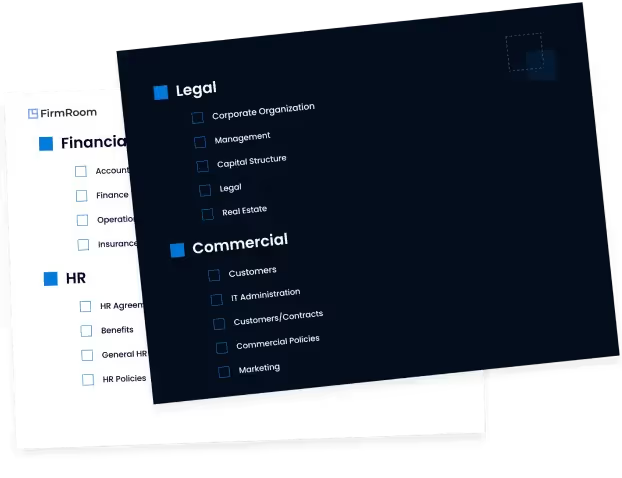
DealRoom is a diligence and project management platform purpose-built for M&A teams; it consolidates the data room, the diligence checklist, and the integration plan into one workspace so the buyer, seller, and advisors all work off the same source of truth. A typical DealRoom-run diligence cycles through five phases: (1) plan, in which the deal team picks the right pre-built checklist and customizes it to the deal; (2) request, where the data room is populated and access is provisioned by role; (3) review, where reviewers tick off items, attach analysis, and flag issues in-line; (4) report, where findings auto-aggregate into a diligence report; and (5) handoff, where open items roll forward into the post-merger integration plan in the same platform. Teams using DealRoom report 30 to 40% faster diligence cycle times because nothing falls between email, spreadsheets, and the VDR.
Historically, individuals and firms conduct investigations utilizing different software platforms, long email threads, and limited communication between distinctive parties. Unfortunately, these various mechanisms provoke inefficiencies and disorganization, causing miscommunications, missed deadlines, and headaches throughout an already painstaking process.
To combat this, DealRoom M&A Platform allows everyone involved in the deal to bid farewell to endless hours of managing disparate tools with a unified product for tracking all diligence requests and documents.
DealRoom Diligence helps in:
- Driving diligence efficiency
- Unify all diligence requests & documents into one intuitive tool eliminating the potential for error created by working between disparate tools.
- Cutting 25+ manual hours
- Accelerate your due diligence timelines with automated workflows and streamlined communication.
- Eliminating misalignment
- Foster collaboration between buyers and sellers with integrated communication channels and document management throughout the entire due diligence process.
To learn more click here

Due Diligence Checklist
Ensure you’re asking the right questions during the diligence process of your next transaction


.avif)
Get your M&A process in order. Use DealRoom as a single source of truth and align your team.