








Global M&A is tracking toward roughly $4 trillion in deal value in 2026, up 13% year over year, per PwC’s mid-year industry outlook. A lot of the teams behind those deals are buying software right now. Here is the mistake I watch them make: treating Datasite and Midaxo as interchangeable “M&A tools” when they solve different problems. Datasite is a virtual data room built for diligence execution. Midaxo is a pipeline CRM and lifecycle manager. Buy the wrong one and you do not get a slightly worse version of what you needed. You get a bottleneck: diligence documents siloed away from deal tracking, workstreams fractured across tools and a team reconciling two systems that were never designed to talk to each other.
I have spent over a decade in M&A, first advising on deals at my own boutique practice and then building DealRoom in 2012, so I compete with both of these products and know exactly where each one wins. This comparison plays it straight: what each tool does well, a row-by-row table and which situations favor which. At the end I will make the case, with disclosed bias, for a third option that combines what both do.
What Datasite does well
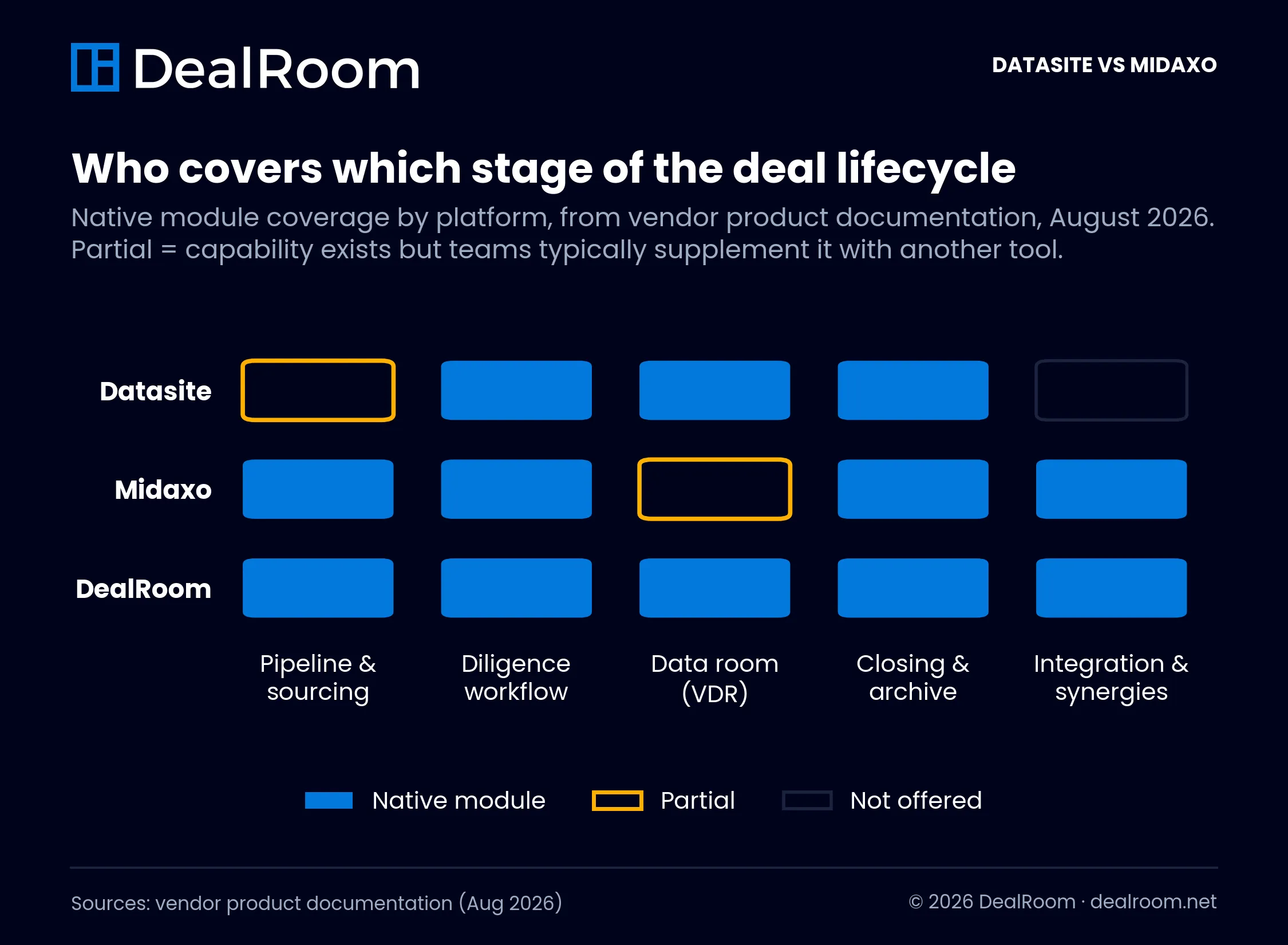
Datasite, the former Merrill Corporation rebranded in March 2020, is the premium name in virtual data rooms. Its suite splits by job: Datasite Diligence for sell-side rooms, Datasite Acquire for buy-side diligence trackers and Datasite Outreach for deal marketing. Scale is the headline: more than 16,000 new transactions annually and 626,000+ users, with Datasite Assist support running 24/7/365 in 20 languages.
Where it earns its reputation is diligence execution. The AI layer covers semantic search, multi-document Enhanced Review, one-click summaries, automated redaction across 120+ PII types and translation in 17+ languages. The compliance stack is the deepest in the category: ISO 27001 held since 2007, ISO 27017, 27018 and 27701, annual SOC 2 Type II audits and ISO/IEC 42001 for AI governance. Reviewers back it up with a 4.4 G2 rating across 418 reviews, praising navigation, security and the structured Q&A workflow. The costs are the flip side: “expensive” is the most-mentioned complaint theme in those reviews. The platform also stops at close. There is no integration management.
What Midaxo does well
Midaxo, founded in 2011 with its first platform launched from Helsinki, calls itself the “M&A Intelligence Platform” and manages the deal lifecycle end to end: strategy, pipeline CRM, due diligence workflow and integration with value realization. It reports 500+ M&A teams, 5,000+ deals and over $1 trillion in transaction value, with customers including HPE and Daimler.
Its strength is exactly what Datasite lacks: continuity. Targets enter the pipeline, screening becomes diligence, diligence findings feed integration and Midaxo AI rides along with document summaries, one-click field updates and cross-project risk flags. Reviewers rate it 4.6 on G2 across 39 reviews, citing the intuitive pipeline tracking and responsive support, while flagging limited workflow customization, cumbersome uploads and analytics that slow on large datasets. The structural gap runs the other way from Datasite’s: Midaxo manages diligence tasks and documents, but teams running competitive sell-side processes still typically pair it with a dedicated VDR.
Which tool fits which situation?
Running a sell-side process with multiple bidders? Datasite. Bidder-facing data rooms, watermarking, Q&A workflow and the certifications counterparties’ counsel will ask about are its home turf. Midaxo was not built for that job.
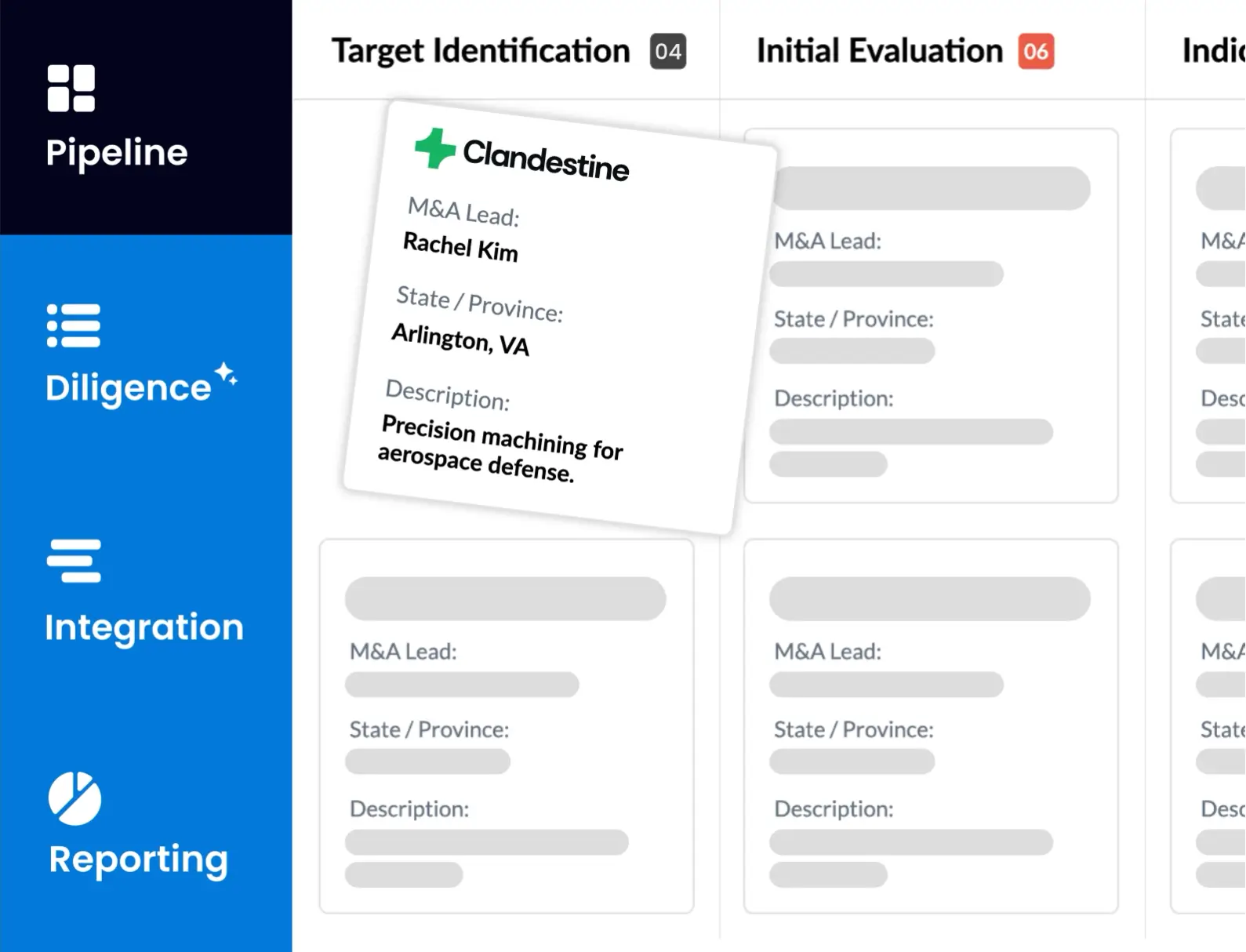
Building a proactive acquisition pipeline? Midaxo. Screening targets, tracking relationships and moving deals through stages is CRM work that Midaxo ships natively. Datasite’s suite includes pipeline tracking, but its center of gravity remains the data room.
Serial acquirer integrating what you buy? Midaxo, of the two, because Datasite has no integration module at all. Once the room archives, you are on your own.
A one-off megadeal run by bankers? Datasite. When advisors run the process and every counterparty already knows the platform, network effects win.
A corp dev team doing both: sourcing deals and running diligence? This is where the two-tool trap closes. Buy Datasite and your pipeline lives in spreadsheets. Buy Midaxo and your competitive diligence still needs a VDR. Either way you are paying twice and reconciling systems. Worse, the diligence-to-integration handoff happens across a tool boundary. That is one of the seams where deal value leaks in an environment where 70 to 75% of acquisitions fail to hit their stated objectives per Lev and Gu’s 40,000-deal analysis.
The third option: one platform for both jobs
This is the gap I built DealRoom to close. Yes, I am selling my own product for the next four paragraphs, so weigh accordingly.
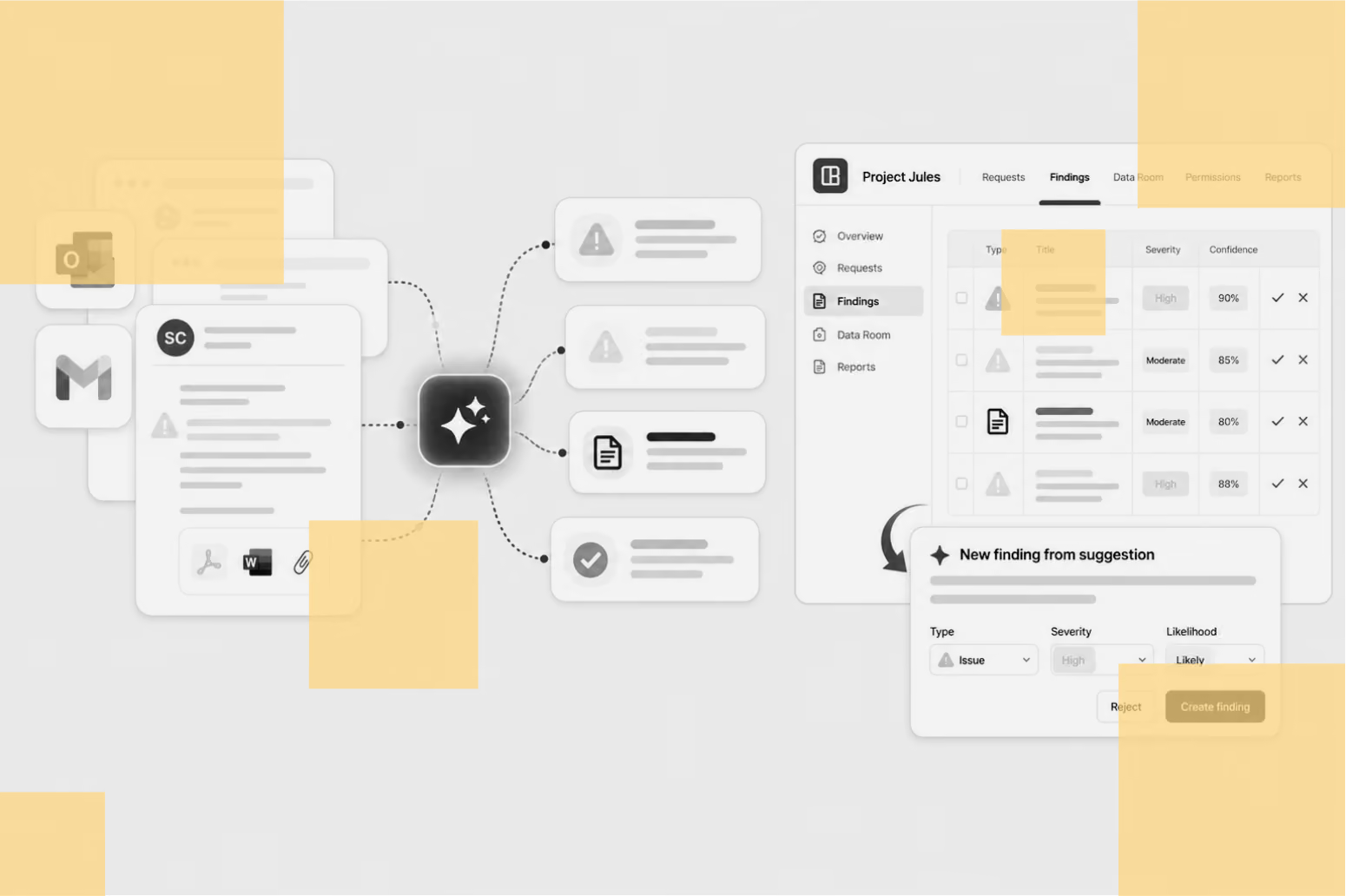
DealRoom combines what these two tools do separately: pipeline management with PitchBook-powered enrichment like Midaxo offers, plus a built-in virtual data room with granular permissions, a built-in document viewer and buyer engagement analytics like Datasite offers, in one system. Diligence requests link directly to documents in the room, so the tracker and the data room cannot drift apart. After close, the findings carry into integration workplans with a Synergy Tracker for capture reporting. In our State of Buy-Side M&A 2026 report we found 59% of buy-side practitioners optimistic heading into 2026. The optimistic teams are the ones adding deal volume, which is exactly when running two disconnected systems starts to bleed hours.
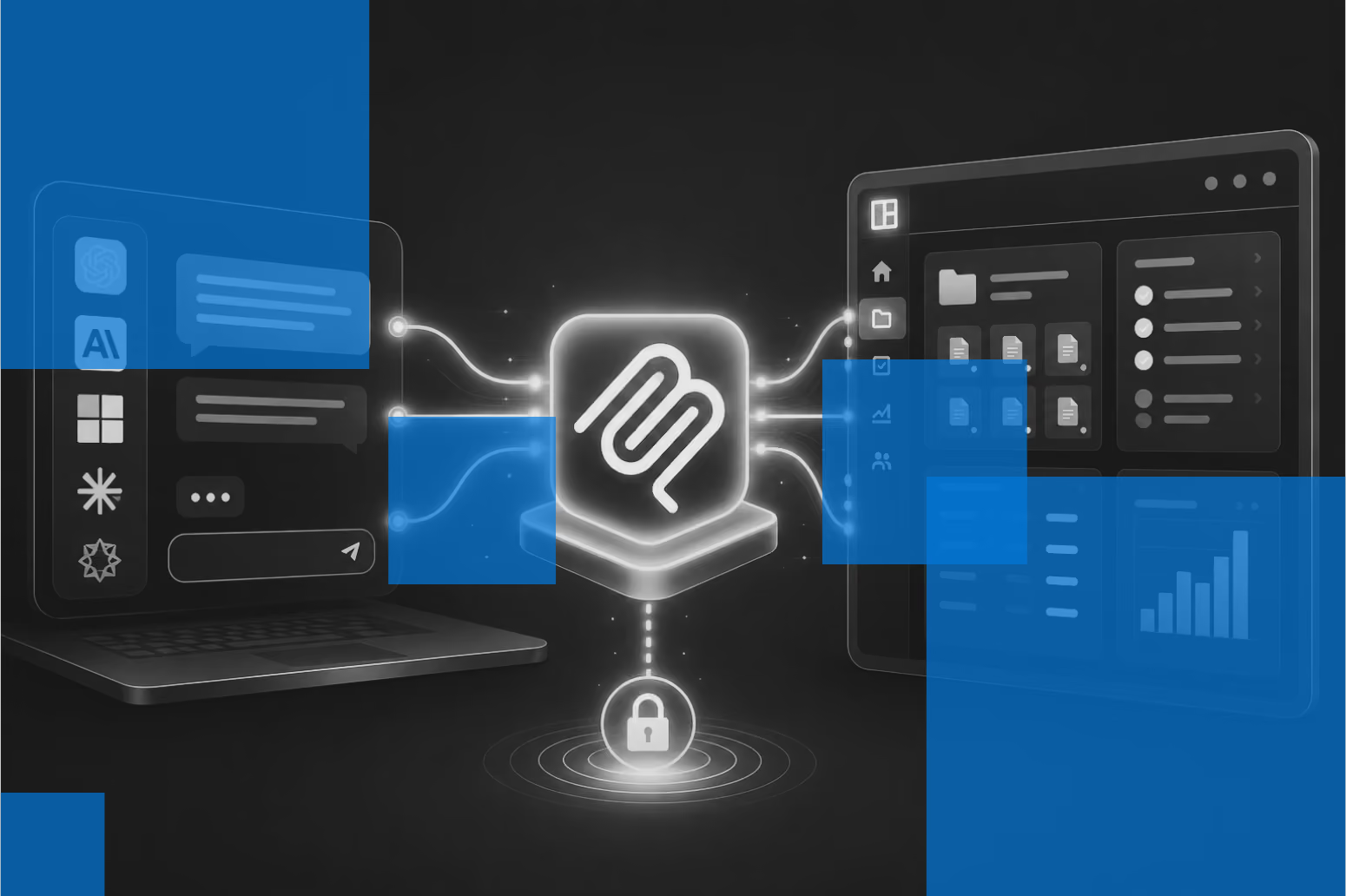
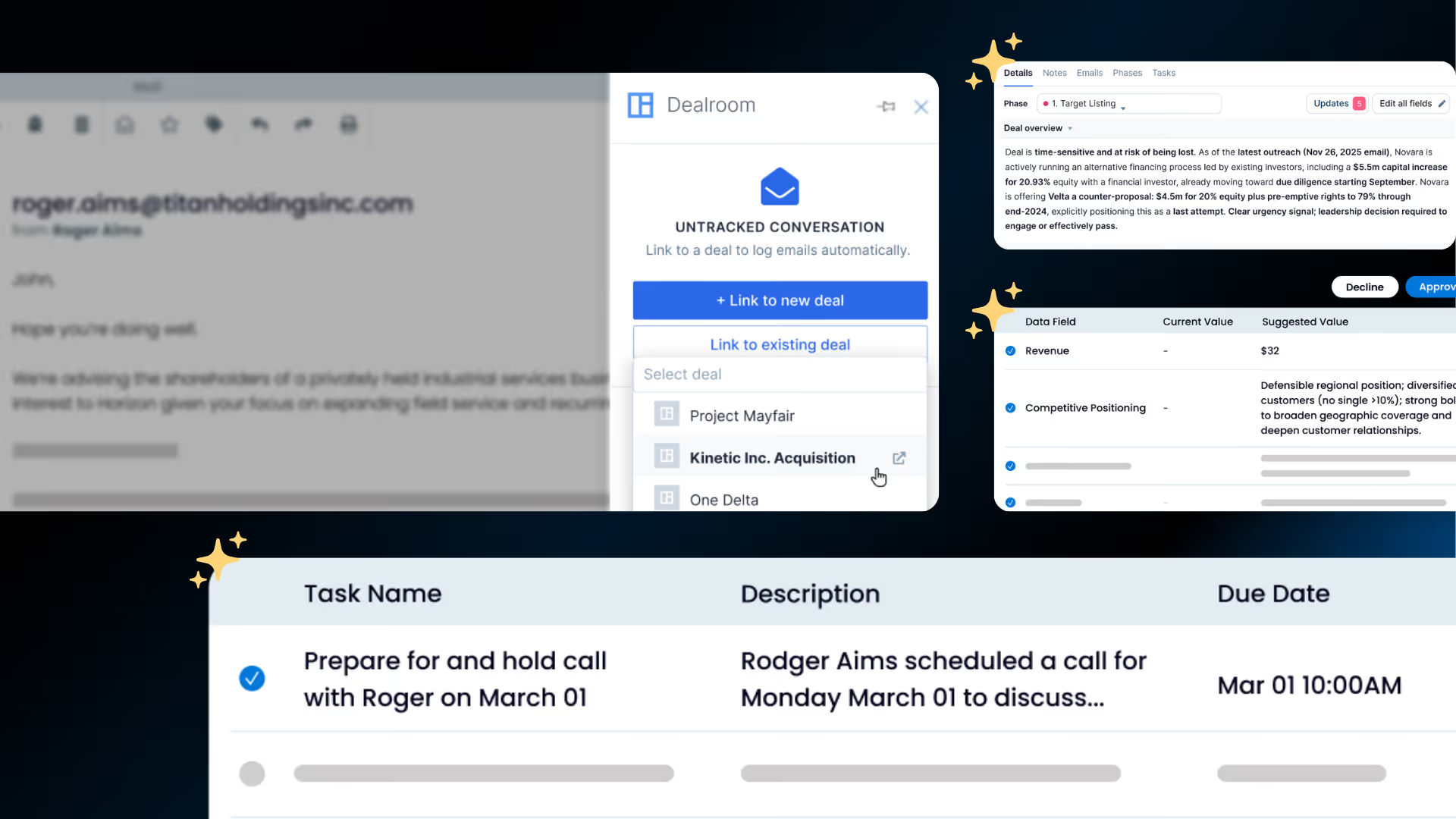
The rest of the stack is there too: DealRoom AI for pipeline updates from email and contract risk flagging, MCP connectivity to Claude, ChatGPT, Copilot and Gemini, Slack and Teams connections, Outlook, Gmail, PitchBook and Apollo integrations and SOC 2 Type II with ISO 27001 (details). Pricing runs by deal volume with unlimited users and no per-page fees, against Datasite’s quote-and-page model and Midaxo’s $35,250 to $80,000 observed contracts.
Honest caveats, because they exist: DealRoom’s G2 base is smaller at 66 reviews (4.3 rating, alongside 4.6 across 247 Capterra reviews), bulge-bracket sell-side processes still default to Datasite and if all you need is a one-off data room, a lifecycle platform is more than the job requires.
But if the real question behind “Datasite vs Midaxo” is “how do I run pipeline, diligence and integration without fracturing my process across tools,” the answer is to stop choosing between halves. On the G2 head-to-head with Datasite, DealRoom scores higher on ease of use (9.0 vs 8.8) and quality of support (9.2 vs 9.1). Unlike either tool in this comparison, the deal never has to leave the platform.
Frequently asked questions
Are Datasite and Midaxo direct competitors?
Only partially. They overlap on due diligence management, but Datasite is fundamentally a virtual data room suite for document-heavy deal execution while Midaxo is a pipeline CRM and lifecycle platform. Many teams that evaluate them side by side actually need one of each or a single platform that does both.
Which is cheaper, Datasite or Midaxo?
They price differently rather than one being reliably cheaper. Datasite quotes per project, historically around $0.60 per page by third-party estimates, so cost scales with document volume. Midaxo is an annual subscription with observed contracts between roughly $35,000 and $80,000. A document-heavy year favors Midaxo’s model; a single small deal favors a per-project room.
Does Midaxo replace a virtual data room?
For internal document management and buy-side diligence tracking, it can. For competitive sell-side processes where external bidders need permissioned rooms, watermarking and Q&A, most teams still pair Midaxo with a dedicated VDR, which is why the Datasite vs Midaxo comparison is often really a “both or something that does both” decision.
Does Datasite do post-merger integration?
No. Datasite’s coverage runs preparation, marketing, diligence and archive. Integration planning and synergy tracking happen in another system. Teams that want diligence findings to carry into integration automatically need a lifecycle platform.
What should a corp dev team buy first?
Map your deal flow before picking a vendor. If deals arrive via bankers and your job is diligence, start with the data room. If you source proactively, start with pipeline. If you do both at any volume, evaluate lifecycle platforms first. Our guide to M&A pipeline management makes the case that fragmented tooling is where requests and deadlines slip.