.jpeg)









The HVAC market is booming in 2026. Global HVAC Equipment-only projections range from $179-$193 billion. The total HVAC Market size (which also includes HVAC services, maintenance, software, etc.) is expected to hit $333.55 billion in 2026, growing from $310.58 billion in 2025 at a CAGR of 7.4%.
The first thing to consider when valuing your HVAC business is to have a concrete figure and a clear rationale for why you believe the figure to be accurate. Most buyers will use Seller’s Discretionary Earnings (SDE) or Earnings Before Interest, Taxes, Depreciation, and Amortization (EBITDA) multipliers and factor in revenue, profit, contracts, and service call revenue.
A practical approach will involve your financials, your revenue, your profit, your contracts, and other factors such as service contracts, equipment condition, technician mix, and customer retention. It’s not just about plugging the numbers into a formula. Buyers want to know about real revenue.
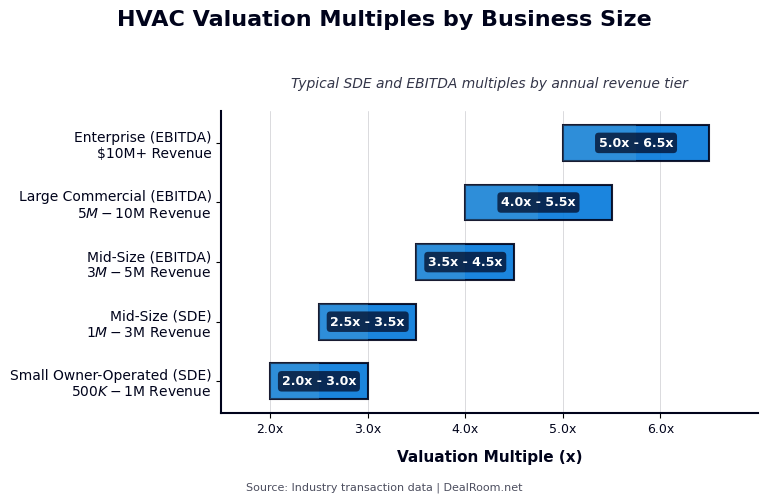
I've worked as an M&A advisor for over a decade now and one common theme I've noticed from over 400 discussions with deal practitioners is that trade service businesses are almost always undervalued. Typically due to owner error from assuming the buyer will see the same business they do. HVAC deals are some of the more dramatic examples of this phenomenon. Often times the difference between a shop trading at 2.5x versus 4.5x has nothing to do with revenue. It's the structure of contracts, depth of technicians, and how well the owner has captured the things that make their business operate without them. Get those elements wrong and no magic multiplier formula will save your deal.
This article will explore further the tools experts use to determine the value of an HVAC business, the different valuations used, and the steps business owners can take to increase the value of the business prior to sale.
HVAC Business Valuation
Professional business valuation using multiple methodologies
Business Details
Valuation Results
Sellable Discretionary Earnings (SDE): $500,000
EBITDA: $575,000
SDE-Based Valuation
EBITDA-Based Valuation
Revenue-Based Valuation
Most Likely Valuation Range
What is HVAC Business Valuation?
The calculation of the value of your HVAC business is referred to as HVAC business valuation. This is the calculation of the financial data of your business, such as SDE, EBITDA, revenue growth, hard assets like vehicles, tools, and soft assets like contracts and customer lists.
Accurate business valuation determines the price you can expect from selling your business, getting loans, tax planning, and exiting your business. Overvaluing or undervaluing your business will affect selling your business or getting loans.
Common Business Valuation Scenarios for HVAC Companies
When conducting a business valuation, not every scenario has the same objective. The scenario you find yourself in will determine what metrics are most important and what valuation method holds the most weight. Let’s review some of the most common scenarios you may encounter.
Selling the Business
If you’re shopping your business around for acquisition, the buyer will be looking for recurring maintenance contracts, up-to-date certifications and steady gross margin trends across all service lines. They want to determine how the business runs without you. Smaller owner operated shops are valued mostly with SDE. The larger your business and have a formal management structure in place, the closer your valuation will be tied to EBITDA.
Seeking Financing
If you’re seeking financing, keep in mind that lenders like predictability. Ideally, you want to show predictable cash flows for two to three years or more, clean accounts receivable aging reports, and diversified revenue that doesn’t consist of primarily one-time installs. Businesses with recurring maintenance contracts will find it much easier to get attractive financing than those with seasonal or project-based revenue.
Merging or Acquiring
Investment buyers are interested in more than just the P&L. Market penetration, cross-selling capabilities, and specialized services (controls, VRF, commercial refrigeration, etc.) can all command a premium during a merger or acquisition. If your company fills a gap in a buyer’s territory or provides a certification they’re missing, it could be worth more to that particular buyer than what financials alone would indicate.
Ongoing Business Planning
Valuation doesn't just happen when a deal is pending. Periodic evaluations allow owners to see if their investments in new personnel, equipment or growth are keeping up with (or getting ahead of) the underlying value being generated. An informed business understands when to expand, when to wait and where the best returns are realized.
Key Value Drivers in the HVAC Industry

The focus here should be on financial information, including future financial prospects, and relationships with customers and the company’s brand. This is where the interest is generated.
Revenue Streams and Profitability
Documentation of your revenue streams is a must. This includes installation projects, maintenance contracts, emergency service contracts, and parts and supplies. Buyers will love a high percentage of recurring maintenance contracts. They will also like the fact that it’s not seasonal.
Be sure to document your gross margins by type of service. Buyers will also be interested in technician productivity. Include revenue per tech as well as average invoice amount. Make sure you can prove you can control costs by demonstrating you track labor utilization, smart purchasing and fleet utilization. Normalize your EBITDA or SDE by removing owner compensation, one-time events and related-party transactions.
Include your recent revenue growth, your install backlog for scheduled installations, and your maintenance to install hours ratio. This will give the potential buyer a feel for the consistency of your cash flows in a downturn or during extreme weather conditions.
“There is a massive divide between the industry average and what is possible with a structured business model,” according to Business Development Resources (BDR). “While the industry average net profit margin for an HVAC business is often less than 2% due to poor expense management, HVAC businesses that implement a strategic financial plan can achieve stable net profit margins of 10% to 20%. For example, an HVAC company with $3 million in revenue, this represents a difference of over $500,000 in annual take-home profit.”
Customer Base and Contracts
Document your customer concentration, contract terms, and contract types. No single customer should represent more than 10-15% of your total revenue.
Recurring service contracts and multi-year contracts on commercial accounts will give your business more predictable revenue and thus more value for a potential buyer.
Document your churn rate, contract value, and renewal rate. For a residential business, document your marketing-driven customer acquisition cost and customer lifetime value. For a commercial business, document your key account managers and service level agreements.
Make sure you can assign permits/licenses and bonded work related to contracts. This will ensure your buyer stays happy and the cash continues to come in.
Reputation and Brand Strength
Don't brag about how great your reputation is if you can't provide proof in the form of your average rating, review count, Net Promoter Score (if you know it), and the ratio of referral business to paid marketing.
Add your operational reputation with your technicians’ certifications and training, safety records, warranty claim history, and ability to consistently acquire new customers with your referral pipelines, digital marketing programs, and local integrations. This is what breathes life into your brand.
Factor in your marketing capabilities like website traffic, CRM capabilities, and social proof. If you have proprietary maintenance checklists or service programs, boast about those too. This is what will make your business attractive to strategic buyers.
Valuation Methods for HVAC Businesses

Use these methods depending on the size of your business, profitability, and assets. Use the one that is more relevant to your business objectives, potential buyers, and quality of your business records.
Asset-Based Approach
Use this if your business equity is built from equipment, vehicles and inventory. This approach works best with smaller service-based businesses. Create a list of assets. This can include trucks, diagnostic equipment, rooftop equipment, parts, compressors, ect. You will then want to list the date purchased, original cost, depreciation, and fair market value.
List leases, customer deposits, warranty reserves, etc. as liabilities. Total up your NAV: Fair Market Value of Assets – Total Liabilities. Take into consideration any seasonal parts you may need to purchase for your business and/or any service contracts you may have already paid for your business.
Income-Based Method
This method will perform best for profitable and growing HVAC businesses with consistent service revenues. For owner-operated businesses, it’s best to use the SDE method. For larger businesses with multiple management levels, it’s best to use the EBITDA method. Eliminate owner benefits, one-time non-operating revenues, and unusual expenses from business earnings.
Project the cash flows out for 3 to 5 years and apply the multiple method or discounted cash flow method. Some of the things you must consider include revenue growth rate, gross margins, contract renewal rate, and capital expenditures for company vehicles and equipment.
Local markets, technician availability, and customer base will also influence the discount rate. Bring contracts, forecasts, and technician productivities to the negotiation table if you want to achieve a high multiple. Your earnings will be stress-tested by potential buyers.
Market-Based Method
Compare your HVAC business with similar deals and multipliers. Research similar deals and multipliers based on HVAC business transactions done in the past year or two. Research similar deals and multipliers based on revenues, geographic markets, type of service (residential and commercial), and earnings margins.
Multipliers include SDE multipliers for businesses with revenues up to $3 million and EBITDA multipliers for large HVAC businesses. Use publicly available HVAC multipliers and then adjust according to growth rate, contracts, technician depth, and brand name.
Create a table for better organization of the information that includes Company, Revenue, SDE/EBITDA, Multiple, Date. You can adjust according to long-term contracts, proprietary software, and high margins. If you fail to find similar deals in your area, look for similar regions and adjust according to risk.
Be sure to document sources used in making the adjustments. This information will have to be made available for review by potential buyers during the due diligence phase.
Valuation Method Comparison Table
You need to be aware of the advantages and disadvantages of every approach in order to determine the best approach to use in valuing the HVAC business. The following table shows the advantages and disadvantages of every approach in comparison to the others.
Selection Guidance:
These three methods should be used in combination for a more justifiable valuation.
- The Asset-Based method will dominate in cases where the condition of the equipment matters or the business has been distressed.
- The Income-Based method will dominate in cases where the business is profitable and has been established for a long time in the HVAC industry.
- The Market-Based method will dominate in a competitive market where transactions and comparable sales are easily available.
How HVAC Valuation Differs from Other Trades

There are a few factors that set HVAC business valuation apart from other service trade businesses including plumbing, electrical, general contracting, and similar businesses. Whether you’re on the buying or selling side of an HVAC business, here’s what you should know.
Seasonal Revenue Patterns
Seasonality affects HVAC in a way that it doesn’t affect plumbing or electrical. HVAC customers surge in summer and winter, and slow to a crawl the rest of the year. If you bring in 40% of your annual revenues during one quarter of the year, buyers will view that as a risk to your cash flow and will discount their multiple to compensate. Other trades have seasonality, but not usually to this degree.
EPA 608 Certification Requirements
Any technician handling refrigerant must have EPA 608 certification. There is no bypassing this requirement. If 100% of your field technicians are certified, your business has significantly less operational risk than one that's at 60%. Plumbers and electricians can fall behind on their license certifications and still operate. Those positions are also far easier to fill. EPA 608 certification creates a smaller pool of technicians with a harder to replace skill set that has a direct impact on your team’s stability and value.
Recurring Maintenance Contracts vs. One-Time Jobs
This is by far the biggest multiple driver in HVAC valuations. Companies that generate 50-60% of revenue from recurring maintenance contracts trade anywhere from 4.0-4.5x SDE. Companies with approximately 20% recurring maintenance revenue typically trade at 2.5-3.0x. Plumbing and electric companies can sell maintenance contracts as well, but the nature of the HVAC service business allows for annual recurring agreements that buyers just don’t see in other industries and are therefore willing to pay a substantial premium for.
Technician Dependency and Skill Level
HVAC work is technical work. It can take five plus years to develop a qualified commercial HVAC technician that also holds EPA 608 along with manufacturer certifications. If you lose one or two technicians after an acquisition, you can see a 20-40% reduction in first year revenue. Companies that have deep benches and emphasize technician cross-training will receive higher multiples. High turnover is a big red flag. Key-person risk is prevalent in other trades, but it's a larger risk in HVAC due to the amount of training and length of time to develop technicians.
Summary: What Makes HVAC Different
HVAC businesses are unique and require special consideration when it comes to valuation. Using standard service industry multiples will not accurately capture the value of a revenue-producing HVAC business.
Factors Influencing HVAC Business Value

After understanding what makes HVAC valuations unique, you’ll want to know what specific items affect your number and how to properly communicate them to buyers.
Geographic Market and Service Area
Where you do business determines your revenue potential and risk. Operating in dense urban markets allows you more customers within a smaller geographic area. Less drive time equates to higher technician utilization and better net margins. Rural franchises have the potential to create rock solid businesses with loyal customers, but longer drive times eat into your profit.
Don’t forget about climate as well. If your business is located in Phoenix where you have a 9-month cooling season, the service demand for your business is dramatically different than one located in Minnesota. Buyers will value that risk accordingly.
Fewer competitors in your area, exclusive contracts with municipalities and protected service territories also decrease your risk by making your revenue much more defensible. Provide buyers with a map of your service areas and highlight the average drive time to a service call. Also be sure to list any exclusive service contracts that mitigate your competitive risk.
Growth Potential and Scalability
There is growth in the HVAC industry every year and buyers will pay for the ability to capture more of that growth. Be sure to include revenue growth history, customer acquisition cost, customer lifetime value and any backlog/project pipeline. Maintenance contracts that renew annually and long-term commercial agreements help this narrative immensely.
Take it a step further with scalability: Can your system be duplicated in another zip code? Do you have digital lead generation, a maintenance subscription model or contacts with builders/property managers you can scale with geographic expansion? A three year growth plan with staffing needs and capital expenditure payback can be a great addendum to your sales package. Back this all up with tracked metrics like call-to-schedule conversion, average ticket size and technician utilization.
Licensing and Certifications
Licenses and certifications provide peace of mind on transaction risk and access to higher tiers of more profitable work categories. The minimum requirements (state contractor’s license, EPA 608, local mechanical/plumbing licenses) should be up-to-date, fully documented and transferable. Additional requirements may include bonding and prevailing wage capabilities for commercial work.
Certifications from manufacturers like Carrier, Trane, or Lennox, and specialty certifications for controls, VRF, or gas work demonstrate technical expertise and will allow you to charge premium prices for select jobs. Either way, keep a detailed record of every license and certification you own: license number, issue date, expiration date, name of holder, restrictions to scope of work. Buyers will ask for and check each of these during their due diligence process, and incomplete credentials can steal a lot of value from your deal in a hurry.
Preparing for a Successful HVAC Business Valuation
If you want to prepare for a successful HVAC business valuation, there are certain steps that you should take. You’ll want to make sure you have clean records, as well as service revenue and effective field operations. Read below to find out some steps to take to ready your business for a successful valuation.
Gathering Financial Statements
When gathering your financial statements for the business valuation, make sure you have at least three years’ worth of audited financial statements. However, if you’re unable to obtain audited financial statements for your business, you may want to make sure you have internally prepared financial statements with supporting schedules.
The financial statements will want to include income statements, balance sheets, cash flow statements, owner compensation, and adjustments for non-recurring items.
You may want to consider providing a month-by-month income statement for the last 12 to 24 months so that trends can easily be seen.
You may also want to consider providing other information such as accounts receivable and payable aging reports, bank statements, tax returns, capital expenditures schedules, vehicle and equipment schedules, leased assets schedules, and add-back schedules so that normalized SDE can easily be seen.
Organizing Client and Contract Data
A list of clients can be created with information such as type of contract, start date, term, annual value, and renewal. The list can be organized to show recurring maintenance contracts, such as monthly or annual billing. The list can also be organized to show the number of residential, commercial, and municipal clients.
Churn metrics such as new vs. lost clients per year, average length of contract, revenue retention, etc. can be offered. Major client concentration can be shown as a percentage, as well as contracts with escalation clauses/termination penalties.
Work order history, agreement templates, and collection information can be gathered for all clients. A quick table can be created for your top 10 clients, including annual revenue generated per client and contract expiration dates.
Assessing Operational Efficiencies
A visual can be created to show technician dispatch routes, average time to complete jobs, and first time fix percentages. This will show labor efficiencies. Consider sharing dispatch reports, vehicle utilization, and inventory turnover reports.
Processes can be standardized such as technician onboarding, safety processes, and preventive maintenance processes. This will show how you can reduce the perception of risk.
Gross margin percentages can be broken down by service type. Pricing and markup criteria can be explained. Bottlenecks such as inventory, billing, warranty, etc. can be identified, as well as what you are doing (or did) to solve them. This will show you have processes in place for a higher value.
Take the Next Step Toward a Successful HVAC Business Sale
When preparing your HVAC business for sale, everything should be clean, documented, and organized. Contracts should be lined up and clean financials prepared. But preparing for sale involves much more than just having the information available. If you want to sell your HVAC business for top dollar, everything should be prepared to stand up to the scrutiny of potential buyers.
That means walking into due diligence with absolutely nothing to hide. DealRoom's M&A platform replaces inefficient spreadsheets, email threads, and siloed tools that drag deals out. Financials, maintenance contracts, technician certifications, licenses, and more can all be stored in one central repository and shown to the right people at the right time, from preparation of valuation to closing.
Request a demo to see how DealRoom can help you manage your next HVAC transaction.
Frequently Asked Questions
What is the average EBITDA multiple for HVAC businesses?
Typically, the HVAC businesses tend to sell at 4-6 times EBITDA. However, this may vary depending on the business. For small owner-operated businesses, the multiples may be 2-3 times SDE.
How much does recurring maintenance revenue impact the valuation?
The higher the recurring maintenance revenue stream a business has (e.g., 40-60%), the more value it adds. You may see multiples 20-40% higher as a result.
What financial information would the buyers need?
Buyers want to see a minimum of three years of financial information. They need income statements, balance sheets, and cash flow statements. They will also want to see owner compensation information. AR/AP aging reports would be necessary as well.
How would I minimize the risks for the buyers and maximize the valuation?
By decreasing customer concentration, owners can help minimize risk for potential buyers. Try to secure as many long-term contracts as you can. Keep clean financials, and document your business processes. Make sure your licenses are up to date. Have a good tech support system in place. Keep your reviews positive.
Does the location really impact the valuation?
Yes, sometimes significantly. Businesses in urban areas may benefit from the higher customer count. They may not need to travel as much.









.png)