








Due diligence is where 26% of the 237 M&A practitioners we surveyed for our State of AI in M&A 2026 Report expect AI to have the greatest impact over the next 12 to 24 months. A due diligence checklist is the list of documents a buyer asks a target company to produce before signing an M&A deal, grouped by workstream. This due diligence checklist covers 110 documents in 10 workstreams, from audited financial statements and material contracts to patents, employment agreements and cybersecurity audits. I have worked from lists like this for over a decade as an M&A advisor and since founding DealRoom in 2012.
{{widget-hsembed}}
Beyond the asset itself, here is more background on what's covered in the checklist along with some additional custom tools we built for those conducting due diligence.
First you can use the interactive checklist tool below to track your progress against the key documents:
We also built this due diligence timeline planner to help answer one of the most common due diligence questions: how long will the due diligence process take?
Complete Due Diligence Template: All 110 Documents in 10 Workstreams

Having a solid due diligence checklist is essential to keep track of your due diligence progress. Here's a list of the core due diligence documents:
1. Legal Due Diligence Checklist (8 Documents)
A comprehensive legal due diligence checklist requires 8 documents, including shareholder certificates, business licenses and permits, and the company's outstanding legal cases. These documents establish whether the target has clean ownership, regulatory standing to operate, and no undisclosed litigation exposure for the buyer.
These documents generally cover all legal aspects of a company’s operations. These are some of the most important documents a buyer would ask during this process, which are essential for the seller’s business. Here are the key types of legal, due diligence documents:
- Shareholder certificate documents
- Local/state/federal business licenses
- Occupational license
- Building permits documents
- Zonal and land use permits
- Tax registration documents
- Power of attorney documents
- Previous or outstanding legal cases
Don't miss our complete legal due diligence checklist.
2. Financial Due Diligence Checklist (19 Documents)
A comprehensive financial due diligence checklist requires 19 documents, including 3+ years of audited financial statements, all loan and credit agreements, and the company's full capital structure. These documents establish the target's true earnings power, debt obligations, and balance-sheet risk for the buyer.
Financial due diligence documents are essential in assessing the financial health and viability of a company. These documents provide a clear view of the target company's financial status and performance history. Here are some of the most important financial documents commonly requested during M&A:
- Up-to-date tax return documents
- Audited financial statements (at least 3 years)
- Auditor's correspondence for the last five years
- Copies of all loans and credit agreements
- Details of company investments (bonds, marketable securities, etc.)
- Capital structure
- Projections, capital budgets, and strategic plans
- Up-to-date tax and pension liabilities
- Details on when contracts and leases are renewed and whether the terms change
- Details of stockholders (percentage holdings, voting rights, etc.)
- Foreign exchange reserves
- List of unrecorded liabilities
- List of collateral for debt
- Details of owner withdrawals (if any)
- Revenue by client (if possible)
- Gross margins analysis
- Fixed/variable expenses analysis
- List of non-operational expenses
- General ledger
{{cta-block3}}
3. Sales and Marketing Due Diligence Checklist (10 Documents)
A comprehensive sales and marketing due diligence checklist requires 10 documents, including the sales and marketing strategy overview, revenue by customer, and details of existing sales contracts with their expiration dates. These documents establish the durability of revenue and the customer-concentration risk for the buyer.
- Detailed overview of sales and marketing strategy
- Marketing/sales coordination protocols
- Revenue listed by customer
- Exhibit the relationship between marketing expense and revenue growth
- Details of existing sales contracts (and when they expire)
- List of top 10 suppliers
- Sales reports by category of product or service
- Details of credit terms with customers
- Current market share (if possible)
- Percentage of sales from each channel (e.g., online, offline, direct sales, etc.)
4. Human Resources Due Diligence Checklist (10 Documents)
A comprehensive HR due diligence checklist requires 10 documents, including the full employee and contractor roster, employment terms and contracts, and worker's compensation and unemployment claims history. These documents establish the workforce cost structure, key-person risk, and inherited employee liabilities for the buyer.
- Provide a list of current employees and independent contractors
- Employee Rules of Conduct Handbook and Safety Policies
- Detail past employee disputes (if any)
- Detail employee and independent contractor terms of employment
- Detail updated employee resumes
- Outline the policy of working with labor unions (if any)
- Outline training conducted with existing employees
- Worker's compensation/unemployment claims history
- Outline policy of bonuses, incentives, commissions, and deferred commissions
- Detail policies for sick days, paid holidays, paid vacations, and overtime pay
5. Property, Plant and Equipment Due Diligence Checklist (4 Documents)
A comprehensive property, plant, and equipment due diligence checklist requires 4 documents covering equipment, real estate, technology, and inventory. These documents establish the target's tangible asset base - what the buyer is actually acquiring on the balance sheet beyond the operating business.
- Equipment
- Real estate
- Technology
- Inventory
6. Contract Due Diligence Checklist (11 Documents)
A comprehensive contract due diligence checklist requires 11 documents, including all customer contracts, supplier and joint-venture agreements, and equipment leases plus loan and credit guarantees. These documents establish the change-of-control consents the buyer will need at closing and the contractual obligations being assumed.
- Customer contracts
- Supplier contracts
- Joint venture/partnership agreements
- Settlement agreements
- Franchising agreements
- Accounts receivable schedule
- Accounts payable schedule
- Equipment leases
- Non-compete agreements
- Employee contracts
- Loans, credits, and guarantees agreements
7. Intellectual Property Due Diligence Checklist (15 Documents)
A comprehensive intellectual property due diligence checklist requires 15 documents, including issued patents and patent applications, trademarks, and all licensing agreements (both inbound and outbound). These documents establish the target's IP ownership, freedom to operate, and the licensing-revenue obligations being acquired by the buyer.
- Trade secrets
- IP claims and litigation
- Domain names
- Issued patents
- Patent applications
- Design patents
- Design patent applications
- Industrial designs
- Industrial design applications
- Liens on intellectual property
- Copyrights
- Licenses
- Licensing agreements
- Trademarks
- Agreements/documents regarding ownership and rights of use of advertising copy, trademarks, logos, and slogans
8. Company's Good Standing and Organization Due Diligence Checklist (11 Documents )
A comprehensive corporate good-standing and organization due diligence checklist requires 11 documents, including the organizational chart, articles of incorporation and bylaws, and a Certificate of Good Standing from each Secretary of State where the company conducts business. These documents establish that the target is a legitimately organized entity with the corporate authority to enter into the transaction.
- Organizational Chart
- Shareholders/percentages owned
- Voting trusts, subscriptions, calls, puts, options, and convertible securities agreements
- State of incorporation status reports for the last three years
- Assumed names
- Company minutes book
- Company bylaws and amendments
- List of the states and countries where the company has employees owns assets, leases assets, and does business
- The Articles of Incorporation/amendments.
- Annual reports for the last three years.
- A Certificate of Good Standing from each Secretary of State where the company conducts business
9. Real Estate Due Diligence Checklist (10 Documents)
A real estate due diligence checklist requires 10 documents on top of the 88 documents in workstreams 1 to 8, including a title insurance commitment, an ALTA/NSPS land title survey, and a Phase I environmental site assessment. These documents establish that the property has clean title, defined boundaries, and no environmental liabilities the buyer would inherit.
If the target company owns or operates real estate, these 10 documents sit on top of the 88 documents in workstreams 1 to 8. These are typically pulled in by either the buyer's real estate counsel or a third-party title company, and the deadline to deliver them is usually written into the purchase agreement as a "real estate due diligence period" of 30-60 days.
- Title insurance commitment - issued by the title company, lists encumbrances, easements, and required endorsements.
- ALTA/NSPS land title survey - prepared to the 2026 Minimum Standard Detail Requirements, which took effect February 23, 2026 and replaced the 2021 standards; the boundary survey most institutional lenders require.
- Phase I environmental site assessment (ESA) - per ASTM E1527-21, the edition EPA recognizes under its All Appropriate Inquiries rule; required to preserve the CERCLA landowner liability protections, including the innocent landowner defense.
- Phase II ESA (if Phase I flags recognized environmental conditions) - subsurface soil and groundwater testing.
- Zoning verification letter - municipal confirmation of allowed uses, setbacks, and any nonconforming-use status.
- Certificate of occupancy - current CofO for each building/unit.
- Rent roll and lease abstracts - current rent roll plus abstracts for all leases over 5,000 sq ft or 5% of NRA.
- Operating expense recoveries (CAM) reconciliations - last 3 years, to validate the underwriting NOI.
- Property condition report (PCR) - structural, mechanical, roof, and parking-lot assessment with deferred-maintenance estimate.
- Real-estate tax bills and assessment appeals - last 3 years of bills plus any pending or recent appeals.
For deals where real estate is the primary asset (rather than incidental to an operating business), the buyer's diligence team typically also pulls a separate set of documents covering the surrounding submarket - tenant financial statements, comparable lease and sale data, and traffic counts - which fall outside this checklist's scope.
10. Technology, Cybersecurity and Data Privacy DueDiligence Checklist (12 Documents)
A technology,cybersecurity and data privacy due diligence checklist requires 12 documents,including the IT systems inventory, the most recent third-party security auditand the data map showing what personal data the target holds and where. Thesedocuments establish whether the buyer is acquiring a security incident, aprivacy regulator's attention or software it does not actually own.
IBM's Cost of a Data Breach Report 2026 puts the global average cost of a breach at $4.99 million and the US average at $11.5 million. Twenty US states now have consumer privacy laws of general application on the books, so a target that sells nationally answers to a patchwork of regimes, plus GDPR if it has European customers. In our State of AI in M&A 2026 Report, dataprivacy and security was the barrier to AI adoption most often cited by the 237 practitioners we surveyed (26%), which is also why buyers now ask how the target itself uses AI.
- IT systems inventory and architecture overview(applications, hosting and cloud providers
- Software license and SaaS subscription schedule,with renewal dates and seat counts
- Open-source software inventory and licensecompliance report
- Source code ownership and IP assignmentagreements for developers and contractors
- Information security policies and the mostrecent third-party audit (SOC 2 Type II or ISO 27001)
- Penetration test reports and remediation log forthe last two years
- Security incident and data breach log, includingnotifications to regulators and customers
- Data map or record of processing: what personaldata is held, where it is stored and on what legal basis
- Privacy policies, consent records and dataprocessing agreements with vendors
- Compliance evidence for the regimes that apply(GDPR, CCPA and the other state privacy laws, HIPAA, PCI DSS)
- Cyber insurance policy, limits and claims history
- AI usage inventory and governance policy: AItools in use, any models trained on customer data and who approved them
The target's CTO or CISO usually owns this workstream; on software or data-heavy targets, buyers also bring in a security firm for the technical review.
When Should You Provide Due Diligence Documents to the Buyer?
Keeping thorough and updated due diligence documents allows you to get relevant information over to the buyer of your business efficiently and with as little friction as possible. But the question then arises:
- When should due diligence documents be provided to the buyer?
- Can this be done too quickly?
Absolutely. Unfortunately, the world of M&A is full of tire-kickers who enjoy finding out about businesses simply to see what’s out there. Asking you for due diligence documents rarely costs them anything (hence the reason why some bankers push for charging buyers for due diligence).
The best policy is to begin by providing audited financial statements - a great signaling device for any owner looking to sell their business that their ship is in order - and send over documents as they’re requested by the buyer, who should have signed an NDA in advance.
The more buyers you speak to, the more likely you’ll be able to anticipate what documents they’re looking for in advance, making the process even more efficient.
How to Collect and Share Due Diligence Documents
What emerges from all the documents outlined above is a true understanding of the business for sale and what’s ‘under the hood.’
Many of the documents will be partially or fully available straight away (for example, details of your employees and their training to date), while others, such as the audited financial statements, will, by their very nature, take longer to put together.
Below, we will share and compare how to collect and share due diligence documents using the old-school way, and the modern approach of doing M&A.
If you would rather not build the list by hand at all, the Diligence Request List Generator in our free M&A Skills Library produces a complete request list with priorities and owners and exports straight to Excel, ready for the data room.
The Old School Way: Using Excel Sheets
Collecting due diligence documents should be done in a systematic manner that allows you to see where documents can be obtained, whether more should be added, progress reports on their collection and more. We suggest putting together a list in a table format structured similarly to the one provided below:

Keeping structured records like this in a spreadsheet also allows you to filter for results faster. Whatever headings you opt for, the ‘last updated’ column is particularly important, allowing you to see at a glance when due diligence documents were last updated and, thus, how likely they are to be relevant.
However, using spreadsheets has limitations, risks, and inefficiencies.
- Data security- a spreadsheet has no document-level permissions and no audit trail, and it travels by email. IBM's Cost of a Data Breach Report 2026 puts the global average cost of a breach at $4.99 million, which is the exposure when a tracker full of deal data is forwarded around.
- Time-consuming - Using Excel involves relying on manual data entry, which can be extremely time-consuming. Also, with the number of people involved in an M&A deal and different people from different departments touching the spreadsheet, errors will likely occur. One wrong formula, formatting, or data entry can wreak havoc on the entire spreadsheet.
- Real-time collaboration- Excel Sheets are not designed for real-time collaboration, which can cause bottlenecks and inefficiencies. Team members will have to wait for the latest version of the file before they can start working on their part. If not, they could be working with outdated information or duplicating someone else’s work.
- Integrated communication: Communication in Excel trackers relies on external channels, such as email or messaging apps. This can lead to fragmented discussions and a lack of context within the platform, creating confusion.
- Cannot store diligence files - Excel cannot store files and will also rely on third-party applications. This limitation often results in confusion, lost files, or hard-to-find files.
A Better Way to Do M&A: DealRoom's AI-Powered End-to-End M&A Platform
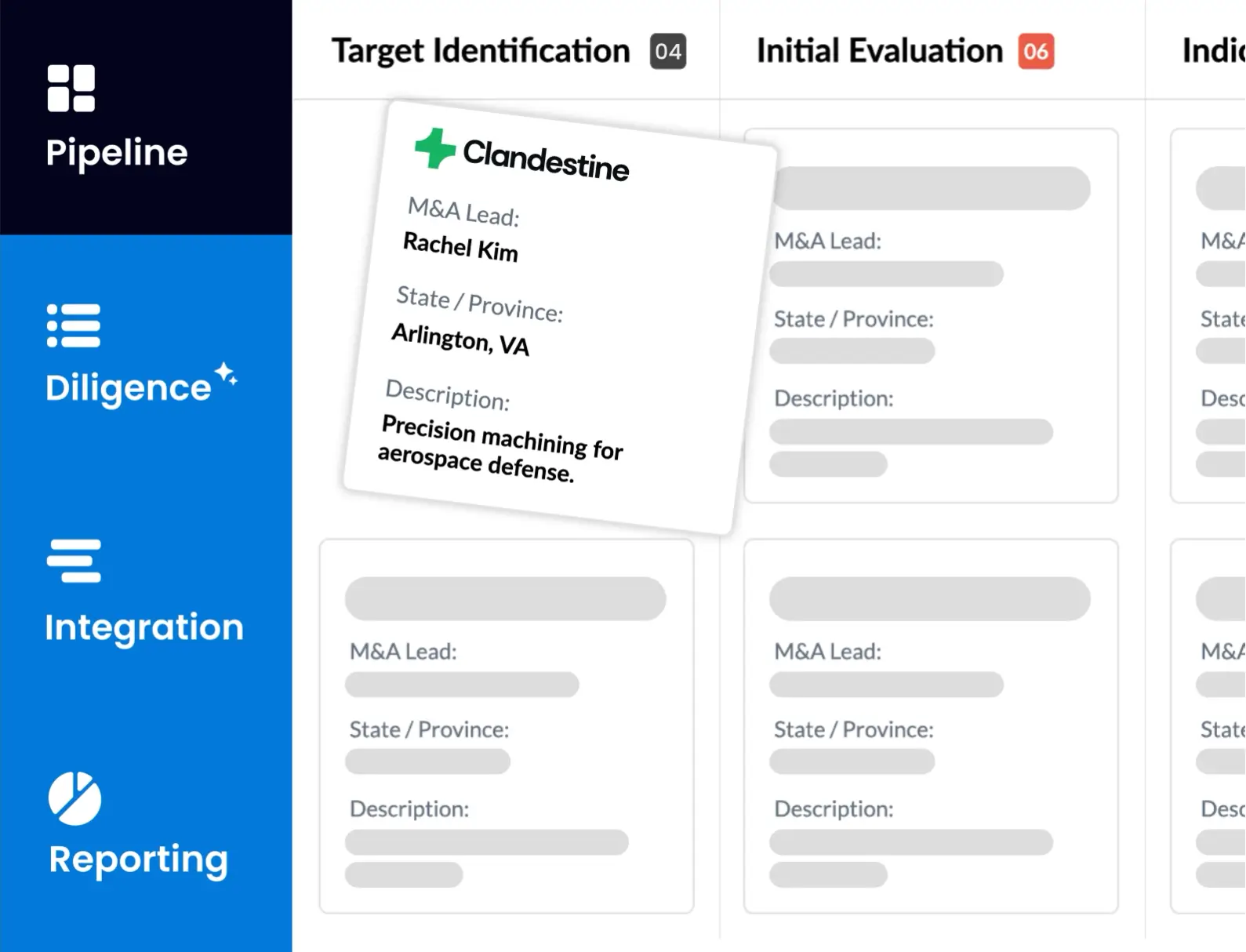
DealRoom, on the other hand, is an AI-powered end-to-end M&A platform purpose-built by M&A practitioners. It’s designed to handle the entire M&A process, from pipeline management and due diligence to integration. Let’s take a look at some of the advantages of using DealRoom.
- Cut 25+ manual hours per deal -DealRoom is a unified, end-to-end M&A platform that allows users to centralize all deal data and communication. This enables M&A teams, both internal and external, to save significant time and, therefore, money. In addition, DealRoom users can automate playbook creation to remove duplicative and time-consuming playbook creation tasks for every single deal.
- Reduce cost - Because DealRoom M&A Platform is an all-in-one platform, instead of relying on and paying for a broad set of tools, teams can reduce their technology expenses. The increased efficiency that DealRoom powers also reduces billable hours and accelerates deal velocity, contributing to lower costs.
- Increases Alignment - What truly sets DealRoom apart from other software is its parallel workstream capabilities. It allows the diligence team and the integration team to work together simultaneously, more specifically, it empowers the integration teams' earlier visibility of deal theses. Which, in turn, increases the success rate of deal value capture.
Spreadsheets still work for a one-off deal, but most teams have moved on: in our State of AI in M&A 2026 Report, 82% of the 237 practitioners we surveyed were already using or piloting AI in their M&A process, and that work runs on structured deal data rather than email attachments.
For more information about how to use DealRoom for this process, check out DealRoom for due diligence.
Frequently Asked Questions
What is due diligence in the context of startups and investments?
Due diligence in M&A is the buyer's structured review of a target company's financial, legal, commercial, HR, IP and technology records before a purchase agreement is signed. It confirms what the seller has represented, surfaces liabilities and feeds the price, the warranties and the integration plan. On most deals it runs30 to 90 days between the letter of intent and closing, organized around a document request list like the 110-item checklist on this page.
Why are due diligence documents important?
Due diligence documents are the evidence behind every number in the deal model and every representation in the purchase agreement. Audited financial statements verify earnings, material contracts show which customers can walk away on a change of control and litigation and IP records show the liabilities a buyer would inherit. Gaps in these documents are what move price, add escrows or stop a deal, so a complete set protects both sides.
What are the main categories of due diligence documents?
The main categories of due diligence documents are legal, financial, sales and marketing, human resources, property plant and equipment, contracts, intellectual property, corporate good standing, real estate and technology, cybersecurity and data privacy. This page lists 110 documents across those 10workstreams. Tax documents sit inside the financial workstream here; larger deals often break tax, insurance and environmental out as separate workstreams with their own owners.
Who prepares due diligence documents?
The seller's management team prepares due diligence documents: usually the CFO or controller for financial records, general counsel or outside counsel for corporate and contract records and the HR and IT leads for their areas. Sellers running a formal process often have an investment bank or M&A advisor assemble the data room before buyers arrive. The buyer's deal team, lawyers and accountants then review the documents and issue follow-up requests.
How does DealRoom help with due diligence?
DealRoom helps with due diligence by combining the request list, the data room and the review in one place. Each of the 110 documents on this checklist becomes a tracked request with an owner, a due date and a status; the seller uploads directly against it and AI organizes and analyzes the documents as they arrive.
What is a data room, and how is it used in due diligence?
A data room is a secure online folder where companies upload due diligence materials. It gives investors controlled access and keeps sensitive information private.
How long does the due diligence process usually take?
Due diligence usually takes 30 to 90 days from the signed letter of intent to the closing decision. Clean, well-documented mid-market targets can finish in 3 to 4 weeks; cross-border, regulated or carve-out deals often run 10 to 12 weeks or longer. The two biggest schedule drivers are how quickly the seller populates the data room and how many third-party consents are needed. The timeline planner above estimates per-phase durations for your deal size and type.
What are common red flags investors look for during due diligence?
Common due diligence red flags include financial statements that do not reconcile to tax returns, revenue concentrated in a few customers, material contracts with change-of-control clauses, undisclosed litigation, unclear ownership of IP or shares, unpaid tax and pension liabilities and recent security incidents. The signal that matters most is often procedural: a seller who is slow to produce audited financials or a cap table usually has a reason.
How can startups prepare for due diligence in advance?
Sellers prepare for due diligence by building the data room before the first buyer asks. Start with the documents that take longest: audited financial statements, a clean cap table, signed copies of every material contract and IP assignment agreements from employees and contractors. Work through this 110-itemchecklist, assign an owner to each item and fix gaps such as expired licenses or missing board minutes before buyers see them. Sellers who start 3 to 6months ahead spend far less time on follow-up requests.
What is the due diligence documents delivery deadline?
The delivery deadline is the date by which the seller must hand over all due diligence documents to the buyer, set in the purchase agreement (or, in real estate, the purchase and sale agreement). Most M&A deals set a 30-day initial delivery deadline after the LOI is signed, with a separate 60-90 day "diligence period" during which the buyer can request follow-up materials. If the seller misses the delivery deadline, the buyer typically gains the right to extend the diligence period or terminate the deal without penalty.
What is the due diligence documents objection deadline?
The objection deadline is the date by which the buyer must raise issues with the documents received - missing items, inaccuracies, or red flags that materially affect valuation. After this date, the buyer typically loses the contractual right to walk away over those specific issues, though warranties and indemnities in the final purchase agreement may still preserve some recourse. The objection deadline is usually set 5-10 business days before the diligence period ends, giving both sides time to negotiate fixes or price adjustments before the closing window.
How long does it take to collect all 110 due diligence documents?
Collecting all 110 due diligence documents typically takes a mid-market seller 2 to 4weeks for the initial package: faster if the company already keeps a data room current, slower if documents sit across folders, email and department leads. Items that are immediately available (employee lists, tax registrations, bylaws) can be delivered within days. Audited financials, IP filings and third-party security audits take longest because they depend on external auditors, counsel and vendors. The buyer's review then typically runs 30 to 90days.
Is there a due diligence checklist template I can download?
Yes. The free due diligence checklist template at the top of this page lists the documents in this checklist by workstream in a spreadsheet format with columns for owner, status and date received. The interactive checklist on this page tracks the same workstreams online, and the Diligence Request List Generator in our free M&A Skills Library (https://dealroom.net/ma-skills-library) builds a deal-specific request list with priorities and owners and exports to Excel.
What is a Due Diligence Checklist?
A due diligence checklist is a comprehensive list of documents, information, and tasks that are used during the due diligence process. It incorporates all the necessary information a company must acquire from their target before moving forward with a deal. The purpose of this checklist is to thoroughly assess a target company’s business, assets, capabilities, and financial performance.
See how DealRoom can help youstreamline the due diligence process and cut diligence time by up to 50%.