Overview
DealRoom is an end-to-end M&A platform that allows deal teams to manage diligence (including legal workstreams) from inception through completion in a single integrated workspace. While DealRoom isn’t built exclusively for legal teams, it offers them a centralized place to collaborate on contract review and manage diligence in-context, alongside the deal process, when supporting M&A deals.
Instead of tracking deal documents in spreadsheets, email threads, and separate data rooms, DealRoom keeps everything related to the deal in one central workspace. Legal teams can review documents and manage diligence activities within structured workflows. Diligence tasks and data stay connected to contracts and data are stored centrally in DealRoom as teams move through the deal process. This allows legal work to stay connected to the rest of the transaction, rather than operating in a silo.
DealRoom includes AI-powered contract analysis that instantly highlights key clauses and summarizes contracts. Legal teams can review contracts more efficiently, allowing them to focus their attention on applying judgment instead of manually reviewing hundreds of lengthy legal documents.
What differentiates DealRoom from other solutions is how it connects diligence activities to the rest of the M&A lifecycle. When legal teams uncover findings during diligence, they don’t get lost after deal signing. They stay connected to the deal throughout integration planning. Teams can easily track any open items discovered during due diligence (like obligations, risks, etc.) even after the deal has closed.
Purpose-Built for the Modern M&A Lifecycle
DealRoom Pipeline:
DealRoom houses your entire M&A pipeline. Documents reviewed during initial research stay connected to the deal opportunity. Information doesn’t get lost when diligence begin.DealRoom Diligence:
Use DealRoom Diligence as your team’s primary legal workspace throughout the transaction. Stash document requests in one centralized request list. Store contracts in the built-in data room. Leave comments and questions attached to specific files under review.DealRoom Integration:
Findings gathered during legal diligence connect to your post-close integration planning with DealRoom Integration. Any legal risks identified during diligence can flow directly into the integration phase. You won’t have to recreate the wheel once the deal closes.
This structure keeps legal diligence tied to the rest of the deal instead of operating as a disconnected workstream.
Key Features
Legal Contract Repository:
Automate requests for legal due diligence. Tie each request to underlying documents, reviewers, and deadlines. Statuses are kept up-to-date in real time and minimize email communication with sellers/advisors.Contract Organization and Version Control:
Upload contracts to DealRoom’s secure data room for version control and centralized storage. Files remain searchable even after you upload them. You can access previous versions of contracts and export exact file revisions for reference.AI-Assisted Contract Review
: DealRoom’s AI tools scan through contracts to identify clauses related to changes of control, termination rights, and more. Legal teams can quickly identify patterns found across similar agreements then flag any outliers for review.Granular Access Controls:
Control who can view contracts and see supporting documents. Hide confidential contracts from team members and share with outside counsel only.Activity Tracking and Audit Logs:
View changes and activity within DealRoom. You’ll always know who viewed which document and when. Audit trails make it easy to maintain regulatory compliance and resolve disputes.Collaborative Legal Review:
Leave comments for counsel, colleagues, and advisors. Add comments directly to documents or requests. Keep questions organized by attaching them to requests or specific contracts.
Pricing
DealRoom offers flexible pricing to accommodate different M&A needs. Check the pricing in detail here.
Pros
- Includes features like contract version control and legal request tracking.
- Integrated VDR (virtual data room). Documents are kept in one secure place.
- AI will save lawyers hours of reviewing contracts and quickly identify important clauses to review.
- Legal diligence is connected to DealRoom's integration module. You won't lose information after closing day.
- Easy-to-use interface. Legal counsel, deal teams, and advisors can collaborate in one place.
Cons
- Some features could be overkill for teams that only do occasional mergers and acquisitions.
- More expensive than a basic project management tool but offers specialized features for M&A.
What Customers Say
There are a lot of different tools such as Outlook, Teams, Sharepoint. but DealRoom is a place where we can go back to and have everything we need in one specific location.

Partnering with DealRoom changed the game for us. Now we can really plan and see where we're falling behind, where you're on track, and what are things that are missing. That's really hard to do without the right tools. Invest in the right tools, like DealRoom, and your deals will flow a lot quicker and a lot easier.


Other M&A management software providers
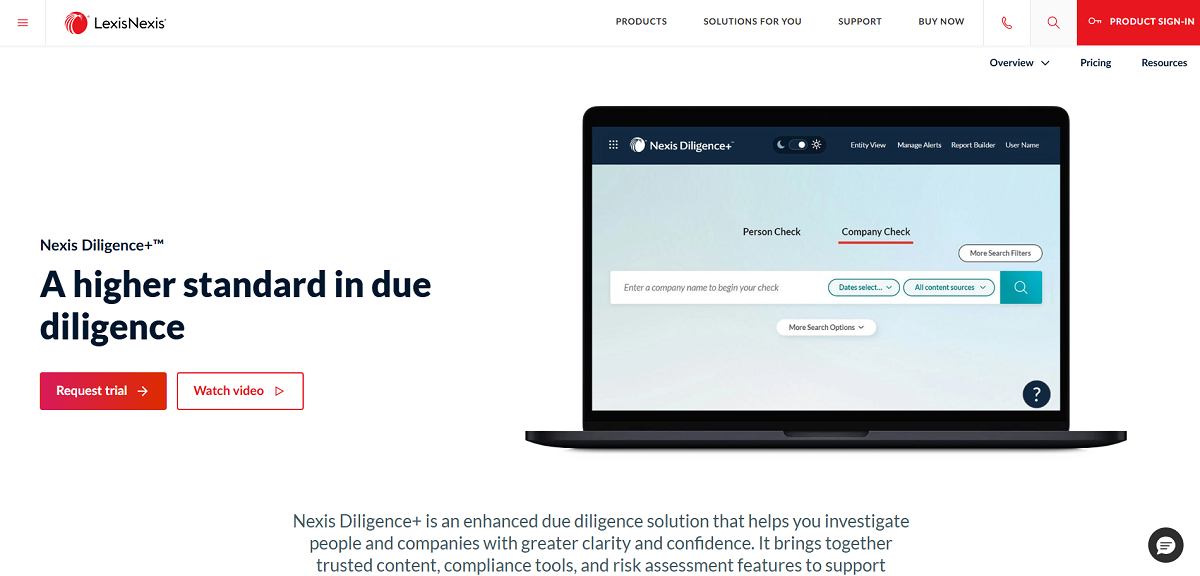
Nexis Diligence+

Nexis Diligence+ enables legal teams to assess risk throughout the due diligence process by uncovering information outside of the deal room. Global news articles, legal filings, sanctions lists and public records are aggregated so legal and compliance professionals can dig deeper into the people and entities behind a transaction. Whether your transaction involves cross-border operations or complex organizational structures, Nexis Diligence+ can help you get to know who you’re doing business with.
Key Features
Global Risk Intellligence:
Global Risk Intelligence searches millions of news articles, court records, sanctions lists and regulators from around the world. Legal teams need to research people and entities in multiple jurisdictions and countries, and Global Risk Intelligence does it all in one place.Entity Screening and Background Checks:
Screen directors, officers, shareholders, and counterparties with people and entity background checks. During your research, you’ll often find prior or pending litigation, enforcement, sanctions risk, or reputational risks related to the company.Bulk Screening for Deal Participants:
Upload a spreadsheet to screen multiple entities or individuals. This comes in handy when there are multiple shareholders involved in a deal, or you have a complex web of ownership to investigate. Or you have long lists of joint venture partners that need screening.Relationship Mapping:
Interactive relationship maps show you ownership links between people and entities. Relationship mapping can help you uncover who owns what and expose potential conflicts of interest or other unknown relationships.Automated Due Diligence Reports:
Automatically generate organized reports of your research. The documentation shows you where you found what, so legal teams can easily create a paper trail.Ongoing Monitoring:
Set up alerts to continue monitoring a person or entity after your initial search is over. Receive alerts when someone is added to a sanctions list, involved in litigation or major news breaks about the company.
Pros
- Covering news and data from around the world allows you to research all the counterparties, executives, and shareholders involved in a transaction.
- Background checks will surface litigation history, sanctions exposure, and reputational risks. These are risks that could negatively affect a deal.
- Bulk screening makes it quick and easy to screen entire groups of owners or business partners.
- Relationship mapping helps you uncover hidden connections between individuals and companies.
- Automated reports create a record of your legal diligence research along with source materials.
- Ongoing monitoring will alert you to any new risks after a deal has closed.
Cons
- Optimized for investigative research use cases. Not as suitable for document heavy diligence workflows.
- No virtual data room for contract review or document management.
- Lack of tools for managing legal diligence requests or tracking document review cycles.
- May have a learning curve for legal teams who are not used to investigative research platforms.
- Pricing can be difficult to justify if your organization only runs background checks occasionally.
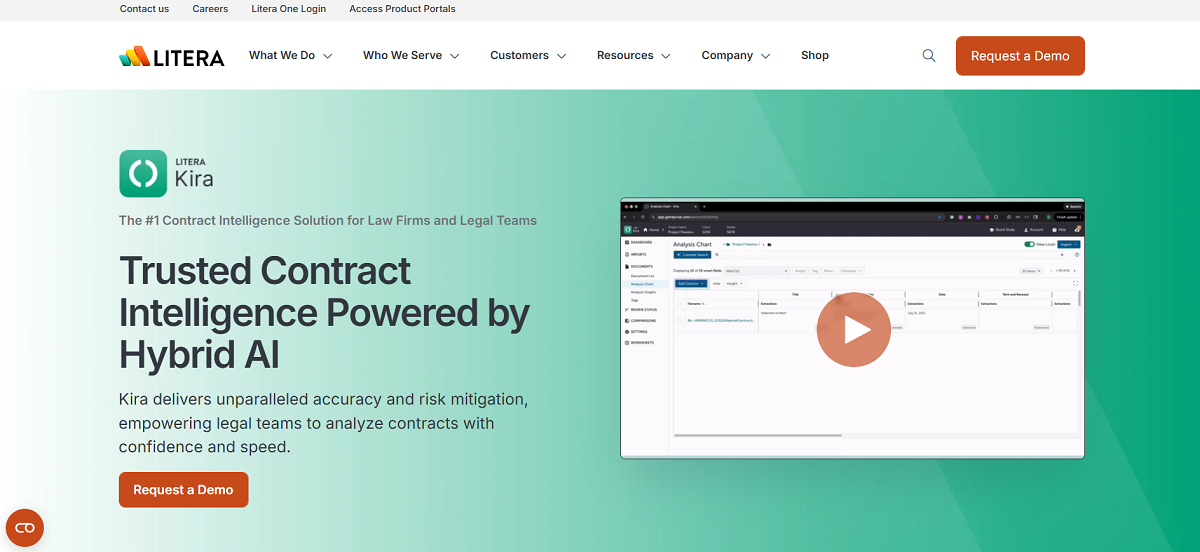
Kira by Litera

Kira from Litera automates contract review, one of the most laborious tasks associated with conducting legal due diligence. The platform uses machine learning to review agreements and extract key provisions. Kira empowers legal teams to review contracts at scale. You can search sets of contracts for provisions such as change of control, assignment, or termination clauses. Kira highlights relevant provisions and groups similar language together so reviewers can easily identify unique provisions that may create risks during diligence.
Key Features
Machine Learning Contract Analysis:
With machine learning models trained on thousands of contracts, Kira can automatically recognize common contract provisions including clauses around change of control, assignment, termination, confidentiality and indemnification.Clause Extraction Across Document Sets:
Lawyers can pull clauses out of hundreds or thousands of agreements in minutes. Kira groups similar clauses together from across the dataset so lawyers can easily review variations in language.Custom Field Training:
Law firms can train the system to identify custom provisions that are unique to their firm or specific to their industry. Customize your contract analysis to fit your transaction profiles.Contract Search and Filtering:
Kira allows users to search contract repositories by clause type or free form language. Users can then filter results by provision type or contract metadata. See where and how frequently provisions are used across your data.Review Dashboard:
Clauses extracted by Kira can be reviewed by your lawyers in Kira’s review interface. Lawyers can validate or correct clauses. Kira learns from corrections.Export Data:
Export data for use in spreadsheets. Contract teams use Kira to assemble diligence reports and deal issue lists.
Pros
- Contracts can be reviewed quickly allowing lawyers to focus on higher-value tasks.
- Reduces time spent on manual review of contracts.
- Allows users to easily compare contract clauses.
- Can be customized to meet the unique needs of your firm.
- Helps manage large diligence projects with hundreds or thousands of contracts.
Cons
- Only focuses on one part of diligence. Legal teams will need a separate platform for managing the diligence process.
- No virtual data room to help manage deal documents.
- Does not have the capability to track requests or facilitate broader deal collaboration.
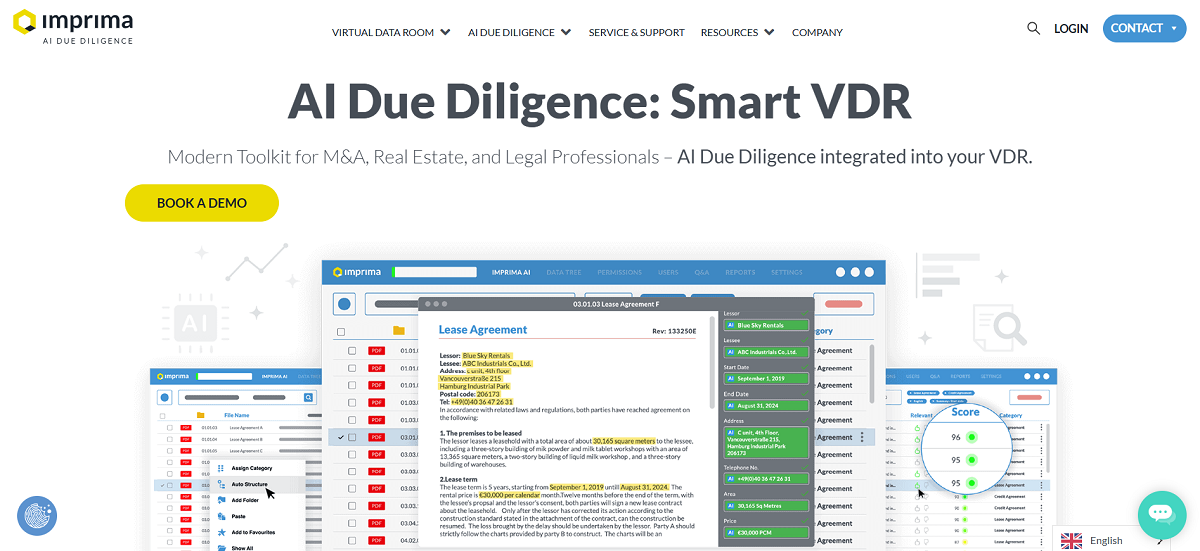
Imprima

Imprima is an AI virtual data room built specifically for due diligence. The AI functionality lives directly inside the virtual data room. Imprima allows legal teams to store, organize, and review deal documents in one secure workspace while taking advantage of AI technology to analyze documents and review contracts quickly. All of these tools are included directly into the virtual data room so lawyers can review contracts, track bidder questions, and monitor document activity without having to hop between tools during due diligence.
Key Features
AI Document Summaries:
Automatically summarizes legal and commercial documents contained within the data room. Allows legal teams to understand key terms without reading every page of every document.Smart Contract Review:
Scan contracts for specific clauses/provisions that may require legal review. Allows teams to quickly spot issues across documents during diligence.Automated Redaction:
Use AI to redact personal/sensitive information. Helps teams automate compliance requirements such as GDPR.AI Document Indexing and Organization:
Automatically categorizes and structures documents as they’re added to the data room using AI. No more wasting time organizing a diligence data room.Integrated Q&A Workspace:
Diligence questions are kept in organized within a Q&A module embedded in the platform. Allows buyers and sellers to collaborate on due diligence. Imprima’s AI can also suggest answers and related documents.Activity Tracking and Reporting:
Track document activity, user engagement, and diligence progress throughout the transaction. All of which is tracked in-platform.
Pros
- Customizable workflows and reporting features.
- Virtual data room and AI document analysis are located in one platform. Ensures document review happens in diligence workspace.
- Automated document indexing/categorization makes it easy to setup a data room.
- Robust permissions and security features allow deal teams to protect deal documents.
- Workflow contains tools like Q&A to help manage communications with the buyer during diligence.
Cons
- Primarily built as a virtual data room vs. a full M&A lifecycle platform.
- Teams may need to rely on other tools for deal pipeline management or planning for integration, etc.
- Some AI features may require training/configuration.
- No publicly available pricing. Potential customers can contact the vendor to receive a quote.
Emma Legal

Emma is an artificial intelligence platform designed for legal due diligence on M&A deals. The software reviews contracts within a deal data room and identifies clause-level risks, missing diligence materials, and other items that could impact the transaction. The results are compiled into structured due diligence reports for attorneys to review and share with deal teams or clients. Emma is ideal for law firms, private equity teams, or in-house counsel working on deals with extensive data rooms.
Key Features
AI-Powered Contract Review:
Quickly review contracts for risks at the clause level throughout your data room. The platform flags unusual provisions and comments for lawyers to follow-up on.Automated Data Room Syncing:
Connect to your data room directly so files are automatically synced to the platform. This allows lawyers to access updated documents rather than download and organize them yourself.Missing Diligence Material Detection:
Leverages AI to identify when information is missing or incomplete based on your request list. Know where your diligence gaps are early.Risk Mapping Across Documents:
Identify where risks are found throughout your document collection. Get a high-level overview of potential risks before diving into document review.Structured Due Diligence Reports:
Automatically organizes your findings into reports that summarize risk and connect to supporting evidence in the data room. Export due diligence reports for client updates or deal documentation.Data Security and User Permissions:
All contracts are secured with end-to-end encrypted storage. Role-based permissions allow you to set controls around sensitive deal data.
Pros
- Allows legal teams to go through large sets of contracts faster with the help of AI.
- Highlights specific risks at the clause level during due diligence.
- Avoids the need for manual document downloads with direct data room connections.
- Detects missing diligence materials before they become a problem.
- Structured reporting makes it easy to explain findings to clients.
Cons
- Doesn’t have as many features for deal workflow management outside of legal document analysis.
- Still requires legal teams to use other tools for creating requests or team collaboration.
- AI analysis will still need to be reviewed by a lawyer for final decision making.
- No pricing information is publicly listed.
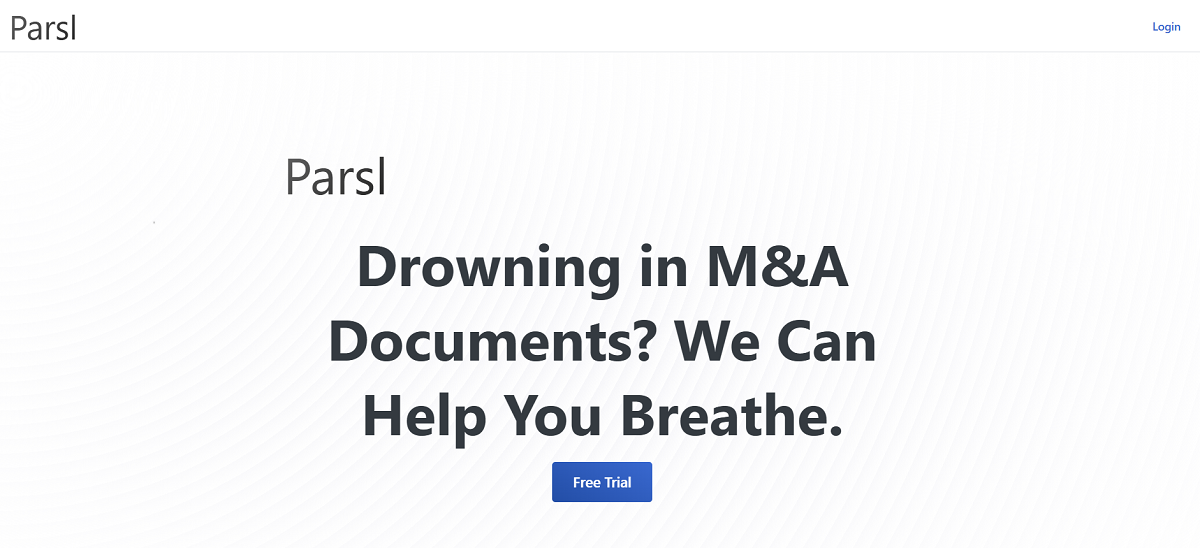
Parsl AI

Parsl automates portions of the initial phases of legal due diligence work on M&A transactions. The AI platform ingests documents from a deal data room, extracting relevant information from contracts to help legal teams review massive quantities of documents with greater speed. Parsl doesn’t just extract clauses from contracts but interprets how provisions operate within the context of a transaction to surface risks and support populating disclosure schedules.
Key Features
AI Contract Review:
Parses agreements pulled from a deal data room to identify important clauses and legal provisions that impact a transaction.Automated Data Extraction:
Contract data is extracted and organized into actionable output that can be used to support legal diligence work.Support for Disclosure Schedules:
Contract information can be used to auto-populate disclosure schedules and diligence summaries.Standardized Contract Review:
AI allows contract documents to be reviewed with consistency across your entire diligence document set.Analyzes Your Data Room:
System can read your seller data room and structure findings in a way that’s queryable for your deal team.
Pros
- Save time reviewing massive sets of contracts during legal diligence with the help of AI.
- Extracts important contract terms and helps you organize your diligence results.
- Supports creation of disclosure schedules and diligence summaries.
- Tailored for M&A deal workflows.
- Minimize repetitive contract review work and focus on actual risk assessment.
Cons
- Largely focuses on contract analysis. Does not provide full diligence workflow management..
- Does not have a virtual data room or document repository built in.
- Contract scan results will still need to be reviewed by a lawyer.
- Parsl does not publicly list pricing.
DiliTrust

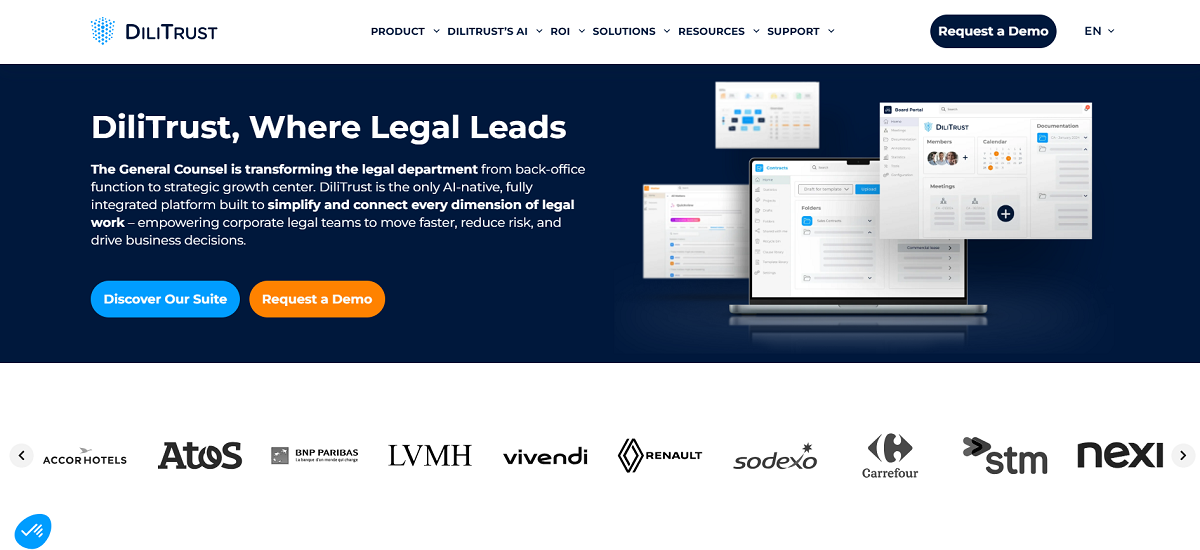
DiliTrust is an enterprise legal and governance platform where organizations can centralize their corporate legal department activities. The platform unifies contract management, entity management, litigation tracking, and secure storage all into one application. DiliTrust works best for organizations that are looking for their due diligence process to be closely integrated with their corporate governance and legal function.
Key Features
Contract Management:
Contracts, draft agreements, and contracts obligations are kept in one place. Set reminders of expiration dates and manage material terms and trigger events on your contract portfolio.Entity Management:
Store and manage ownership information, share certificates, and subsidiary information. Keep corporate records up to date in preparation for transactions.AI-Powered Legal Analysis:
Included AI engine allows you to summarize documents, pull out key terms and conditions, and ask questions about your legal files using natural language processing.Litigation Tracking:
Track matters, disputes, investigations, and more alongside your contracts and governance information.Secure Document Library and Data Room:
Private legal documents can be kept in a secure document library with access controls and audit trails.Track matters, disputes, investigations, and more alongside your contracts and governance information.Board and Governance Tools:
Board meeting prep, information distribution, and voting can all be managed through DiliTrust’s board portal feature.
Pros
- All contracts, governance documents, legal files are in one place.
- AI summaries of legal files, key clause extraction from contracts.
- Entity management to aid in due diligence around ownership and subsidiaries.
- Secure file storage with permissioning and audit logs.
- Connects legal work to board and corporate activities through governance tools.
Cons
- Focuses on legal operations and governance more than M&A specific diligence workflows.
- Does not have as many tools around managing lists of diligence requests or transaction task lists.
- Some teams may only need part of the governance suite.
Midaxo

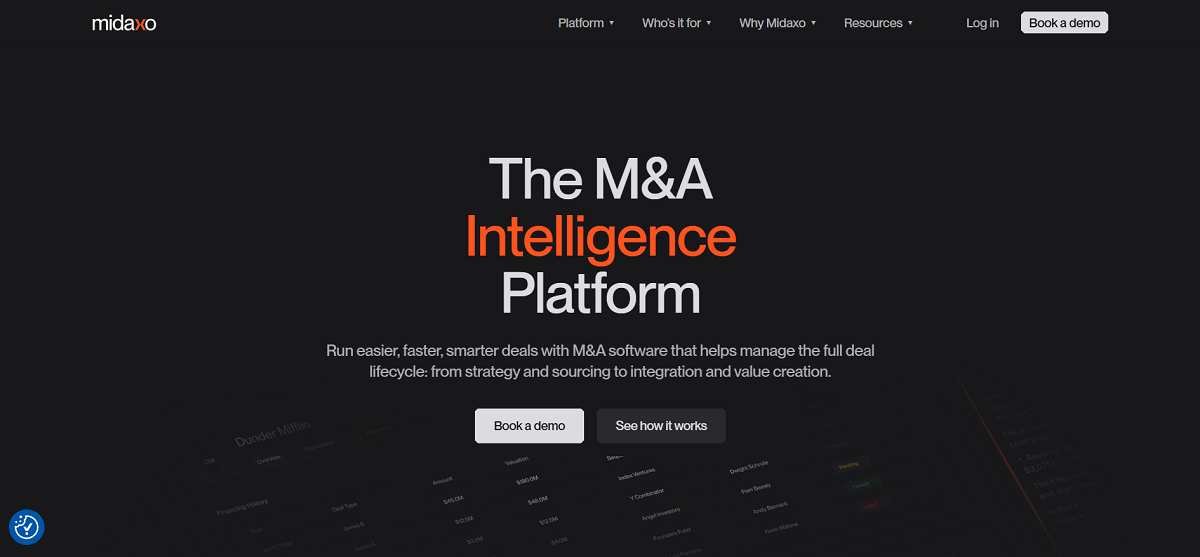
Midaxo allows business development and legal teams to work on deals, manage due diligence, and plan for post-close integration from a single workspace. Legal teams can use Midaxo to store all their documents and tasks associated with a transaction in one place. Teams can work through materials within a secure deal room and ensure stakeholders are aligned throughout the review process. Midaxo also features AI capabilities that summarize documents and identify potential risks within your diligence set.
Key Features
Integrated Virtual Data Room:
Midaxo’s platform has a virtual deal room where teams can store diligence documents and securely view them. It restricts access to sensitive files and allows stakeholders to stay connected throughout the diligence process.Task and Risk Tracking:
Midaxo allows legal and deal teams to keep track of diligence tasks, approvals, and risks all in one place. It helps you keep the diligence process organized so nothing falls through the cracks in email chains or spreadsheets.AI Document Summaries:
Midaxo’s AI assistant can scan diligence documents and provide summaries. Lawyers and deal teams can scan AI summaries of key information before reviewing full documents.Deal Pipeline Management:
Midaxo allows you to track your deal pipeline in addition to your active diligence projects. You can promote opportunities from initial evaluation into the legal review process without changing tools.Standardized M&A Workflows:
Midaxo’s templates and playbooks allow your teams to handle diligence the same way on every deal. You can standardize your most successful processes to scale and reduce risk.
Pros
- Centralizes your deal pipeline, diligence workflow, and post-close integration planning into a single platform.
- Deal room connects all documents and diligence tasks to the deal they’re associated with.
- AI technology can summarize documents and identify deal-breaking risks.
- Midaxo offers templates and playbooks to create a standardized workflow your team will follow with each deal
- Allows users to gain visibility into multiple active deals.
Cons
- Primarily built for managing the full M&A lifecycle instead of just legal diligence.
- Document analysis features may not be as robust as specialized contract review software.
- Implementation and setup may take longer for larger organizations.
- Custom enterprise pricing.
Datasite

Datasite offers virtual data rooms used during M&A transactions and due diligence processes. Deal teams use Datasite to collaborate and exchange information related to transactions. Lawyers use Datasite to store contracts, company records, and diligence information all within one deal hub. Activity tracking and security capabilities allow users to trust Datasite with confidential transactions that require complete control and protection over shared documents.
Key Features
Secure Virtual Data Room:
Easily upload and review deal documents with Datasite’s secure virtual data room. It allows you to lock down files and folders from being viewed or downloaded by others.AI-Assisted Redaction:
Users can auto-redact confidential information within documents using Datasite’s machine learning-powered tools.Q&A Tracking:
Buyers and sellers can easily keep track of diligence questions within the platform. Diligence questions are organized with built-in workflows. Users can attach supporting documents to Q&A responses.Document Analytics:
Identify which documents are being reviewed. How often they are being reviewed, and by whom. Team members can assess reviewer engagement with specific parts of the transaction.Advanced Search and Document Comparison:
Search for contract clauses, or deal documents using keywords. Document comparison features allow teams to review changes to document versions quickly.
Pros
- Datasite is a trusted virtual data room used across complex M&A deals.
- Robust security options allow you to safely share legal documents.
- Automatic redaction tools allow you to prep diligence documents in less time.
- Q&A module keeps buyer/seller communication streamlined.
- Document analytics allow you to assess reviewer engagement.
Cons
- Datasite does not have as many features for managing full deal workflows.
- Users may use other software platforms to manage diligence requests/issues.
- Contract analytics and review capabilities are not as robust as standalone legal AI platforms.
- Paid plans are typically sold on a per-project basis and require a custom quote.

Intralinks
Originally developed for virtual data rooms, Intralinks is one of the first-ever virtual data room providers leveraged during M&A deals. Designed to help legal teams and deal advisors share and review sensitive information, Intralinks has become popular amongst lawyers for storing contracts, corporate records, and due diligence materials inside of a secure virtual data room. Equipped with robust permissions and detailed activity tracking, Intralinks is well-suited for complex transactions where confidentiality and information access needs to be tightly controlled.
Key Features
Secure Virtual Data Room:
Allows users to upload their diligence materials into a virtual data room for secure review. Share entire data rooms or grant document-level permissions to protect sensitive data.Permission Levels:
Restrict data room access by defining granular user roles. Set whether specific users can view, download, or share files with others. Ideal for transaction with multiple buyers and advisors.Q&A Tools:
Buyers can submit diligence questions directly in the data room for sellers to respond. Questions are organized with an internal Q&A workflow and no information is able to leave the data room without being reviewed.AI Document Processing:
Automate document classification, data identification, and redaction with AI tools. Great for prepping contracts and sensitive information for sharing with the other party.Tracking and Logging:
Full visibility into who is downloading what with download logs and page views. Teams can use reporting metrics to gauge buyer engagement and access a full audit log of data room activity.
Pros
- Established software used during high-stakes M&A transactions.
- Robust security permissions allow legal teams to protect confidential information.
- Q&A functionality allows users to stay organized during diligence.
- AI can automate repetitive tasks like document classification and redaction.
Cons
- Primarily built for document sharing, not full diligence processes.
- Lacks contract-level analytics available from legal AI platforms.
- Software interface and data room configuration may be difficult to learn.
- Custom pricing is required which is typically determined by deal size.
Best M&A Deal Management Software Comparison Chart
Review all the software solutions we just covered in this convenient table where you can see them side-by-side.

General
Core Due Diligence Features
Legal Due Diligence Features
AI-Assisted Legal Document Analysis
Security & Compliance
Workflow & Reporting
Why Legal Due Diligence Software?
Legal due diligence is the hub of every deal. Contracts must be reviewed. Corporate records must be verified. Risky compliance issues need resolution before moving forward.
But for many legal teams, due diligence lives in emails, spreadsheets, and shared folders. Fragmentation of the diligence process begins before diligence even starts and continues throughout.
Error potential increases as the number of documents increases. Someone may miss a clause in a contract. Someone else may review the wrong document. By the time you realize there’s a problem, you may already be behind schedule on closing.
Legal due diligence software reduces that risk. It provides teams a single environment where diligence documents, requests, reviews, and findings all live together. Lawyers spend less time searching for data and more time analyzing risk.
What You Gain with Legal Due Diligence Software:
Get Centralized Legal Workflows
- Contracts, company records, diligence requests, and anything else is housed in one workspace. Lawyers no longer toggle between spreadsheets, emails, and filing cabinets to track progress.
Speed Up Contract Review
- AI assisted search and other technologies can crawl through your contracts to identify clauses relevant to the deal. Lawyers review the findings but don’t have to spend as much time searching.
Track Issues with Clarity
- Findings from due diligence can be created as issues, assigned to the right team, and tracked to resolution. Deal teams have visibility into what issues remain open.
Collaborate Seamlessly with Deal Teams
- Corporate development, legal, and outside counsel can review documents and collaborate on issues in-platform. Discussion stays with the file instead of getting lost in email threads.
Create Clear Audit Trails and Accountability
- Document views, updates, and comments are logged and kept. When issues come up months into the deal process you’ll have a record of who saw what and when.
What’s at Stake Without It?
Unclear Legal Risks
- Trying to conduct due diligence from a spreadsheet and email leaves too much room for human error. Missed clauses. Unfamiliar contract language. What looked like minor details can turn into gaping holes once the deal is signed.
Time Lost During Deal Phases
- Lawyers waste valuable hours searching for document versions, tracking down files, and following up on requests that went unanswered. Frustrating? Yes. But that time isn’t being used to do actual legal work.
Miscommunication Across Workstreams
- Corporate development, legal, and outside counsel typically keep their own records of diligence activities. Information gets siloed and sharing updates can take time.
Unclear Review Procedures
- If each deal runs through a slightly different process, then it’s likely that review findings will vary from person to person. One issue may be called out in one deal but missed on the next.
- Document review keeps stacking up, but diligence timelines don’t slow down for your growing deal funnel. Legal due diligence software can help your team gain the control, visibility, and process they need to handle any deal that comes their way.
Types of Legal Due Diligence Software
Law firms and corporate legal teams may use several solutions throughout the deal process. Below are the categories of tools you will come across when searching for legal due diligence software.
Virtual Data Room (VDR) Platforms
- Virtual data rooms are usually at the center of diligence efforts. These platforms host all the confidential transaction documents including contracts, company records, and policies. Confidential documents are stored in one central repository buyers and advisors can securely review.
Data rooms allow you to set permissions, index documents, ask questions, monitor activity. You can keep legal teams organized with large document sets and who is reviewing what.
Examples: Datasite, Intralinks, Imprima
Contract Analysis and Legal AI Tools
- Contract analysis tools use artificial intelligence to extract data from your contracts. The tool scans each agreement and identifies important clauses.
Assignment provisions, change of control rights, indemnification provisions, and termination clauses are standard clauses AI tools detect. You no longer have to read each contract yourself, just search all contracts at once to compare language.
Examples: Kira by Litera, Parsl AI, Emma Legal
M&A Lifecycle and Deal Management Platforms
- Corporate development, legal, and Deal management platforms focus on the larger deal process. From tracking deal flow, to assigning diligence tasks, sharing documents, and linking diligence findings to integration planning.
Lawyers use deal platforms to connect requests for information, documents, and risk findings to the transaction itself. Helps deal teams stay organized as diligence progresses.
Examples: DealRoom, Midaxo
Compliance and Risk Screening Tools
- Contract review is only one part of legal diligence. You will also have to research counterparties, company officers, and business structures.
Risk intelligence platforms pull information from sanctions lists, litigation databases, public records, and global news. Lawyers use these platforms to do screenings on people and companies. You can find risks such as regulatory risks, previous lawsuits, and other reputation risks.
Examples: Nexis Diligence+
Legal and Governance Operations Platforms
- Platforms in this category are built more for legal operations teams inside organizations. Solutions that focus on managing contracts, entities, board documents, and compliance material.
Typically not tailored for performing M&A transactions but can aid in diligence by helping you organize company records.
Examples: DiliTrust
How to Choose the Best Legal Due Diligence Software
- Ideally, legal due diligence would make contract review, document sharing, and risk tracking easier. In reality, diligence tends to get messy because your tools vary from stage to stage. You have document management software, contract analysis tools, and a separate platform to track requests/issues.
Before you can pick the right platform you need to understand how diligence is handled at your organization.
Map Out Your Diligence Workflow
- How does your team currently operate? Take notes on the following:
- Where Where do contracts get stored?do contracts get stored?
- How do they keep track of document requests?
- What tool do they use to record issues/findings?
Once you understand how diligence works at your organization, you can begin to identify opportunities for improvement. If those three elements aren’t already integrated into a single platform, your due diligence software should at minimum connect those dots. You’ll save yourself a lot of headache if you have a tool that connects your contracts, document requests, and team communication.
Deal teams will often gravitate toward a virtual data room first. VDRs were made for storing sensitive documents, and they allow you to give multiple reviewers secure access to transaction docs.
Consider Security and Permissions
- Contracts, IP portfolios, litigation history, and employee policies are all examples of sensitive data that gets shared throughout diligence. You should look for a platform that offers bank-level encryption, role-based permissions, and granular controls for sharing documents.
You should be able to limit certain reviewers to view-only access or restrict the ability to download documents entirely.
Audit logs are also important. You should look for a platform that tracks when someone opened a document and when they closed it. Audit logs become really useful if there’s a dispute later about who knew what during the deal.
Evaluate Contract Analysis Capabilities
- Reviewing agreements is a big part of any diligence process. If you’re doing due diligence on a company that has hundreds of contracts, you’ll want software that can automate parts of the review process.
Many legal due diligence platforms come equipped with AI that can search across documents and identify clauses, obligations, etc. Sure, you can manually search for keywords in contracts but that takes forever. Enabling full-text search can save you hours by allowing you to find specific terms across your contract repository.
Remember, your goal shouldn’t be to automate legal review. Your goal should be to minimize the amount of time your lawyers spend searching for information.
Look for Collaboration and Workflow Tools
- Due diligence is a team sport. You don’t want to silo lawyers from the rest of corporate development, finance, or external advisors.
Ideally, the diligence platform includes tools for teams to share documents, ask questions, assign action items, and monitor the progress of requests from a central location. Good due diligence platforms make it easy to assign tasks and keep all communication about a document in one place.
Without centralized communication, your Q&As will get lost in email threads.
Factor in Deal Volume & Complexity
- Every organization is different. The ideal platform for your organization will largely depend on how many transactions you process each year.
Law firms may only need contract review software with built-in analysis features. Mid to large sized companies performing numerous transactions per year may benefit from a full deal management solution. Smaller companies who do diligence only occasionally might be fine with a virtual data room.
Picking a platform that aligns with your deal volume ensures you don’t pay for expensive features your team won’t use.
Don’t Overlook UX/UI
- Due diligence isn’t a relaxed process. You shouldn’t have to wait weeks for IT to configure a platform before your deal teams can access it.
Nobody has time to administer a tool or manage software training. If your software isn’t intuitive enough for outsiders to onboard themselves, you’ll need to hire someone to do it for you. Expecting your team to wait on IT will only delay your diligence process.
Software should simplify your diligence process. If learning how to use the software adds more steps to your process, your software is doing more harm than good.
When selected carefully, legal due diligence software can streamline contract review, organize documentation, and make it easier to track risks throughout the transaction.
Ready to begin your legal review?
Legal due diligence is one of the most critical steps in closing a deal. Use our free checklist to make sure nothing slips through the cracks.